Chakras and Reiki: How Two Different Energy Traditions Became Connected
Updated: Sep 20
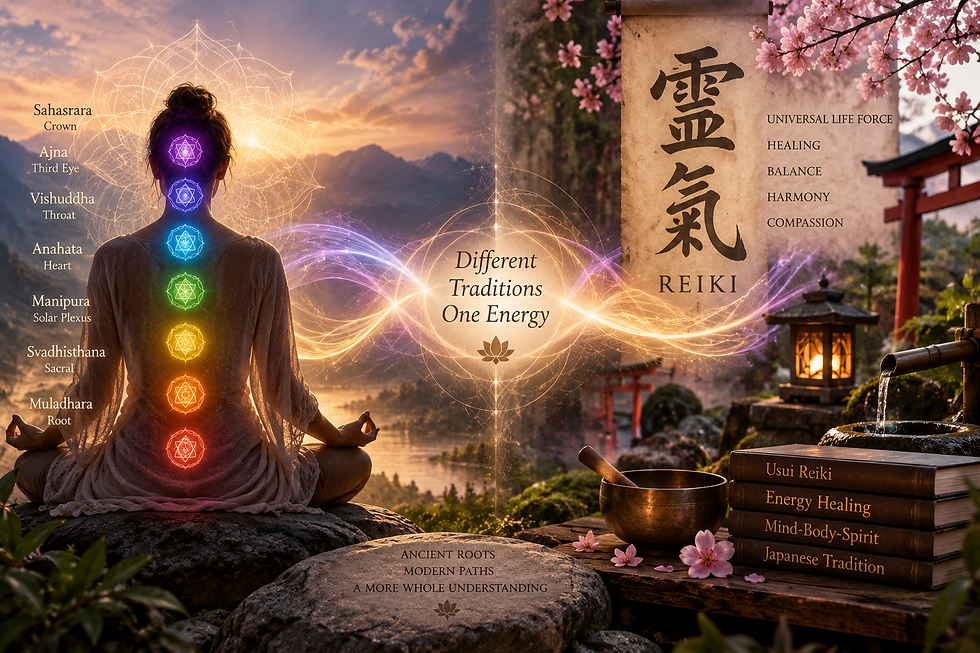
Place a modern Reiki chart beside a chakra diagram and they can look as though they have always belonged together.
Reiki practitioners may place their hands over the crown, heart, solar plexus or other chakra areas. Classes sometimes teach chakra balancing as part of a Reiki session. Crystals, colors and chakra language may appear alongside Japanese Reiki symbols.
It is easy to assume that chakras were part of Reiki from the beginning.
Historically, however, the story is more complicated. Reiki developed in Japan. Chakra systems developed in South Asia. Their modern partnership is largely the result of traditions meeting, traveling and being reinterpreted.
Understanding that difference does not make the combination less meaningful. It reveals how living spiritual practices actually evolve.
What Are Chakras?
The word chakra comes from Sanskrit and is commonly translated as wheel or disk.
Chakra systems appear in Indian religious and yogic traditions, particularly within tantric contexts. They describe subtle centers associated with the body, consciousness and spiritual practice.
There was not one single chakra map used identically throughout all of Indian history. Different texts and traditions described different numbers, locations, symbols and functions.
The familiar seven-chakra rainbow diagram popular in modern wellness culture is only one later way these complex traditions have been organized.
Where Did Reiki Begin?
Reiki emerged in early twentieth-century Japan through Mikao Usui.
Its historical environment included Japanese Buddhist practice, concepts of ki, spiritual cultivation and healing traditions.
Early Reiki was not simply an imported Indian chakra system with a Japanese name.
That distinction is important because modern presentations sometimes blend the histories until their separate origins disappear.
Did Mikao Usui Teach the Seven Chakras?
There is not strong historical evidence that the modern Western seven-chakra framework was a central part of Usui's original Reiki system.
Early Japanese Reiki teachings focused on practices and concepts that developed within their own cultural setting.
This does not mean no Japanese practitioner could ever have encountered Indian Buddhist ideas. Buddhism itself traveled from India through other parts of Asia before reaching Japan, carrying and transforming many concepts along the way.
But broad historical influence is different from saying Usui taught the modern chakra-balancing system familiar in today's Reiki courses.
So How Did Chakras Enter Modern Reiki?
Reiki changed as it moved across cultures.
After Usui, Chujiro Hayashi helped systematize treatment approaches. Hawayo Takata brought Reiki into a Western context, and later generations of teachers expanded it further.
During the late twentieth century, Western interest in yoga, meditation, chakras, crystals, metaphysics and holistic healing grew dramatically.
Reiki entered that spiritual landscape and naturally began interacting with other systems.
The result was not necessarily deception. It was synthesis.
Spiritual Traditions Have Always Borrowed and Changed
We sometimes imagine authentic traditions as sealed containers that remain unchanged for centuries.
History rarely works that way.
Ideas travel with merchants, migrants, monks, books, teachers and students. Languages change them. New cultures emphasize different parts. Practices merge.
Even the concepts of prana, qi and ki reveal centuries of cultural development rather than one universal vocabulary frozen in time.
Reiki and chakras are another example of spiritual traditions meeting in the modern world.
The Seven Chakras Most People Know Today
Modern chakra teachings commonly describe seven major centers running from the base of the spine to the crown of the head.
They are usually associated with themes such as grounding, creativity, personal power, love, communication, intuition and spiritual awareness.
Specific colors are also commonly assigned to each chakra, producing the familiar rainbow sequence.
These associations are enormously influential today, but not every element of the modern chart can simply be projected backward onto ancient Indian sources.
Why Reiki and Chakras Fit Together So Easily
Even though they have different histories, the systems share practical similarities that make integration intuitive.
Both invite attention toward the body. Both use an energetic framework. Both are often practiced in stillness. Both can involve subtle sensation and the idea that balance matters.
A Reiki practitioner working with hand positions may naturally notice that several common treatment areas overlap locations described in modern chakra systems.
Once that resemblance is noticed, combining the maps becomes easy.
The Heart Center
The center of the chest is especially important in modern energy work.
Chakra teachings commonly associate the heart center with love, compassion and connection. Reiki practitioners often place the hands over or near the chest during self-practice or treatment.
There are also straightforward physiological reasons the chest feels emotionally significant: breathing, heartbeat, muscular tension and autonomic sensations are all experienced there.
Traditional symbolism and embodied experience can therefore reinforce one another without needing to be identical explanations.
The Solar Plexus and the Feeling of the Gut
Modern chakra language often connects the solar plexus area with will, confidence and personal power.
People also commonly experience anxiety, anticipation and intuition through sensations in the abdomen.
Modern neuroscience studies communication between the brain and internal organs, while interoception helps explain how bodily signals become part of emotion and intuition.
That does not scientifically prove a chakra at the solar plexus. It does show why humans across cultures might attach deep meaning to sensations arising from the body's center.
The Brow and Intuition
The area often called the third-eye chakra is associated in modern spiritual practice with intuition and inner perception.
Reiki sessions may include hand placements around the forehead or head, creating another area of overlap.
Our exploration of where intuition comes from looked at unconscious pattern recognition, body signals and inner knowing.
Those scientific ideas do not prove a third-eye energy center, but they offer another language for asking why some forms of knowing arrive before conscious reasoning can explain them.
What Does Chakra Balancing Mean?
Within modern energy practice, a chakra may be described as blocked, overactive, underactive or out of balance.
Reiki may then be used with the intention of restoring energetic harmony.
These are spiritual and symbolic descriptions. Medicine does not diagnose blocked chakras as anatomical disorders.
A practitioner should therefore avoid telling someone that a serious symptom is caused by a blocked chakra or that balancing one will cure disease.
Chakra language can remain meaningful without being turned into unsupported medical diagnosis.
Can Science Detect Chakras?
Science has not established chakras as discrete anatomical structures or measurable energy vortices.
Researchers can measure electrical activity, blood flow, nerve signaling, hormones, temperature and many other physiological processes in regions associated with chakra locations.
But finding biological activity in the same area does not prove that the chakra itself has been detected.
Every part of the living body contains complex biological activity.
Are Chakras the Endocrine Glands?
A popular modern claim maps each chakra directly onto an endocrine gland.
The correspondence can be symbolically interesting, but it should not be presented as established ancient anatomy or scientific proof.
The endocrine system is a biological network of glands and hormones. Chakra systems developed within spiritual and subtle-body traditions.
One can compare them without declaring them identical.
Are Chakras Electromagnetic Fields?
Another attempt to scientificize chakras identifies them with electromagnetic fields.
The body does generate measurable electrical and magnetic activity, especially through the heart, brain, nerves and muscles.
However, science has not shown that the seven traditional chakra centers are distinct electromagnetic vortices with the properties attributed to them in modern energy healing.
As with Reiki hand sensations, measurable physiology and spiritual interpretation should not be collapsed into one claim.
Using Chakras During Reiki
A modern practitioner may choose to use a chakra framework during Reiki while being transparent about the synthesis.
The chakras can serve as a map for attention. A session might move from lower-body grounding toward the chest, throat, forehead and crown.
The practitioner may reflect on the symbolic themes associated with each center while allowing Reiki practice to remain distinct.
This approach respects both traditions more than claiming they were always one system.
Chakra Meditation and Self-Reiki
Chakra work can also be combined with self-Reiki.
A person might rest the hands over different areas of the body while noticing breath, sensation and emotional associations.
The goal does not need to be forcing a chakra open.
It can simply be a structured way of moving attention through the body while observing what arises.
What About Chakra Colors?
The rainbow colors now strongly associated with the seven chakras are so familiar that they can seem ancient.
Their modern standardized presentation developed through more recent esoteric and New Age interpretations rather than appearing in exactly that form across all early chakra traditions.
This is a useful reminder that spiritual symbols can feel timeless even when their current presentation is relatively modern.
Traditions accumulate layers.
Does Historical Accuracy Remove the Mystery?
It can do the opposite.
The real history reveals a vast network of human searching.
Indian practitioners developed subtle-body maps. Chinese traditions explored qi and channels. Japanese systems developed their own approaches to ki and spiritual cultivation. Modern Western seekers encountered all of them and began creating new combinations.
That is not a story of one perfect system descending unchanged from antiquity.
It is a story of ideas moving through human beings.
Discernment in Energy Work
The more traditions are blended, the more useful it becomes to know which idea came from where.
Discernment does not require rejecting personal experience.
Someone can feel a profound shift while receiving Reiki over the heart area and interpret it through chakra symbolism. Another person may understand the same moment through emotion, touch, breathing and nervous-system regulation.
The experience can be honored while the explanations remain distinct.
Two Traditions, One Modern Practice
Reiki and chakras did not begin as one ancient healing system.
They came from different places and different historical streams.
Yet traditions do not stop moving simply because historians identify their origins.
Today, chakra work has become deeply woven into many forms of Western Reiki. For countless practitioners, the combination has become its own meaningful spiritual language.
Knowing that the partnership is modern does not make it false.
It makes it visible.
Where the Paths Meet
Perhaps the most interesting question is not whether Reiki and chakras were always connected.
They were not, at least not in the familiar modern form.
The more revealing question is why people felt compelled to connect them.
Both systems give language to experiences that can be difficult to describe: vitality, intuition, emotion, presence, inner movement and the sense that the body may carry more meaning than its surface reveals.
Their histories are different.
Their modern paths have crossed.
And in that crossing we can see something larger—the continuing human effort to map the invisible dimensions of being alive.

$50
Product Title
Product Details goes here with the simple product description and more information can be seen by clicking the see more button. Product Details goes here with the simple product description and more information can be seen by clicking the see more button

$50
Product Title
Product Details goes here with the simple product description and more information can be seen by clicking the see more button. Product Details goes here with the simple product description and more information can be seen by clicking the see more button.
$50
Product Title
Product Details goes here with the simple product description and more information can be seen by clicking the see more button. Product Details goes here with the simple product description and more information can be seen by clicking the see more button.


Comments