Where Does Intuition Come From? The Science and Mystery of Knowing Without Knowing Why
Updated: Sep 20

Most of us can remember a moment when we knew something before we could explain how we knew it. A decision suddenly felt clear. A person seemed untrustworthy despite saying all the right things. An idea arrived fully formed after hours—or days—of getting nowhere through deliberate thought.
Experiences like these are often called intuition. In spiritual traditions, intuition may be described as inner guidance, a deeper intelligence or a way of knowing that reaches beyond ordinary reasoning. Psychology and neuroscience approach the subject differently, examining unconscious pattern recognition, memory, emotion, bodily signals and rapid decision-making.
But neither perspective makes intuition simple. The central mystery remains: when an answer seems to rise from somewhere beneath conscious thought, where did it come from?
What Do We Mean by Intuition?
Intuition is usually described as knowing or judging something without consciously working through each step of the reasoning process.
That does not necessarily mean no reasoning occurred. It may mean that much of the processing happened outside conscious awareness.
The brain is continually comparing present information with past experience. It notices patterns, predicts outcomes and prepares responses before the conscious mind can narrate every calculation involved. Sometimes the result enters awareness simply as a feeling: yes, no, something is wrong, look closer.
This is one reason intuition can feel immediate and mysterious even when it has roots in experience.
The Expert Who Knows Before Explaining
One of the clearest examples of intuition appears in expertise.
A veteran firefighter may sense danger in a building before consciously identifying the cues. A nurse may feel that a patient's condition is changing before a single measurement makes the problem obvious. A chess player can recognize a strong position almost instantly after years of studying thousands of patterns.
These abilities are not magic. Repeated experience builds complex internal models. Eventually, pattern recognition can become so fast that the conclusion arrives before the explanation.
In this sense, intuition can be knowledge that has become too practiced to require step-by-step conscious thought.
But What About Intuition Without Expertise?
Not every intuitive experience happens in a field where we have years of formal training.
People report sudden impressions about relationships, choices, places and situations they cannot easily connect to prior experience. Some interpret these moments spiritually. Others assume subtle cues were registered without conscious awareness.
Science can investigate mechanisms such as implicit learning, emotion, memory and perception. It cannot verify every personal interpretation of an intuitive event, especially when the proposed explanation reaches beyond measurable processes.
That leaves a boundary worth exploring rather than pretending it has already been settled.
The Body's Role in Intuition
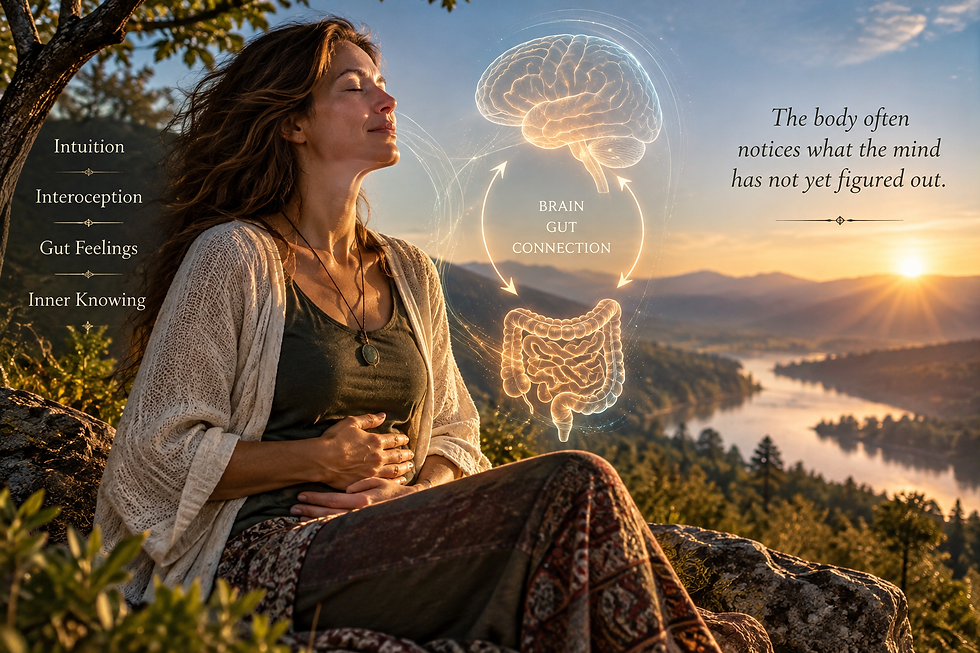
Intuition is often felt physically. The stomach tightens. Breathing changes. The chest feels open or constricted. A wave of calm appears around one choice and tension around another.
Our recent exploration of intuition and interoception looked at how the brain continually receives information from inside the body. These signals contribute to emotion and can become part of rapid judgments.
A gut feeling therefore does not need to be imaginary simply because it is difficult to verbalize. The body is supplying information. The harder question is how that information should be interpreted.
The Somatic Marker Idea
Neuroscientist Antonio Damasio's work helped popularize the idea that bodily and emotional signals can guide decision-making. Experiences become associated with positive or negative bodily states, and those states may later help narrow choices before deliberate reasoning is complete.
This does not mean the body predicts the future. It suggests that previous experience can become embodied in ways that influence decisions.
What feels like an inexplicable warning may sometimes be the nervous system recognizing a familiar pattern faster than conscious thought can describe it.
Intuition Is Not Always Right
If intuition were an infallible inner oracle, human decision-making would be much easier.
The same rapid mental processes that produce useful pattern recognition can also produce bias. Familiarity can be mistaken for truth. Fear can be mistaken for warning. Desire can be mistaken for certainty. Stereotypes can operate automatically and feel intuitive precisely because they bypass deliberate reflection.
As explored in Hidden Patterns of the Mind, beliefs and learned expectations can influence us without announcing themselves as beliefs.
The feeling of certainty tells us how strongly something is being experienced. It does not, by itself, prove that the conclusion is correct.
Why Fear Can Sound Like Inner Guidance
Fear is designed to capture attention. When the nervous system perceives threat, the body prepares to respond quickly. That urgency can feel authoritative.
Past experience may also cause a harmless present situation to resemble an earlier danger. The resulting signal is real—the body truly is reacting—but the interpretation may belong partly to the past.
This is one reason discernment cannot be reduced to trust your gut.
Sometimes the wisest response is to listen to the signal and then investigate it.
Intuition Versus Impulse
Impulse and intuition can also be confused.
An impulse often seeks immediate action or relief. Intuition may sometimes be immediate too, but people frequently describe it as simpler and less argumentative—a quiet recognition rather than an escalating internal debate.
There is no universal scientific test that separates the two by feeling alone. What helps is learning our own patterns over time.
Which signals tend to appear during anxiety? Which ones remain after emotion settles? Which impressions have repeatedly proved useful? Which disappear when we sleep, eat, rest or gain more information?
Inner discernment develops through observation, not blind obedience.
What Spiritual Traditions Mean by Inner Guidance
Across spiritual and contemplative traditions, human beings have long explored forms of knowing that are not limited to discursive reasoning.
The language varies: wisdom, insight, discernment, revelation, gnosis, inner voice, higher mind.
These terms come from different traditions and should not be treated as interchangeable. Yet they share an interest in the possibility that ordinary surface thought does not exhaust the mind's capacity for knowing.
That question sits close to Antara Veda's exploration of inner knowing: not abandoning reason, but asking what else becomes visible when the noise of habitual thought grows quieter.
Can Silence Make Intuition Easier to Hear?
Constant stimulation gives subtle signals little room to emerge.
When attention is continually occupied by notifications, conversation, worry and mental rehearsal, quieter impressions may be drowned out. Practices such as meditation, walking, journaling or simply sitting without immediate distraction can change the conditions under which thoughts arise.
There is nothing supernatural required for this effect. Reducing competing demands on attention can make previously unnoticed thoughts, emotions and bodily sensations easier to detect.
Whether someone interprets what emerges psychologically, spiritually or both is a separate question.
When the Answer Arrives After We Stop Trying
There is another familiar form of intuition: the solution that appears after deliberate effort has been abandoned.
A person struggles with a problem, takes a shower or goes for a walk, and suddenly the answer appears.
Psychology has long studied incubation effects in problem-solving. Stepping away can sometimes allow previously activated information to reorganize without the same conscious fixation.
The experience can feel as though the answer came from nowhere. More likely, the mind never completely stopped working on the problem.
The conscious search ended. The deeper processing continued.
The Mystery of Conscious Awareness
Even when unconscious processing explains part of intuition, another mystery remains.
Why do some hidden processes cross the threshold into awareness as a feeling, image or sudden knowing while countless others remain invisible?
That question touches the larger puzzle of consciousness. Neuroscience can identify systems involved in attention, memory and decision-making, but the nature of subjective experience remains an active philosophical and scientific problem.
Intuition is therefore interesting not only because of what it tells us, but because of the strange way information becomes experience.
A Practice of Discernment
Instead of asking whether intuition is always trustworthy, a better question may be: how can we become better listeners?
When an intuitive impression appears, notice it before building a story around it. Pay attention to the body. Record the impression if it feels important. Allow time when circumstances permit. Look for evidence. Notice whether fear is escalating the message or whether clarity remains as emotion settles.
Then observe what happens.
Over months and years, patterns become visible. We learn which inner signals tend to accompany anxiety, which arise from wishful thinking, and which repeatedly point toward something we had not yet consciously recognized.
This turns intuition from a vague mystical concept into an ongoing relationship with our own awareness.
Where Does Intuition Really Come From?
There may not be one answer.
Some intuition clearly grows from experience and rapid pattern recognition. Some emerges through bodily signals. Some may reflect memories and associations we cannot consciously retrieve. Some apparent intuition is bias or fear.
And some experiences remain difficult for the person who has them to explain within any of those categories.
We do not need to force all of these experiences into a single theory.
The more interesting path may be to remain curious—to respect what science can reveal about the hidden work of the mind while leaving room to question whether our current models describe the whole of human knowing.
Reason asks us to examine.
Intuition asks us to listen.
Wisdom may require learning when to do each.

$50
Product Title
Product Details goes here with the simple product description and more information can be seen by clicking the see more button. Product Details goes here with the simple product description and more information can be seen by clicking the see more button

$50
Product Title
Product Details goes here with the simple product description and more information can be seen by clicking the see more button. Product Details goes here with the simple product description and more information can be seen by clicking the see more button.
$50
Product Title
Product Details goes here with the simple product description and more information can be seen by clicking the see more button. Product Details goes here with the simple product description and more information can be seen by clicking the see more button.


Comments