Hidden Patterns of the Mind: How Unconscious Beliefs Shape the Life We Live
Updated: Sep 19

There are moments when the mind seems to know what it wants, yet something deeper refuses to follow. We make a decision, set an intention, repeat a new belief—and then find ourselves returning to an old pattern almost automatically.
Why?
One possibility is surprisingly simple: conscious intention is only one part of the inner world. Beneath deliberate thought lies a vast network of learned expectations, emotional associations, habits, memories and predictions that can influence what feels safe, possible or familiar before we have time to reason about it.
Older spiritual traditions called this territory by many names. New Thought writers spoke of the subconscious. Modern psychology uses more precise concepts such as implicit learning, automatic processing and schemas. The languages differ, but they circle a compelling question: how much of our life is being shaped by patterns we do not consciously choose?
The Mind Is Larger Than Conscious Thought
When we think about the mind, we often picture the inner voice—the stream of words, plans and reflections we can consciously hear. But conscious thought represents only a portion of mental activity.
The brain is continually processing sensory information, comparing the present with past experience, regulating the body, predicting what may happen next and preparing responses. Much of this occurs without entering awareness in a clear verbal form.
That is one reason a reaction can appear before an explanation. A room can feel uncomfortable before we identify why. A familiar situation can trigger tension before we consciously remember the earlier experience it resembles.
The conscious mind often arrives after deeper processes have already begun.
How Hidden Patterns Are Formed
Many automatic patterns begin through repetition. An experience happens once and may leave little trace. When similar experiences happen repeatedly—especially when they carry strong emotion—the mind becomes better at anticipating them.
This ability is useful. We could not function efficiently if every familiar situation had to be analyzed from the beginning.
But the same learning process can preserve patterns long after circumstances change.
A person who repeatedly learned that speaking openly led to criticism may begin withholding thoughts automatically. Someone whose early attempts at independence were punished may experience guilt when setting boundaries. A person who lived through unpredictable environments may become highly alert to subtle changes even when the present situation is relatively safe.
The pattern may once have served a purpose. Later, it may quietly become a limitation.
Beliefs We Never Chose
Some of our deepest beliefs were never consciously selected.
Ideas about money, relationships, success, spirituality, worth, authority and even what kind of life is possible can be absorbed from family, culture and repeated experience.
Because these assumptions are familiar, they may not feel like beliefs at all. They can feel like reality.
This is where the search for inner wisdom becomes more complicated. Looking within does not automatically reveal pure truth. Sometimes what we find first is conditioning.
The New Thought Idea of the Subconscious
Early New Thought writers became fascinated with the possibility that repeated ideas could enter a deeper level of mind and eventually shape experience.
For Joseph Murphy, the subconscious became central. He believed deeply accepted ideas influenced habits, emotions and circumstances. Neville Goddard emphasized assumption and imagination. Florence Scovel Shinn focused on spoken words, belief and intuition.
Their metaphysical explanations went beyond what contemporary science can verify. Yet their attention to hidden mental patterns anticipated a question that psychology would continue investigating through very different methods.
What Psychology Calls Automatic Processing
Psychology distinguishes between processes that require deliberate attention and those that operate more automatically.
Reading a difficult new skill may initially demand intense concentration. With practice, parts of it become automatic. The same principle appears in habits and learned responses.
Automatic does not mean mysterious or uncontrollable. It means the process can occur with relatively little conscious deliberation.
This helps explain why insight alone does not always produce immediate change. We can intellectually understand a pattern while the learned response remains strong.
Why Familiar Can Feel Like True
The mind is strongly influenced by familiarity. Repeated ideas become easier to process. Familiar situations can feel predictable, even when they are not especially healthy or desirable.
This creates an uncomfortable possibility: sometimes we return to what is familiar not because we consciously want it, but because the nervous system already knows the pattern.
A new possibility may be objectively better and still feel strangely uncertain.
This does not mean we are trapped. It means change may require more than deciding once.
The Brain as a Prediction System
One influential way of understanding perception describes the brain as continually generating predictions about what it expects to encounter and updating those predictions through incoming information.
From this perspective, we do not simply receive the world like a camera. Past experience helps shape what we notice and how we interpret it.
This connects naturally with questions explored in Can the Brain Explain the Mind? The brain is not merely waiting for reality to happen. It is actively organizing experience.
That does not mean we create every external event through expectation. It means expectations can participate in how events are perceived, interpreted and responded to.
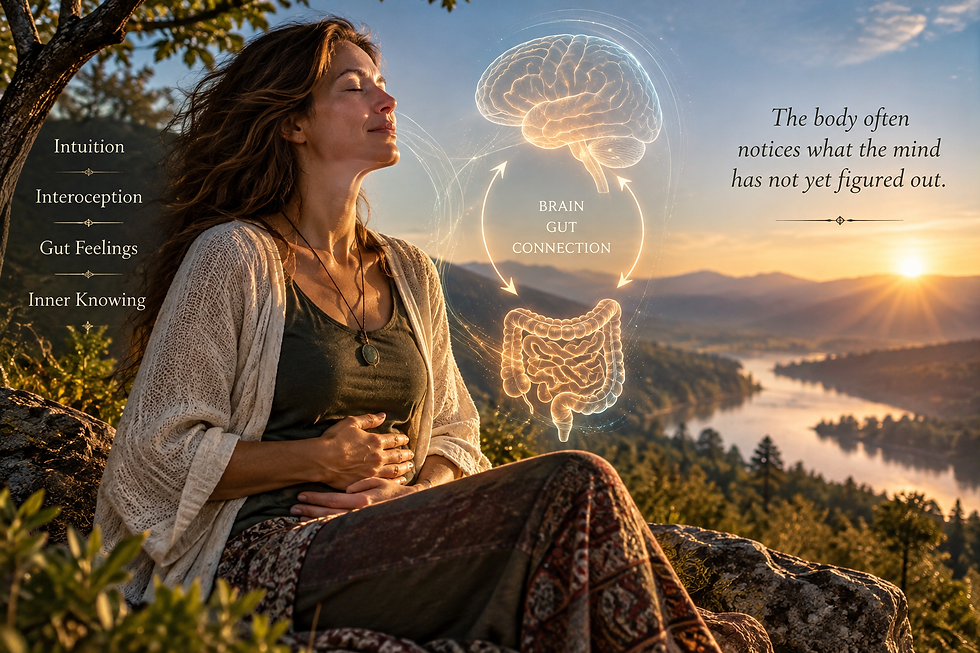
When Intuition and Conditioning Feel Similar
This may be one of the hardest parts of listening within.
A strong feeling can arise from genuine observation, subtle pattern recognition, fear, memory, desire or learned expectation. From the inside, these experiences may initially feel similar.
That is why inner knowing requires discernment rather than blind trust in every internal signal.
We can ask: Does this feeling become clearer when I am calm? Is it connected to evidence I have noticed? Does it repeatedly appear across time, or only during fear? Does it invite careful action, or demand immediate reaction?
Inner wisdom may speak quietly. Conditioning often arrives with the force of familiarity.
Can Hidden Patterns Be Changed?
The encouraging answer is that learned patterns are not necessarily permanent.
The brain remains capable of change throughout life. New experiences, repeated practice, reflection, behavioral change and supportive relationships can gradually alter learned expectations and habits.
This is slower and more complex than the idea that one positive statement instantly rewrites the subconscious. But it also means the past does not have absolute authority over the future.
Repeated conscious choices can eventually become familiar too.
Attention as the Beginning of Change
Before a pattern can be changed deliberately, it often has to become visible.
This is where practices such as journaling, meditation and reflective observation can become useful—not because they reveal an infallible hidden truth, but because they create space to notice repetition.
What situations repeatedly trigger the same reaction? Which inner sentences appear again and again? What do we assume will happen before anything actually happens?
These questions turn attention inward without demanding that every internal experience be believed.
The Person Watching the Pattern
There is an even deeper mystery here.
If we can observe a thought, then in some sense we are not identical to that thought. If we can recognize an old pattern, something within awareness has stepped far enough away to see it.
This does not solve the philosophical mystery of consciousness. But it reveals something remarkable about ordinary experience: the mind can become aware of its own activity.
We can notice fear without immediately obeying it. We can recognize an inherited belief and ask whether it still belongs to us. We can watch a familiar reaction begin and sometimes choose another response.
That small space between pattern and awareness may be one of the most important places inner work begins.
What Is Quietly Running Your Life?
Hidden mental patterns are not proof that an invisible force controls our destiny. Nor are they evidence that every difficulty originates inside the mind.
Life is shaped by circumstances, relationships, biology, chance, culture and forces far beyond individual thought.
Yet within that larger reality, patterns matter.
A belief repeated for years can influence what we attempt. An expectation can change how we interpret another person's behavior. A familiar fear can close a door before we consciously consider walking through it.
And sometimes the most powerful change begins with a question rather than an affirmation: Where did this belief come from?
The answer may lead into memory, family, culture, experience—or somewhere we did not expect.
But once a hidden pattern becomes visible, it is no longer entirely hidden.
And awareness gives us something automatic repetition never does: the possibility of choice.

$50
Product Title
Product Details goes here with the simple product description and more information can be seen by clicking the see more button. Product Details goes here with the simple product description and more information can be seen by clicking the see more button

$50
Product Title
Product Details goes here with the simple product description and more information can be seen by clicking the see more button. Product Details goes here with the simple product description and more information can be seen by clicking the see more button.
$50
Product Title
Product Details goes here with the simple product description and more information can be seen by clicking the see more button. Product Details goes here with the simple product description and more information can be seen by clicking the see more button.


Comments