Can the Brain Explain the Mind? Where Neuroscience Meets the Mystery of Self
Updated: Sep 17

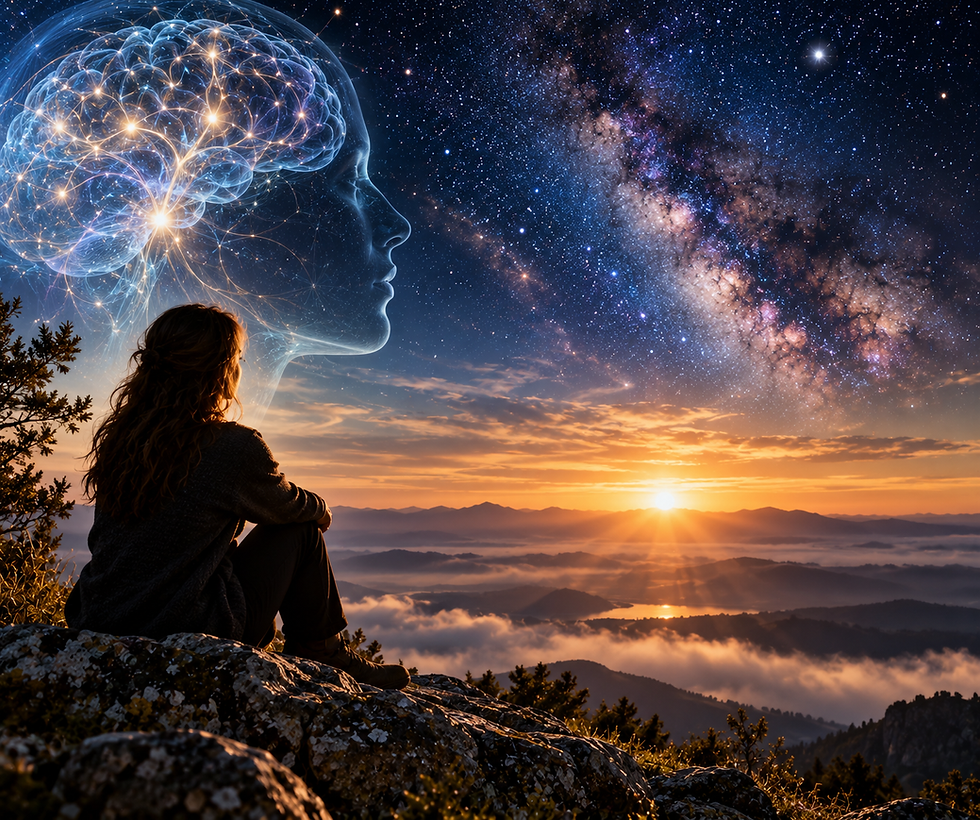
You can hold a memory in your mind without touching it. You can imagine a place that is thousands of miles away, hear a song silently inside your head, recognize yourself in a mirror and wonder who, exactly, is doing the wondering.
All of these experiences depend on the brain. Damage particular brain systems and memory, language, perception or personality can change. Alter the brain with sleep, anesthesia, medication or injury and the world we experience may change with it.
Yet a deceptively simple question remains: if we understood every neuron and every connection, would we have fully explained the mind?
Brain and Mind Are Closely Connected—but Are They the Same Thing?
The brain is a physical organ. It contains billions of nerve cells organized into networks that communicate through electrical and chemical signals. We can weigh it, scan it, study its tissue and observe changes in its activity.
The mind is harder to point to. We use the word to describe thought, memory, imagination, attention, emotion, intention and the private stream of experience that seems to accompany us through life.
Modern neuroscience provides overwhelming evidence that mental life is deeply dependent on brain function. But dependence does not make every philosophical question disappear. Knowing that a process depends on the brain is not necessarily the same as explaining why that process has an inner, felt quality.
What Brain Injuries Have Revealed
Some of the most striking clues about the mind have come from cases in which the brain was injured or altered. Changes in particular regions can affect language, memory, emotional regulation, recognition and decision-making. A person may remain awake and intelligent while losing access to a specific ability that once seemed inseparable from who they were.
Split-brain research offered another unusual window. In certain patients whose connection between the brain's hemispheres had been surgically severed to treat severe epilepsy, carefully designed experiments revealed that information available to one hemisphere was not always available to the other in the usual way. The findings raised difficult questions about unity: why does consciousness normally feel like one continuous point of view when the brain is made of many specialized systems?
The lesson is not that there are literally two complete people hidden in every brain. The science is more complicated than that. What these cases show is that the seamless unity of ordinary experience may be something the brain actively constructs.
The Brain Does Not Simply Record Reality
It is tempting to imagine perception as a camera: the world sends information in, the brain receives it and the mind sees an accurate picture.
But perception is far more active. The brain continuously combines incoming sensory information with memory, expectation, context and prior learning. What we experience is not a raw copy of the external world but an interpretation built from limited signals.
This is one reason optical illusions are so revealing. They are not merely tricks. They expose the assumptions the perceptual system normally makes so quickly that we never notice them.
Predictive-processing approaches take this idea further, proposing that the brain is continually generating expectations about what is happening and updating them when sensory evidence disagrees. Researchers debate the details, but the broader insight is powerful: experience is constructed through an ongoing conversation between the world and the nervous system.
Where Is the Self?
If the mind is constructed through many interacting systems, what about the person at its center?
Most of us experience ourselves as a single, stable self moving through time. Yesterday's memories belong to me. Today's thoughts belong to me. Tomorrow's plans belong to the same person.
Neuroscience, however, has not found a tiny command center containing the self. Our sense of identity appears to emerge from distributed processes involving memory, bodily signals, emotion, attention, social understanding and the story we continuously tell about our lives.
That does not make the self meaningless. A rainbow is real even though there is no solid object called a rainbow sitting in the sky. The interesting question is what kind of thing the self actually is.
Ancient Traditions Asked the Same Question Differently
Long before brain imaging, people investigated the self from the inside. Indian philosophical traditions asked what remains when thoughts, sensations and roles are observed rather than automatically identified with. Buddhist traditions developed detailed practices for examining whether a permanent, independent self could actually be located in experience.
These traditions should not be retrofitted into neuroscience. They were not conducting modern laboratory experiments. But they remind us that the question “Who am I?” has never belonged to science alone. It is also a question people can investigate through attention, reflection and lived experience.
Meditation as a Meeting Point
Meditation offers an especially interesting meeting place because it is both an ancient practice and a subject of modern scientific study. Researchers can examine changes in attention, emotion and brain activity while practitioners examine their experience from the first-person perspective.
Science can measure correlates of these changes. First-person observation describes what they feel like. Neither perspective replaces the other.
Does Explaining the Mechanism Explain the Experience?
Imagine that future neuroscience becomes extraordinarily precise. Suppose we can map every process involved when you remember your childhood home: which networks activate, how sensory details are reconstructed, how emotion changes the memory and how the brain distinguishes remembering from seeing.
Would that completely explain what remembering your childhood home feels like to you?
Some philosophers and scientists believe that a sufficiently complete physical explanation ultimately will account for the mind. Others argue that subjective experience presents an explanatory problem that cannot simply be dissolved by adding more neural detail. Still others think our concepts of mind and matter may eventually change in ways we cannot yet anticipate.
At present, there is no consensus that closes the question.
Where Soul Meets Science
The mystery of mind does not require us to choose between science and inner inquiry.
Neuroscience has transformed what we know about perception, memory, emotion and the biological foundations of thought. It deserves to be taken seriously precisely because it can test ideas against evidence.
But the first-person world remains part of the phenomenon we are trying to understand. Every experiment about consciousness is ultimately connected to the strange fact that somewhere inside the measurements there is an experiencing being.
Perhaps the most interesting position is not to rush toward a final answer. It is to keep the question open while becoming more precise about what we know, what we suspect and what remains unexplained.
The Mystery Is Getting Clearer, Not Smaller
The more closely we study the brain, the less simple the mind appears. Perception is constructed. Memory is reconstructed. The self is distributed across interacting systems. Conscious experience changes with sleep, attention, injury, meditation and countless shifts in brain state.
None of this makes human experience less remarkable. It makes the question deeper.
The brain may be the most intricate object we have ever tried to understand. The mind is the place from which we are trying to understand it. And somehow, in every attempt to solve the mystery, the investigator and the mystery remain inseparably connected.

$50
Product Title
Product Details goes here with the simple product description and more information can be seen by clicking the see more button. Product Details goes here with the simple product description and more information can be seen by clicking the see more button

$50
Product Title
Product Details goes here with the simple product description and more information can be seen by clicking the see more button. Product Details goes here with the simple product description and more information can be seen by clicking the see more button.
$50
Product Title
Product Details goes here with the simple product description and more information can be seen by clicking the see more button. Product Details goes here with the simple product description and more information can be seen by clicking the see more button.
Comments