What Is Gnosis? A Beginner’s Guide to Inner Knowing
Updated: Sep 8
There is a difference between being told something is true and discovering something for yourself.
Most of us spend our lives surrounded by information.
We are told who we are.
We are taught what the world is.
We inherit beliefs about what is possible, what is impossible, what is sacred, what is real and what it means to be human.
Some of those ideas may contain profound wisdom.
Others may simply be ideas passed from one generation to the next until nobody remembers to ask where they came from.
But beneath all of that information lies a much older question:
What do you actually know?
Not what have you been taught.
Not what have you memorized.
Not even what do you believe.
What do you know?
That question takes us into the ancient idea of gnosis—a word usually translated as knowledge, but one that has come to represent something far more intriguing in spiritual and philosophical exploration.
Gnosis points toward a kind of knowing that is experienced, recognized or discovered.
It is the difference between hearing about something and encountering it.
Between accepting an answer and seeing something for yourself.
And perhaps most importantly, between knowing about the world and beginning to know yourself.
Once we enter that territory, the questions become much larger.
Who are we beneath everything we have been told we are?
How much of reality do we actually perceive?
Can consciousness understand itself?
Can inner experience reveal anything true?
Has important knowledge been forgotten, obscured or lost?
And if it has—
how would we begin searching for it?
WHAT DOES GNOSIS MEAN?
The word gnosis comes from Greek and means knowledge.
At its simplest, there is nothing mysterious about the word.
But knowledge itself is not as simple as it first appears.
Imagine reading everything ever written about the ocean.
You could learn its chemistry.
Study its currents.
Memorize its depths.
Identify thousands of creatures living beneath its surface.
You might become an expert on the sea without ever standing beside it.
Then one day you walk barefoot into the water.
You feel the pull of the tide.
You hear the waves.
You look toward a horizon that seems to have no end.
You already possessed knowledge about the ocean.
But now you know it differently.
This distinction helps us understand why gnosis became such a powerful idea.
There is intellectual knowledge.
There is belief.
And then there is direct experience.
In spiritual contexts, gnosis came to be associated with this deeper kind of knowing—knowledge that is somehow encountered or recognized rather than merely accepted because someone else said it was true.
That doesn't make direct experience infallible.
Human beings can misunderstand what they experience.
But it raises a question that is difficult to dismiss:
Is everything worth knowing something another person can teach us?
KNOWING ABOUT SOMETHING IS NOT THE SAME AS KNOWING IT
We already understand this distinction in ordinary life.
You can study love without being in love.
You can read about grief without grieving.
You can learn how meditation affects the brain without ever sitting silently long enough to observe your own mind.
You can memorize philosophical arguments about consciousness while still having no idea why you are conscious at all.
Information can describe an experience.
It cannot completely replace one.
And that may be why the idea of direct knowing appears again and again in humanity's spiritual and philosophical history.
There have always been people who were not satisfied with simply being told what reality is.
They wanted to experience something for themselves.
They contemplated.
Meditated.
Prayed.
Fastened their attention inward.
Observed nature.
Studied dreams.
Questioned perception.
Entered silence.
Examined consciousness.
And asked one of the oldest questions humanity knows:
Who am I?
THE ANCIENT SEARCH FOR SELF-KNOWLEDGE
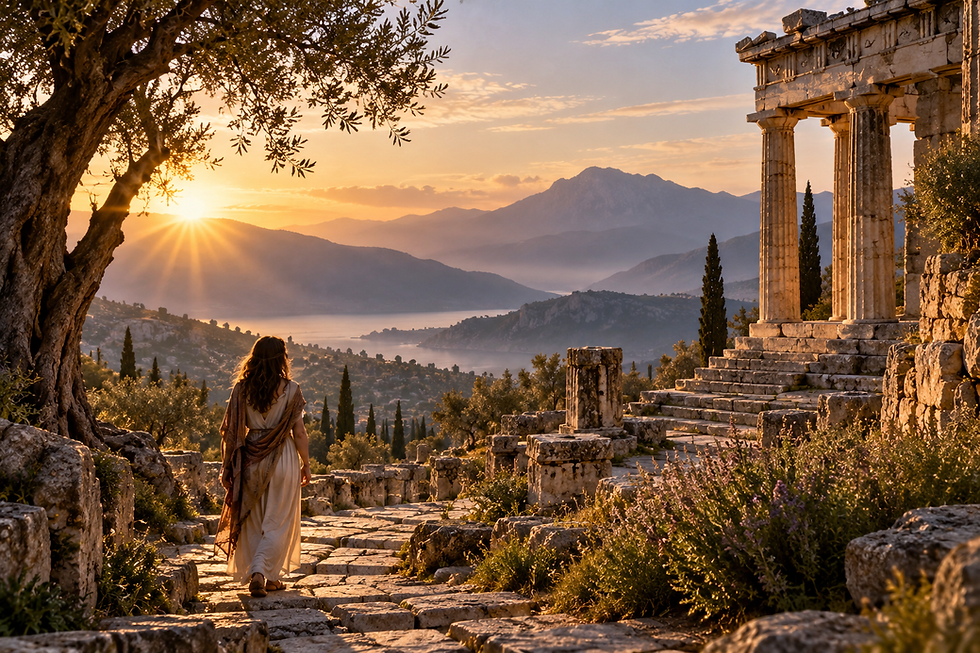
Long before modern psychology existed, human beings were trying to understand the self.
The famous instruction “Know thyself” was associated with the sanctuary of Apollo at Delphi in ancient Greece.
Philosophers returned repeatedly to questions about identity, knowledge, perception and reality.
But the search was never confined to Greece.
Across cultures and centuries, contemplative traditions developed practices intended to turn attention inward.
Their philosophies were not identical.
Their beliefs about the universe were often profoundly different.
We should not collapse all of them into one tradition.
Yet an intriguing pattern remains.
Again and again, human beings have suspected that understanding ourselves may reveal something important about the larger mystery of existence.
Why?
Why would looking inward tell us anything about reality?
Perhaps it doesn't.
Or perhaps consciousness itself is part of the mystery we are trying to understand.
After all, everything you have ever experienced has appeared through consciousness.
Every landscape.
Every sound.
Every relationship.
Every memory.
Every dream.
Every belief.
Every doubt.
Every idea you have ever had about the universe has appeared within the mysterious fact that you are aware.
And despite centuries of philosophy and modern scientific investigation, consciousness remains one of the great unresolved questions.
We know enormously more about the brain than ancient people did.
Yet the existence of subjective experience still raises profound questions.
Why is there an experience of being you?
That mystery alone gives us reason to keep looking.
GNOSIS AND THE TRADITIONS CALLED GNOSTIC
The word gnosis is closely associated today with ancient movements commonly grouped under the term Gnosticism.
These movements flourished in different forms during the first centuries of the Common Era.
There was not one single Gnostic organization with one universally accepted set of beliefs.
Different communities developed different cosmologies, symbols and teachings.
But a number of writings associated with these traditions share an intriguing idea:
Human beings may not fully understand what they are.
In some texts, ignorance is not simply a lack of education.
It is a deeper condition.
Human beings have forgotten their origin.
They misunderstand their relationship with divine reality.
They mistake a limited perception of existence for the whole.
And knowledge—gnosis—becomes part of awakening from that condition.
That is a very different way of understanding the human problem.
Instead of asking only:
What have we done wrong?
these traditions sometimes lead us toward another question:
What have we forgotten?
WHEN KNOWLEDGE DISAPPEARS

This is where the history surrounding gnosis becomes particularly interesting.
Many writings associated with ancient Gnostic traditions did not survive openly through the centuries.
Some were known primarily because early Christian writers described and argued against them.
Religious authorities debated which teachings were acceptable.
Ideas considered heretical could be condemned.
Books could cease to be copied.
Communities disappeared.
Languages changed.
Libraries were destroyed.
Wars erased entire worlds.
And sometimes writings simply vanished.
Then, in 1945, ancient codices were discovered near Nag Hammadi in Egypt.
Among the collection were writings connected with ideas that had been absent from ordinary circulation for centuries.
The discovery did not give us every missing answer.
But it gave us something incredibly valuable:
voices that had been difficult or impossible to hear directly before.
That leads to a much larger question.
How much human knowledge has disappeared?
We cannot know.
Ancient history survives in fragments.
What reaches us depends partly upon what someone considered worth preserving, what someone continued copying, what escaped destruction—and sometimes what happened to survive by chance.
There is something humbling about realizing that.
The history we inherited is not everything that ever happened.
The books we possess are not everything that was ever written.
The ideas that survived are not necessarily the only ideas people once considered important.
There are gaps.
And inside those gaps are questions.
WHAT ELSE MIGHT WE HAVE FORGOTTEN?
When people hear the phrase lost knowledge, it can immediately sound sensational.
But knowledge really does disappear.
Traditional skills disappear.
Languages disappear.
Stories disappear.
Medicinal knowledge can disappear when cultures are disrupted.
Philosophies disappear when their texts are no longer copied.
Spiritual practices disappear when communities stop practicing them.
Sometimes knowledge is deliberately suppressed.
Sometimes it is rejected.
Sometimes it is absorbed into another tradition.
Sometimes nobody bothers to preserve it.
And sometimes history simply destroys the evidence.
We cannot automatically assume that everything lost was profound.
But neither should we assume that everything valuable survived.
That leaves us with a fascinating possibility.
Perhaps part of searching for wisdom involves examining what exists outside the familiar path.
Old texts.
Forgotten philosophies.
Indigenous knowledge traditions.
Mystical writings.
Ancient practices.
Ideas rejected by dominant cultures.
Questions modern society has stopped asking.
Not because every forgotten teaching must be true.
But because wisdom cannot be discovered if curiosity ends at the boundaries of what we already know.
WHO ARE YOU WITHOUT THE STORY OF YOU?

The search becomes even more interesting when it turns inward.
If gnosis involves knowing, what exactly are we trying to know?
Suppose I ask:
Who are you?
You might tell me your name.
But your name was given to you.
You might tell me your occupation.
But you existed before you had it.
You might describe your personality.
Your relationships.
Your accomplishments.
Your failures.
Your nationality.
Your beliefs.
Your memories.
Your body.
Your history.
All of those things are meaningful parts of your life.
But the ancient question pushes deeper.
Who is aware of all of them?
Who notices the thought?
Who remembers the memory?
Who experiences the emotion?
Who is reading these words right now?
This is where self-knowledge stops being a personality exercise and becomes something much stranger.
We can observe many parts of ourselves.
But what exactly is doing the observing?
CONSCIOUSNESS: THE MYSTERY SITTING IN PLAIN SIGHT

Perhaps one of the strangest things about consciousness is how ordinary it feels.
We wake up every morning and simply begin experiencing the world.
We rarely stop to marvel at the fact that there is an experience happening at all.
Modern neuroscience can observe extraordinary relationships between the brain and conscious states.
Changes to the brain can change perception, memory, emotion and personality.
Yet enormous philosophical questions remain.
What exactly is subjective experience?
Why does brain activity produce—or accompany—the feeling of being someone?
Is consciousness entirely generated by the brain?
Is it an emergent property of complex biological systems?
Or is our current understanding still incomplete?
These questions remain actively debated.
And this is one place where Antara Veda's idea of Soul & Science becomes particularly interesting.
Ancient seekers approached consciousness from within.
Modern science investigates it from outside.
Perhaps neither direction should frighten us.
We can ask what ancient people experienced.
We can ask what neuroscience discovers.
We can compare.
We can question.
And we can resist the temptation to pretend that mysteries are solved simply because we have become accustomed to them.
INTUITION, INSIGHT AND INNER KNOWING
People sometimes use the word intuition when describing inner knowing.
But intuition and gnosis should not automatically be treated as identical.
Intuition itself is fascinating.
Sometimes the brain recognizes patterns before conscious reasoning catches up.
Experience can produce a sense that something is wrong—or right—before we can explain why.
But intuition can also be influenced by fear, bias, expectation and past experience.
So how do we know when to trust it?
We don't always.
And that is where discernment becomes essential.
Inner wisdom should not mean:
“I felt it, therefore it must be true.”
Instead, we can become curious about our inner experience.
Where did this feeling come from?
Does it remain when fear settles?
Does evidence support it?
Does experience confirm it?
Does it lead toward greater clarity or greater confusion?
Can I question it without becoming defensive?
Real exploration should survive questioning.
Otherwise we have simply replaced one unquestioned authority with another—ourselves.
WHY SO MANY TRADITIONS TURN THE SEEKER INWARD
There is something remarkable about the number of spiritual and philosophical traditions that developed some form of inward practice.
Meditation.
Contemplation.
Prayer.
Silence.
Self-inquiry.
Breath awareness.
Dream observation.
Mindfulness.
Retreat.
These practices emerged within very different cultures and should be understood in their own contexts.
But they share something simple:
they change where attention is directed.
Most of the day, attention moves outward.
Toward work.
Other people.
Problems.
Entertainment.
Responsibilities.
News.
Phones.
Noise.
In contemplative practice, something different happens.
We begin watching the watcher.
Thought becomes something we can observe.
Emotion becomes something we can notice.
The constant story of ourselves becomes quieter.
And sometimes people report experiences that challenge their ordinary sense of identity.
What those experiences ultimately mean is a much larger question.
But the fact that human beings have repeatedly explored them is worth understanding.
WHAT HAVE WE INHERITED WITHOUT QUESTIONING?
Every human being is born into a story already underway.
Before we can speak, other people have ideas about who we are.
Before we can reason, we are surrounded by assumptions about reality.
Culture teaches us what is normal.
Family teaches us what is expected.
Religion may teach us what is sacred.
Science teaches us ways of investigating the physical world.
Society teaches us what success looks like.
None of those sources should simply be discarded.
They contain accumulated human experience.
But gnosis introduces an uncomfortable question:
Have I examined what I inherited?
Which beliefs have I actually investigated?
Which ones did I absorb because everyone around me believed them?
Which ideas would I still hold if I had been born somewhere else?
Which assumptions have I never even noticed?
The purpose isn't to become suspicious of everything.
It is to become conscious of what we believe and why.
There is freedom in that.
INFORMATION IS NOT THE SAME AS WISDOM
We live in an extraordinary age.
Human beings can access more information in seconds than many people in the ancient world could encounter in a lifetime.
And now artificial intelligence can organize, explain and generate information almost instantly.
Yet access to information does not guarantee wisdom.
A person can know thousands of facts about nutrition and still struggle to nourish themselves well.
Know everything about meditation and never sit quietly.
Read hundreds of books about relationships and still fail to listen.
Study every philosophy of happiness and remain deeply dissatisfied.
Knowledge can accumulate without transforming us.
Wisdom seems to require something more.
Experience.
Reflection.
Discernment.
Humility.
Application.
Perhaps even silence.
And this may bring us closer to what makes gnosis compelling.
Some things cannot merely be collected as information. They must become understood through living.
CAN INNER KNOWING BE TRUSTED?
This may be one of the most important questions we can ask.
If we turn inward, how do we know that what we find is true?
We don't automatically.
The human mind is capable of extraordinary insight.
It is also capable of extraordinary self-deception.
That is why inner exploration should not require abandoning reason.
We can investigate experience.
Compare perspectives.
Study history.
Learn what psychology tells us.
Examine what neuroscience discovers.
Notice patterns.
Remain open to mystery.
And still say:
I don't know yet.
There is strength in that sentence.
Mystery does not demand that we invent an answer.
Sometimes mystery simply asks us to keep looking.
THE SEARCH FOR INNER KNOWING TODAY

Gnosis may be an ancient word, but the search behind it has never disappeared.
People still ask:
Who am I?
Why am I here?
What is consciousness?
Why do certain experiences feel deeply meaningful?
Can meditation change how we perceive ourselves?
What is intuition?
Why do mystical experiences appear across cultures?
How much of our identity is learned?
Can we observe the mind without being controlled by every thought it produces?
What can ancient wisdom teach us?
What has modern science discovered?
Where do they agree?
Where do they conflict?
And where are the mysteries still wide open?
These are exactly the kinds of questions we want to explore at Antara Veda.
Not because we already possess every answer.
But because the questions themselves are worth following.
GNOSIS IS A DOOR, NOT A DESTINATION
Perhaps the most useful way to approach gnosis is not as another doctrine we are required to believe.
Think of it as a doorway.
On one side is everything we have been told.
Our inherited beliefs.
Our assumptions.
Our accumulated information.
On the other side is investigation.
Experience.
Self-knowledge.
Curiosity.
Discernment.
And mystery.
We don't have to throw away what we already know to walk through that door.
We simply have to become willing to look again.
At ancient wisdom.
At forgotten ideas.
At consciousness.
At nature.
At science.
At spiritual experience.
At the stories humanity has carried forward.
At the stories that disappeared.
And, eventually, at ourselves.
Because perhaps the search for hidden wisdom eventually leads to an unexpected place.
Not another book.
Not another teacher.
Not another person telling us what to believe.
But a question waiting quietly underneath everything else:
Who am I, really?
There may not be a simple answer.
But there is something powerful about finally asking.
And perhaps that is where gnosis begins.
CONTINUE EXPLORING
There is far more to discover.
We will explore forgotten texts and ancient philosophies, consciousness and modern science, intuition and self-inquiry, meditation and mystical experience, the nature of identity, and the many ways human beings have searched for wisdom across cultures and centuries.
Some paths will lead into the ancient world.
Others will lead into laboratories, psychology, philosophy, nature and contemplative practice.
And some will lead inward.
We do not have to know where every path ends before we begin.
We only have to remain curious enough to follow it.

$50
Product Title
Product Details goes here with the simple product description and more information can be seen by clicking the see more button. Product Details goes here with the simple product description and more information can be seen by clicking the see more button

$50
Product Title
Product Details goes here with the simple product description and more information can be seen by clicking the see more button. Product Details goes here with the simple product description and more information can be seen by clicking the see more button.
$50
Product Title
Product Details goes here with the simple product description and more information can be seen by clicking the see more button. Product Details goes here with the simple product description and more information can be seen by clicking the see more button.


Comments