The Corpus Hermeticum: What the Ancient Hermetic Texts Actually Teach
Updated: Sep 17
Among the writings associated with Hermes Trismegistus, the Corpus Hermeticum holds a special place. These texts do not read like a single doctrine handed down in one moment. They are a collection of conversations, revelations and philosophical teachings that ask some of humanity’s oldest questions: What is the nature of the divine? What is the human mind? Why are we here? And what happens when a person begins to truly know themselves?
To understand the collection, it helps first to know the mysterious figure at its center. Hermes Trismegistus became the legendary teacher associated with a body of wisdom that developed in the religious and philosophical crossroads of the ancient Mediterranean world.
What Is the Corpus Hermeticum?
The Corpus Hermeticum is a collection of Greek philosophical and religious treatises generally dated by modern scholars to the early centuries of the Common Era, often roughly the first through third centuries CE. The surviving collection is not one ancient Egyptian book, nor is it believed to have been written by a single historical author named Hermes Trismegistus.
Instead, the writings emerged from the culturally mixed world of Greco-Roman Egypt, where Egyptian religious ideas, Greek philosophy and other currents of thought encountered one another. The texts take different forms, but many present teachings as dialogues involving Hermes and students or companions.
This matters because Hermeticism is sometimes described as though it were one fixed system. The surviving texts are more complicated. They share recognizable themes, yet they do not always speak with one voice. Their differences are part of what makes them so revealing: they preserve a living intellectual and spiritual conversation rather than a perfectly uniform creed.
Poimandres and the Vision of Divine Mind
The opening treatise of the Corpus Hermeticum, commonly called Poimandres, begins with a visionary encounter. Its subject is not simply information about the universe but a transformation in the way the seeker understands existence.
One of the central ideas is nous, often translated as mind or divine intellect. In the Hermetic worldview, mind is not treated merely as the stream of private thoughts moving through an individual brain. It participates in a much larger order of reality. Human beings are therefore portrayed as possessing a remarkable position: embodied within the material world, yet capable of recognizing something beyond ordinary material existence.
That ancient question feels unexpectedly close to the modern mystery explored in What Is Consciousness? The Question Science Still Hasn’t Solved. The language and methods are entirely different, but both inquiries eventually confront the strange fact that awareness exists at all.
The Human Being Between Two Worlds
A recurring Hermetic theme is the dual character of humanity. We are physical beings living within nature, subject to change, limitation and mortality. Yet the texts also describe a capacity for intellect, self-knowledge and recognition of the divine.
This is not simply a rejection of the body. The cosmos itself is often presented as ordered, meaningful and alive with divine influence. The deeper problem is ignorance: becoming so absorbed in appearances, appetites and ordinary identity that we forget the greater nature the texts say is available to be known.
Knowledge That Changes the Knower
The knowledge sought in the Corpus Hermeticum is not merely the accumulation of facts. It is closer to gnosis: knowledge through direct recognition or insight. To know the divine, in this framework, also requires a change in the person doing the knowing.
That is why themes of awakening, rebirth and purification appear throughout the Hermetic writings. The seeker is not simply told what reality is. The seeker is invited to become capable of perceiving it differently.
This distinction is important. Ancient mystery traditions frequently used symbolic language because some forms of knowledge were understood as transformative rather than merely descriptive. Whether one interprets the Hermetic accounts spiritually, philosophically or psychologically, the texts repeatedly return to the possibility that ordinary perception may reveal only part of what a human being can know.
Self-Knowledge and the Search Within
The Hermetic path continually turns the search inward. The human being is presented almost as a meeting point between the visible and invisible worlds. By understanding our own nature, the texts suggest, we begin to understand something about the larger order to which we belong.
This is one reason the Corpus Hermeticum fits naturally within the broader tradition of Hermeticism. The Hermetic search is not only about secret books or obscure symbols. Its deeper mystery concerns the relationship between mind, cosmos and self.
Philosophical Hermetica and the Wider Hermetic Tradition
Scholars often distinguish the philosophical or religious Hermetica, including the Corpus Hermeticum and the Asclepius, from technical Hermetic writings concerned with subjects such as astrology, alchemy and magic. These streams were historically related in complicated ways, but they should not simply be treated as one identical body of teaching.
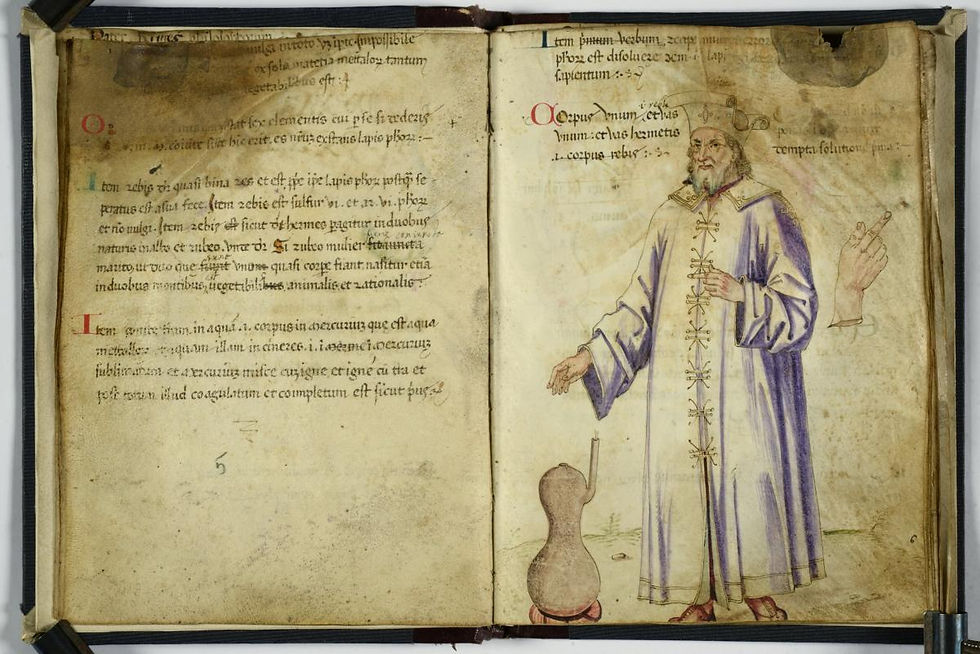
Over centuries, however, they became intertwined in the broader Western imagination. Hermes Trismegistus came to represent a legendary source of ancient wisdom, and writings attributed to him influenced philosophical, magical and alchemical traditions.
The Renaissance Rediscovery
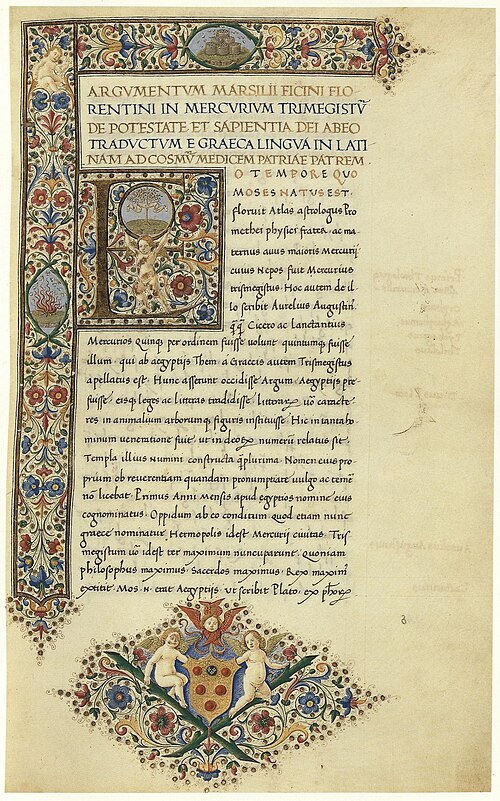
The Corpus Hermeticum gained extraordinary influence in Renaissance Europe after Marsilio Ficino translated a Greek manuscript into Latin in the fifteenth century. At the time, many readers believed the Hermetic writings were vastly older than they actually were—possibly remnants of primordial Egyptian wisdom predating major Greek philosophers.
That chronology was later challenged. In the early seventeenth century, classical scholar Isaac Casaubon argued from the language of the texts that they belonged to the post-classical Greco-Roman period rather than remote Egyptian antiquity. Modern scholarship broadly agrees that the surviving philosophical Hermetica were composed in the early centuries CE.
Yet correcting the date did not erase their importance. The texts remain witnesses to a remarkable period when different cultures, philosophies and religious ideas were meeting, combining and asking profound questions about the nature of reality.
Were the Hermetic Teachings Hidden?
The history of esoteric knowledge is rarely as simple as a single secret being deliberately concealed for thousands of years. Texts disappear, manuscripts survive by chance, languages are forgotten, libraries are destroyed, teachings move into private circles, and ideas can vanish from one culture while remaining alive in another.
The Corpus Hermeticum itself illustrates that fragile chain of transmission. Much of the ancient literary world has been lost. What survives is only what happened to be copied, preserved, translated or rediscovered.
For a seeker, that leaves an intriguing possibility—not that every mystery has one hidden answer waiting in a forgotten manuscript, but that human beings have repeatedly asked questions deeper than the explanations available in their own age. Some of those questions survive because someone chose to preserve them.
What Do the Hermetic Texts Ultimately Teach?
There is no single sentence that can reduce the Corpus Hermeticum to one teaching. But a pattern emerges across the collection: reality possesses an intelligible order; human beings participate in that order; ignorance keeps us from recognizing our deeper nature; and knowledge can become a form of transformation.
The texts ask the reader to look beyond surface identity. They ask whether mind is larger than ordinary thought, whether the cosmos is more meaningful than it appears, and whether knowing ourselves might reveal something about the structure of reality itself.
Nearly two thousand years later, those questions have not disappeared. We have new instruments, new scientific models and vastly more knowledge about the physical universe. Yet the ancient Hermetic question remains strangely alive: if we can examine the world around us with increasing precision, how deeply do we understand the consciousness through which we experience it?
Perhaps that is why the Corpus Hermeticum continues to draw seekers. It does not simply offer a collection of old answers. It preserves an ancient invitation—to question appearances, search beneath inherited assumptions, and discover what may become visible when the search for knowledge turns inward.

$50
Product Title
Product Details goes here with the simple product description and more information can be seen by clicking the see more button. Product Details goes here with the simple product description and more information can be seen by clicking the see more button

$50
Product Title
Product Details goes here with the simple product description and more information can be seen by clicking the see more button. Product Details goes here with the simple product description and more information can be seen by clicking the see more button.
$50
Product Title
Product Details goes here with the simple product description and more information can be seen by clicking the see more button. Product Details goes here with the simple product description and more information can be seen by clicking the see more button.

Comments