What Is Hermeticism? Ancient Wisdom, the Mind and the Search for Hidden Knowledge
Updated: Sep 17

Across centuries, certain ideas keep resurfacing in different languages and traditions: that the visible world may be only part of reality, that the human mind participates in how experience is understood, and that wisdom is not simply information collected from outside ourselves. Hermeticism is one of the ancient streams in which these questions were explored with unusual depth.
Often surrounded by mystery, Hermetic thought grew from writings attributed to Hermes Trismegistus, a legendary teacher whose identity blends the Greek god Hermes with the Egyptian god Thoth. The texts connected with his name do not give us a single religion or a neat system of rules. Instead, they preserve a philosophical and spiritual search concerned with mind, cosmos, transformation, divine intelligence and the possibility of knowing something deeper about ourselves.
That may be why Hermetic ideas continue to attract readers today. Beneath the historical distance is a question that still feels immediate: what if understanding the universe and understanding ourselves are not entirely separate pursuits?
Who Was Hermes Trismegistus?
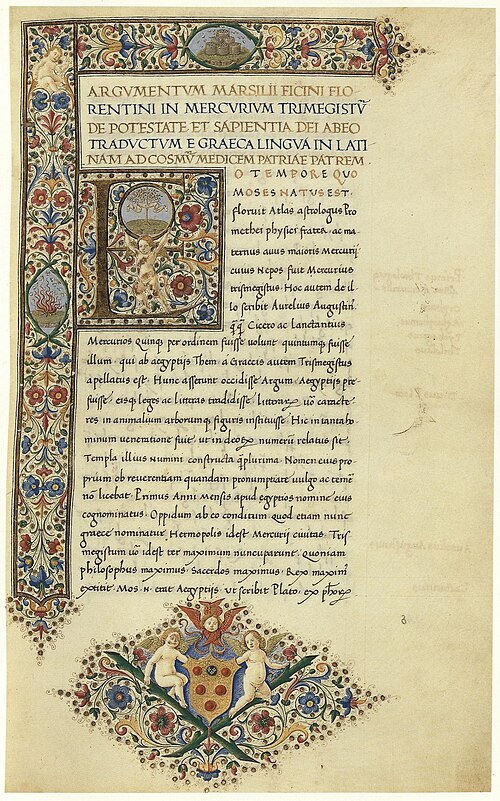
Hermes Trismegistus—“Hermes the Thrice-Great”—is best understood as a legendary or composite figure rather than a historical author whose biography can be reconstructed. In the Greco-Egyptian world, Hermes and Thoth were associated with writing, knowledge, language and sacred wisdom. Over time, the name Hermes Trismegistus became attached to a body of teachings now known as the Hermetica.
The most influential philosophical Hermetic writings were composed in the early centuries of the Common Era, in a cultural world where Greek philosophy, Egyptian religious ideas and other intellectual traditions met. Among the best known are texts collected in the Corpus Hermeticum and the Asclepius. Their speakers discuss the nature of God, mind, the cosmos, the human condition and spiritual awakening.
For centuries, however, many European readers believed these writings were far older. During the Renaissance, scholars sometimes regarded Hermes as an ancient sage who had lived before major Greek philosophers. Later textual scholarship dated the surviving philosophical Hermetic writings much later. That correction changed the historical story, but it did not erase the influence of the ideas.
A Universe Filled With Meaning
One of the most striking qualities of Hermetic writing is the way it refuses to treat the human being as an isolated observer standing outside the universe. The cosmos is presented as ordered, alive with intelligence and connected through layers of being. Humanity occupies a peculiar place within that order: embodied and limited, yet also capable of thought, awareness and the search for the divine.
This is not the language of modern physics, and it should not be confused with a scientific theory. It is a philosophical and spiritual vision. Yet its central intuition—that the observer, the mind and the world we experience cannot always be considered in complete isolation—continues to echo in modern discussions about consciousness, perception and the nature of reality.
“As Above, So Below”
The phrase most commonly associated with Hermeticism is “as above, so below.” Its roots are connected with the Emerald Tablet, a short and enigmatic text that became enormously influential in alchemical traditions. The phrase has acquired many modern interpretations, some of them far removed from its historical setting.
At its broadest, the idea points toward correspondence: patterns in one level of reality may reflect patterns in another. The greater world and the smaller world—the macrocosm and microcosm—were often imagined as connected. Human beings could therefore study nature not merely as something external, but as a mirror through which deeper principles might be contemplated.
This idea invites a different kind of attention. Instead of asking only what a thing is made of, we begin asking what relationships, patterns and meanings connect it to something larger.
Knowledge That Changes the Knower
Hermetic wisdom was not simply about accumulating secret facts. The deeper goal was transformation. To know the divine or the nature of reality was also to change the person doing the knowing. Ignorance was not merely a shortage of information; it was a condition of being unable to recognize our deeper nature and our relationship to the whole.
This is one place where Hermeticism stands close to other traditions of inner knowing. Knowledge becomes experiential. A person may read descriptions of truth endlessly and still not possess the kind of understanding the texts are pointing toward. The movement is inward as well as outward: observe the cosmos, question appearances, examine the mind, and become capable of seeing differently.
The Mind and the Mystery of Consciousness
Hermetic texts give mind—nous—a profound role. Divine mind, human intelligence and the intelligibility of the cosmos are woven together in ways that can sound startlingly contemporary, even though the philosophical framework is ancient.
Modern neuroscience approaches mind through the brain, nervous system, perception, memory and cognition. Hermetic writers were asking a different kind of question: what is mind in the deepest sense, and what does our capacity for awareness reveal about our place in reality? These approaches should not be collapsed into one another, but placing them side by side can be fruitful. Science can investigate mechanisms. Philosophy and spiritual traditions can continue asking what subjective experience means and why consciousness exists at all.
That question also connects naturally with our exploration of Neville Goddard, imagination and the mystery of consciousness, where a much later thinker placed the imaginative mind at the center of his spiritual philosophy.
Alchemy: More Than Turning Lead Into Gold
Hermeticism later became closely associated with alchemy. Popular imagination often reduces alchemy to the attempt to manufacture gold, but historical alchemy was far more complicated. It included practical experimentation with substances, philosophical speculation, symbolic language and, in some traditions, ideas of purification and transformation.
The alchemical image of transforming something base into something refined became a powerful metaphor for inner change. Whether every alchemist understood the work spiritually is another question, and the historical traditions varied widely. But the symbolism endured because it speaks to a recognizable human experience: the possibility that confusion, suffering or ignorance can become material for transformation rather than simply obstacles to escape.
Was Hermetic Knowledge Hidden?
Hermetic writings have often been described as secret or hidden teachings, and there is real history behind the association between esoteric traditions and restricted knowledge. Ancient and later spiritual schools did not always treat every teaching as something to be distributed without preparation or context. Manuscripts could disappear, traditions could be interrupted, and texts could survive only through copying, translation and rediscovery.
At the same time, “hidden” can mean more than physically concealed. Some teachings are hidden because their language is symbolic. Others become inaccessible because the culture that understood their symbols changes. Still others remain in plain sight but are rarely encountered outside specialized study.
That makes the search itself important. We do not have to accept every esoteric claim literally to recognize that human history contains ideas that were forgotten, marginalized, lost, rediscovered or interpreted in radically different ways across generations.
Why Hermeticism Still Matters
Hermeticism survives because it asks questions that modern life has not made obsolete. What is consciousness? Is reality exhausted by what our senses immediately reveal? What is the relationship between mind and world? Can knowledge transform the person who seeks it? Are there patterns connecting the inner life with the larger world around us?
These are not questions with easy answers, and perhaps that is part of their value. Hermetic writings do not need to become unquestioned doctrine to be worth exploring. They can be approached as part of humanity’s long attempt to understand what we are, where consciousness belongs in the universe, and whether wisdom requires more than intellectual explanation.
The Search Beneath the Surface
There is something deeply human in the suspicion that appearances are not the whole story. Across cultures and centuries, seekers have turned toward temples, manuscripts, philosophy, nature, contemplation and their own interior lives looking for a deeper pattern.
Hermeticism belongs to that search. Its language comes from another age, but its invitation remains recognizable: look more carefully. Question the division between inner and outer. Do not confuse information with wisdom. Pay attention to what changes in you as you search.
Perhaps the enduring mystery of ancient wisdom is not that it gives us a final answer. It is that, centuries later, it can still lead us back to the questions we have not finished asking.

$50
Product Title
Product Details goes here with the simple product description and more information can be seen by clicking the see more button. Product Details goes here with the simple product description and more information can be seen by clicking the see more button

$50
Product Title
Product Details goes here with the simple product description and more information can be seen by clicking the see more button. Product Details goes here with the simple product description and more information can be seen by clicking the see more button.
$50
Product Title
Product Details goes here with the simple product description and more information can be seen by clicking the see more button. Product Details goes here with the simple product description and more information can be seen by clicking the see more button.

Comments