The Kybalion: Where the Seven Hermetic Principles Really Came From
Updated: Sep 17
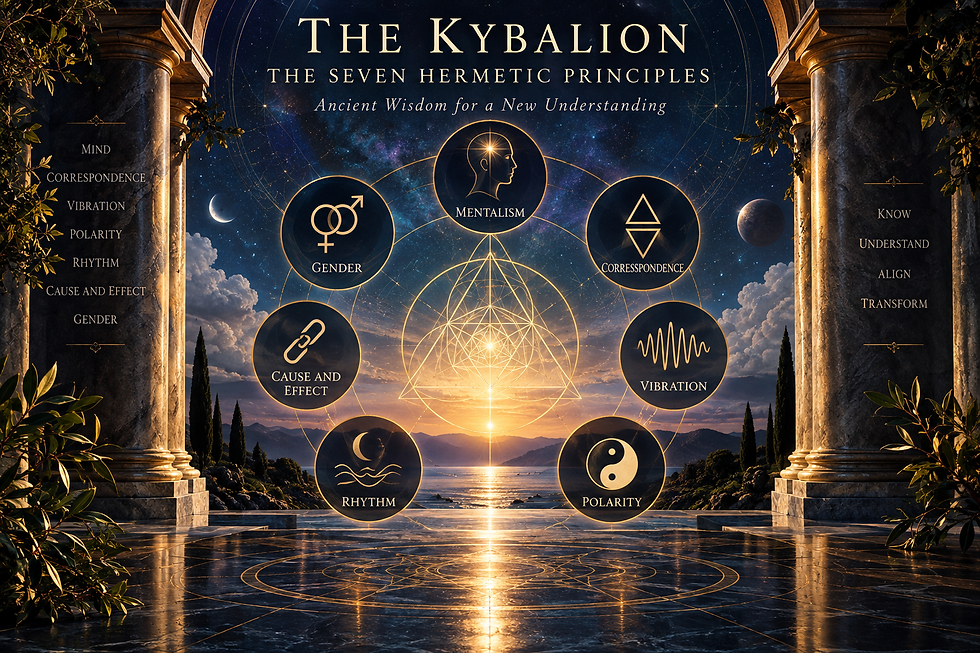
Seven principles. A mysterious group of authors calling themselves the Three Initiates. A book claiming to preserve an ancient Hermetic teaching passed quietly from teacher to student. Few modern esoteric books have acquired an aura quite like The Kybalion.
Published in Chicago in 1908, The Kybalion has shaped the way generations of readers understand Hermeticism. Its seven principles—Mentalism, Correspondence, Vibration, Polarity, Rhythm, Cause and Effect, and Gender—are repeated today across books, websites, spiritual teachings and manifestation communities. They are often described simply as ancient Hermetic laws.
But the history is more complicated, and more interesting. The Kybalion is a modern work. Its language reflects the New Thought and occult currents of the late nineteenth and early twentieth centuries as much as the ancient Hermetic texts. Understanding that distinction does not diminish the book. It reveals how old ideas can be rediscovered, reshaped and carried into a new age.
What Is The Kybalion?
The Kybalion was first published in 1908 by the Yogi Publication Society and attributed not to a named author but to “Three Initiates.” The book presents itself as an introduction to Hermetic philosophy and repeatedly invokes Hermes Trismegistus as the legendary source of the tradition.
Hermes himself is the mysterious wisdom figure at the center of the older Hermetic tradition. We explored that story in Hermes Trismegistus: The Mysterious Teacher Behind Hermetic Wisdom.
The anonymity of The Kybalion helped create part of its enduring mystery. Who were the Three Initiates? Was the book preserving a secret lineage, or was the name a literary device used by a modern author?
No universally accepted answer has settled the authorship question. William Walker Atkinson, a prolific New Thought writer and occult publisher, is the person most frequently associated with the work, and researchers have pointed to similarities in language, ideas and publishing connections. Other names have also been proposed. It is therefore more accurate to describe Atkinson as a leading candidate than to present his authorship as an unquestioned fact.
The Seven Hermetic Principles
The Kybalion organizes its philosophy around seven principles. This tidy framework is one reason the book became so memorable. Each principle offers a way of interpreting patterns in mind, nature and experience.
1. The Principle of Mentalism
The first principle presents mind as fundamental to reality. In the worldview of The Kybalion, the universe exists within an infinite living Mind rather than being merely dead matter operating independently of consciousness.
This idea resonates strongly with later manifestation teachings and with older philosophical questions about whether mind is secondary to matter or somehow more fundamental. It should not, however, be confused with a scientific conclusion that modern physics has proven the universe is literally mental. That remains a philosophical and metaphysical claim.
2. The Principle of Correspondence
Correspondence is the principle most closely associated with the familiar phrase “as above, so below.” It proposes that patterns repeat across different levels of existence, allowing the seeker to use what is known at one level to illuminate what is difficult to understand at another.
The phrase has a much older history than The Kybalion and is closely associated with the Emerald Tablet and the Hermetic idea of correspondence.
This is an important distinction: The Kybalion did not invent the Hermetic fascination with correspondence. It reorganized and interpreted such ideas within its own seven-principle system.
3. The Principle of Vibration
The third principle teaches that everything is in motion and that differences between states can be understood as differences of vibration. In modern spiritual culture this idea is often expanded into talk of “raising your vibration.”
Physics certainly studies oscillation, waves, frequency and motion, but the scientific use of those concepts is not evidence for every metaphysical claim made about spiritual vibration. The language may overlap while the meanings remain different. Keeping those meanings distinct allows us to explore the philosophy without pretending science has already settled it.
4. The Principle of Polarity
Polarity describes apparent opposites as differing degrees of something that belongs to the same underlying continuum. Hot and cold, light and dark, love and hate are used as examples of qualities that may appear opposite yet can be understood in relation to one another.
Psychologically, this principle invites a fascinating question: if some mental states exist along continuums rather than as absolute opposites, can shifting degree eventually transform our experience? The Kybalion connects this possibility with the practice it calls mental transmutation.
5. The Principle of Rhythm
Rhythm describes movement, cycles and the tendency of phenomena to swing between conditions. The natural world is filled with cycles—day and night, seasons, tides, biological rhythms—and human life also seems to unfold through periods of expansion and retreat, activity and rest.
The Kybalion turns this observation into a broader metaphysical principle and teaches that understanding rhythm can help a person avoid being unconsciously carried by its extremes.
6. The Principle of Cause and Effect
This principle rejects the idea that events are simply disconnected accidents. Every cause has effects, and every effect arises from causes, even when those causes are not immediately visible.
At an everyday level, cause and consequence are obvious parts of life. The Kybalion extends the principle into a universal metaphysical law and encourages the student to become more conscious of the causes they set in motion rather than feeling entirely controlled by circumstances.
7. The Principle of Gender
The final principle uses “gender” in a broad symbolic sense, proposing masculine and feminine aspects throughout nature and mind. Its terminology reflects the period in which the book was written and should not be confused with modern scientific or social understandings of sex and gender.
Within the book’s own system, the principle is about generative polarity: the interaction of complementary forces through which creation occurs.
Are These Really Ancient Hermetic Principles?
This is where one of the most persistent misunderstandings about The Kybalion appears. The seven principles, as a named and numbered system, are not found in the ancient Corpus Hermeticum.
The older tradition explored in What Is Hermeticism? Ancient Wisdom, the Mind and the Search for Hidden Knowledge includes themes such as divine mind, cosmic order, correspondence, spiritual rebirth and humanity’s relationship with the divine. But it does not present the familiar seven-principle list of The Kybalion.
That does not mean the modern book has no relationship to Hermetic thought. It means the relationship is one of interpretation and development rather than simple preservation. Some themes echo older traditions; others bear the unmistakable fingerprints of the intellectual world surrounding the book in 1908.
The New Thought Connection
The Kybalion appeared during a period when New Thought writers were intensely exploring the power of mind, belief, suggestion, imagination and mental causation. These movements did not emerge in isolation. They drew from philosophy, mesmerism, metaphysical religion, occultism and older esoteric traditions while creating distinctly modern systems of thought.
This historical setting matters because The Kybalion often sounds much closer to New Thought literature than to translations of ancient Hermetic dialogues. Its emphasis on mastering mental states and transforming experience through mind belongs naturally within that turn-of-the-century environment.
The same larger current later helps us understand teachers such as Neville Goddard and his emphasis on imagination and assumption.
The bridge between Hermeticism and New Thought is one of the most intriguing parts of the story. Ideas rarely remain inside neat historical boxes. They migrate. They are translated into new language. They merge with other traditions. Eventually the new form can become so popular that people forget where one era ends and another begins.
Why the Book Became So Influential
The Kybalion offers something ancient philosophical texts often do not: a compact system. Seven principles are easy to remember, teach and apply. The book transforms a sprawling history of Hermetic, metaphysical and occult ideas into a structure that feels almost like a map.
That made it especially adaptable. Readers interested in mental discipline could use it psychologically. Occult students could interpret it metaphysically. Later manifestation communities could connect Mentalism and Correspondence with ideas about consciousness shaping experience.
The book therefore became influential not because it was the oldest Hermetic text, but because it was unusually effective at translating esoteric ideas into a modern language of mind and personal transformation.
Mental Transmutation: The Hidden Center of the Book
Beneath the seven principles lies an idea that may be even more important to understanding The Kybalion: mental transmutation.
Traditional alchemy sought transformation through work with substances while also accumulating layers of symbolic and spiritual meaning. The Kybalion turns strongly toward the mental realm. Its seeker learns to change states of mind, redirect attention and become less passive before internal forces.
Here the old alchemical image of transformation reappears in a distinctly modern form. The laboratory moves inward.
This helps explain why the book still speaks to readers interested in consciousness and self-development. Even when someone does not accept its entire metaphysical system literally, the underlying question remains compelling: how much of our experience changes when the mind that interprets it changes?
Ancient Wisdom or Modern Reinvention?
Perhaps the most useful answer is that The Kybalion belongs to a lineage rather than a single historical moment. It is not an ancient Egyptian manuscript. It is not part of the Corpus Hermeticum. Its seven principles should not be placed unchanged into the mouth of Hermes Trismegistus.
Yet it also did not appear from nowhere. It emerged from centuries of Western fascination with Hermeticism, alchemy, mental transformation and hidden laws of nature, combined with the powerful New Thought currents of its own era.
That makes The Kybalion a fascinating example of how wisdom traditions evolve.
The Search Beneath the Seven Principles
There is a temptation when discovering an old or mysterious teaching to ask only one question: Is it ancient?
But another question may be more revealing: Why did this idea survive?
The Kybalion survived because its principles give language to patterns people believe they recognize in their own lives—the movement between opposites, repeating cycles, cause and consequence, the relationship between inner state and outward action, and the possibility that consciousness is more mysterious than ordinary experience suggests.
History asks us to be precise about where those teachings came from. Inner inquiry asks us what, if anything, they reveal when examined carefully.
We do not have to choose between the two.
The deeper path is to know the history, question the claims, follow the older sources and still remain curious. That is where the story of The Kybalion becomes more than seven principles memorized from a page. It becomes part of a much longer human search for the hidden patterns connecting mind, nature and the mystery of existence.

$50
Product Title
Product Details goes here with the simple product description and more information can be seen by clicking the see more button. Product Details goes here with the simple product description and more information can be seen by clicking the see more button

$50
Product Title
Product Details goes here with the simple product description and more information can be seen by clicking the see more button. Product Details goes here with the simple product description and more information can be seen by clicking the see more button.
$50
Product Title
Product Details goes here with the simple product description and more information can be seen by clicking the see more button. Product Details goes here with the simple product description and more information can be seen by clicking the see more button.

Comments