As Above, So Below: The Emerald Tablet and the Hidden Meaning of Hermetic Wisdom
Updated: Sep 17

Few phrases from the ancient esoteric world have traveled as far as “as above, so below.” It appears in books on Hermeticism, alchemy, astrology and modern spirituality, often as if its meaning were obvious. Yet behind those six familiar words is a much stranger history—one that leads to a compact, cryptic text known as the Emerald Tablet.
The Emerald Tablet is not a long scripture or a complete philosophical system. It is a brief collection of enigmatic statements associated with Hermes Trismegistus and the Hermetic tradition. Its language became especially influential among medieval and early modern alchemists, who read it as a key to transformation, correspondence and the hidden relationships within nature.
But what did “as above, so below” originally mean? And why has the idea survived long after the world that produced it disappeared?
What Is the Emerald Tablet?
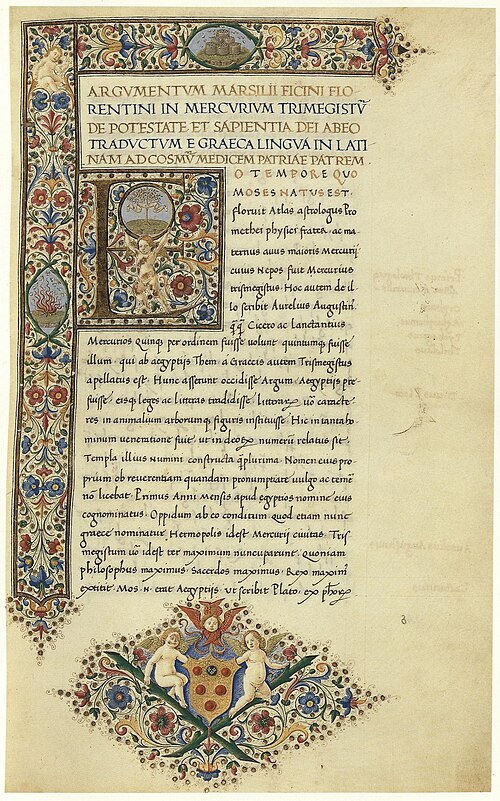
The Emerald Tablet, often called the Tabula Smaragdina, is a short Hermetic text that became famous through Arabic and later Latin alchemical traditions. Despite later legends describing an actual tablet of emerald bearing ancient inscriptions, historians do not have an archaeological emerald tablet that can be identified as the original object. What survives is a textual tradition copied, translated and interpreted across centuries.
Versions of the text appear in medieval Arabic sources before it entered Latin Europe. From there, it became one of the most influential short texts associated with alchemy. Its authority came partly from its attribution to Hermes Trismegistus—the legendary sage linked with the broader Hermetic tradition—and partly from the tantalizing density of its language.
If you have not explored that larger tradition yet, begin with our introduction to Hermeticism, which looks at Hermes Trismegistus, mind, alchemy and the search for transformative knowledge.
The Meaning Behind “As Above, So Below”
The famous modern wording is a condensed expression of a passage in the Emerald Tablet describing what is below as corresponding to what is above, and what is above as corresponding to what is below. The underlying idea is correspondence: different levels of reality may reflect or participate in the same deeper order.
For ancient and medieval thinkers, the universe was often imagined as an interconnected whole rather than a collection of unrelated parts. The heavens, the natural world and the human being could be understood through relationships between the macrocosm—the greater cosmos—and the microcosm—the smaller world represented by the human being.
In that framework, studying the stars, metals, plants, bodily processes or the movements of the mind could become more than the study of isolated objects. Each might reveal something about patterns operating on another level.
The Macrocosm and the Microcosm
The idea that the human being somehow reflects the larger cosmos appears in more than one philosophical and spiritual tradition. In Hermetic and later esoteric thought, this relationship became especially important. Humanity stood between different realms: physical yet capable of thought, limited yet able to contemplate the infinite.
This did not mean that every event in the sky mechanically caused an identical event inside a person. The idea was more subtle. It suggested that nature possesses patterns, proportions and relationships that may repeat or correspond across scales.
To a modern reader, the concept can function as a philosophical lens rather than a scientific law. It asks us to notice relationships: between our inner state and our actions, between individual life and the systems surrounding it, between what we perceive and the consciousness through which perception occurs.
Alchemy and the Language of Transformation
The Emerald Tablet became inseparable from alchemy because its language seemed to describe a process of separation, purification, union and transformation. Alchemists worked with physical substances, but their writings frequently used symbols whose meanings could operate on several levels at once.
The search for the philosopher’s stone and the transformation of base metals into noble ones became the most famous images of alchemy. Yet alchemical literature also developed a powerful symbolic vocabulary for change. Fire could destroy and purify. Dissolution could represent the breaking apart of an old form. Conjunction could represent the joining of what had been separated.
That symbolism is one reason alchemy continues to fascinate people who have no intention of working in a laboratory. The image of transformation speaks inwardly as well as outwardly: something unfinished can be worked upon; something hidden can be revealed; something divided can be brought into a new relationship.
Was the Emerald Tablet a Secret Teaching?
The text certainly belongs to a tradition in which knowledge was often expressed cryptically. Alchemical writers became famous for veiled language, strange images, coded references and deliberate ambiguity. Part of this reflected the specialized nature of the work. Part reflected philosophical traditions in which certain knowledge was thought to require preparation. And part may simply reflect the difficulty of translating technical and symbolic ideas across languages and centuries.
Calling such knowledge “hidden” does not require us to imagine one single organization guarding one secret through all of history. Knowledge can disappear in many ways. Texts can be lost. Languages can stop being widely read. Libraries can be destroyed. Ideas can fall outside accepted institutions. Symbols can survive after their original meanings become obscure.
Sometimes what is hidden is not locked away at all. It is waiting in a manuscript, an old translation or a familiar phrase whose history almost no one stops to investigate.
The Problem With the Seven Hermetic Principles
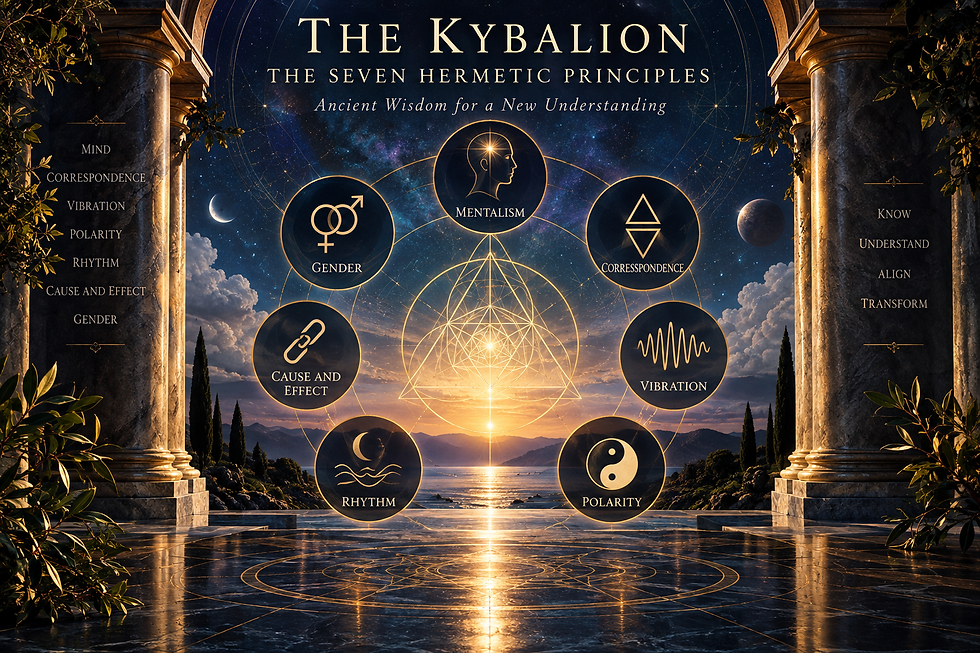
Modern discussions of Hermeticism often present seven principles—Mentalism, Correspondence, Vibration, Polarity, Rhythm, Cause and Effect, and Gender—as if they came directly from the ancient Hermetic writings. These principles are associated with The Kybalion, a book first published in 1908, not with the ancient Corpus Hermeticum or the earliest forms of the Emerald Tablet.
That distinction matters because later spiritual traditions can be meaningful without being projected backward into antiquity. Hermetic thought changed as it moved through different cultures and centuries. Separating ancient sources from later interpretations actually makes the story more interesting: we can see how an idea evolves, what later thinkers added, and why certain interpretations became more popular than the older texts themselves.
Does “As Above, So Below” Connect With Modern Science?
It is tempting to connect Hermetic correspondence directly with quantum physics, neuroscience or modern cosmology. Those comparisons can be imaginative and philosophically stimulating, but they should not be treated as proof that ancient Hermetic writers possessed modern scientific theories in coded form.
Science depends on testable models, observation and evidence. Hermetic correspondence belongs to a philosophical and spiritual way of interpreting reality. The two can be placed in conversation without pretending they are identical.
What makes the comparison interesting is the shared human impulse beneath them: the search for patterns. Modern science has revealed genuine relationships across scales—from repeating mathematical structures to biological systems nested within larger ecosystems. That does not validate every esoteric correspondence, but it reminds us that reality is often more interconnected than everyday perception suggests.
The Inner Meaning of Correspondence
There is another way to approach the phrase that requires no claim about supernatural forces. What happens within us often shapes what we notice, how we interpret events and how we respond to the world. Fear can make a neutral situation appear threatening. Attention can reveal possibilities we previously overlooked. Beliefs can influence choices, and choices can gradually alter the conditions of a life.
The outer world is not simply created by our thoughts, but neither do we encounter it without the filter of consciousness. There is a continual relationship between inner experience and outward action.
In that sense, “as above, so below” can become an invitation to investigate correspondence rather than a formula to repeat. What patterns appear in both our inner and outer lives? What do our reactions reveal? What changes outside us when something changes within us? And where do the parallels end?
Why the Emerald Tablet Still Draws Seekers
The Emerald Tablet survives partly because it does not explain itself completely. Its brevity creates space for interpretation. Alchemists, philosophers, occultists and spiritual seekers have read it through very different lenses, each generation finding new meanings in the same compact language.
There is danger in that openness—we can make an old text say almost anything if we ignore its history. But there is also value in encountering a text that refuses to do all of our thinking for us.
Ancient wisdom often reaches us in fragments: a manuscript, a symbol, a sentence copied across centuries. We inherit not only the words but the unanswered questions surrounding them.
Looking Again at a Familiar Phrase
“As above, so below” has become so familiar that it is easy to pass over it without asking what it asks of us. Beneath the modern slogan lies an older vision of a universe connected by relationships, a tradition of alchemical transformation, and a belief that knowledge of nature and knowledge of ourselves may belong to the same search.
Perhaps that is why the phrase continues to endure. It does not simply tell us what to believe. It turns our attention toward patterns—between the visible and invisible, the larger world and the smaller one, the life around us and the consciousness through which we experience it.
And once we begin looking for those relationships, the ancient question becomes personal: what might the world outside us reveal about the world within?

$50
Product Title
Product Details goes here with the simple product description and more information can be seen by clicking the see more button. Product Details goes here with the simple product description and more information can be seen by clicking the see more button

$50
Product Title
Product Details goes here with the simple product description and more information can be seen by clicking the see more button. Product Details goes here with the simple product description and more information can be seen by clicking the see more button.
$50
Product Title
Product Details goes here with the simple product description and more information can be seen by clicking the see more button. Product Details goes here with the simple product description and more information can be seen by clicking the see more button.

Comments