Who Was Hermes Trismegistus? The Mysterious Teacher Behind Hermetic Wisdom
Updated: Sep 17
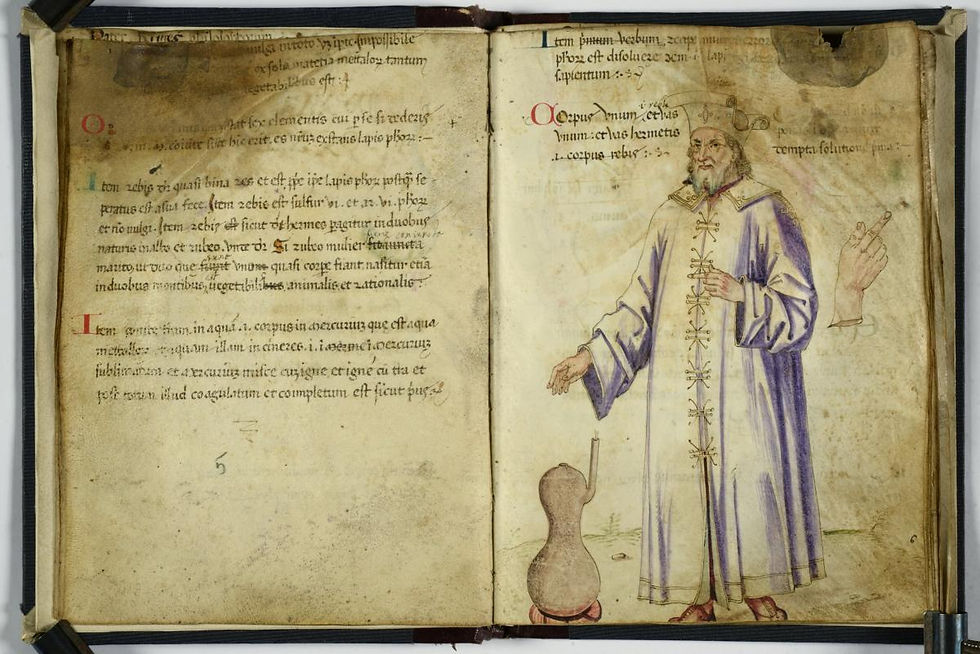
For centuries, a mysterious name has appeared at the crossroads of philosophy, astrology, alchemy and the search for hidden wisdom: Hermes Trismegistus. He was described as a great teacher, a master of sacred knowledge and the source of writings that promised insight into the relationship between the human being, nature and the cosmos.
But who was Hermes Trismegistus? Was he a real person, an ancient Egyptian sage, a Greek philosopher—or something more complicated?
The historical answer is fascinating because Hermes Trismegistus is best understood not as one securely documented individual, but as a legendary figure created through the meeting of Egyptian and Greek religious and philosophical traditions. The teachings written in his name would become the foundation of what we now call Hermeticism.
A Figure Born Between Two Worlds
The name Hermes Trismegistus means “Hermes the Thrice-Great.” The figure emerged in the cultural world of Greco-Roman Egypt, where Greek and Egyptian traditions had been interacting for centuries.
The Greek god Hermes was associated with language, interpretation, boundaries and the transmission of knowledge. The Egyptian god Thoth was associated with writing, wisdom, calculation, sacred knowledge and the ordering of the cosmos. In the syncretic religious world of Egypt under Greek and Roman rule, the two figures became closely identified.
From this blending emerged Hermes Trismegistus: an idealized ancient sage whose authority seemed to reach back into the deepest past.
The Hermetic Writings
A collection of philosophical and religious writings attributed to Hermes circulated during the first centuries of the Common Era. Today, some of the best-known are grouped under the name Corpus Hermeticum, along with the Latin Asclepius and other surviving fragments.
These texts are not a single book written at one moment. They come from different authors and settings, but they share recurring questions about God, mind, the cosmos, the human condition and the possibility of spiritual awakening.
The writings often take the form of dialogues in which Hermes teaches a student. Their concern is not simply belief. Again and again they ask what a human being must come to know in order to understand his or her true place in reality.
The Mystery of Knowing
One of the most striking features of philosophical Hermeticism is its emphasis on direct understanding. The seeker is invited to move beyond appearances and recognize a deeper order within existence.
This does not mean every Hermetic text teaches exactly the same system. Some passages are optimistic about humanity’s relationship with the cosmos; others emphasize the need to rise beyond confusion and attachment. Yet knowledge—especially transformative knowledge—remains central.
That is one reason Hermeticism fits so naturally beside the idea of gnosis. Knowledge in this setting is not merely information collected from the outside. It can become recognition: a shift in how the seeker understands self, mind and the greater whole.
As Above, So Below
Few phrases are more closely associated in modern culture with Hermetic thought than “as above, so below.” The wording comes from translations of the Emerald Tablet, a short and cryptic text that became enormously influential in medieval and early modern alchemy.
We explored that tradition more closely in As Above, So Below: The Emerald Tablet and the Hidden Meaning of Hermetic Wisdom, including the idea that patterns in one level of reality may correspond with patterns in another.
The Emerald Tablet is related to the broader Hermetic tradition, but it should not simply be treated as another chapter of the Greek Corpus Hermeticum. Its textual history is different, with surviving versions appearing through Arabic sources before becoming famous in Latin Europe.
That distinction matters. “Hermetic” came to cover a large family of ideas over time, and later readers often brought philosophical Hermeticism, astrology, magic and alchemy into conversation with one another.
Hermes and the Alchemical Tradition
Alchemy became one of the great homes of Hermetic symbolism. Medieval and Renaissance writers frequently imagined ancient wisdom as something transmitted through Hermes and preserved in riddles, emblems and coded teachings.
That world continues in Alchemy Beyond Gold: The Great Work and the Hidden Art of Transformation, where the physical work of alchemy meets its later symbolic interpretation as a language of transformation.
Hermes therefore became more than the supposed author of a set of texts. He became a symbol of the ancient master—the one who knew how the visible and invisible worlds fit together.
Why Renaissance Europe Became Fascinated with Hermes
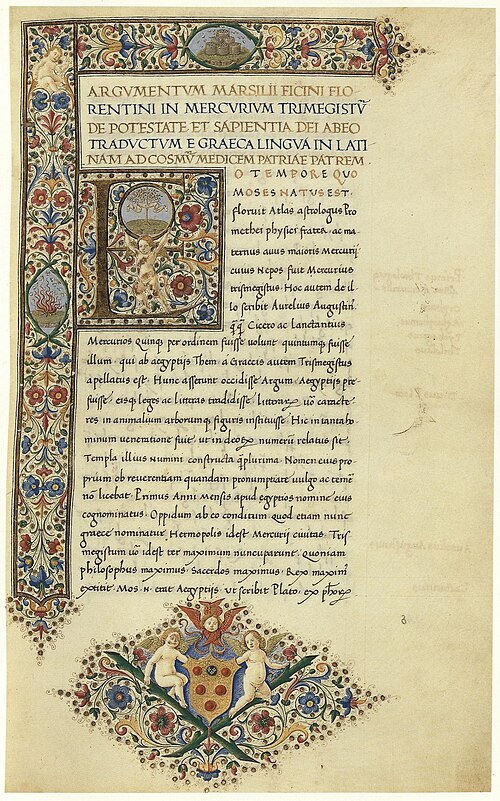
Hermetic writings gained extraordinary attention in Renaissance Europe. In the fifteenth century, Marsilio Ficino translated a Greek collection of Hermetic texts into Latin. At the time, many scholars believed these writings were extremely ancient—older than, or nearly as old as, some of the foundational figures of biblical and Greek tradition.
That belief gave Hermes tremendous prestige. If these texts came from a primordial sage, perhaps they preserved fragments of an original wisdom that had existed near the beginning of civilization.
Later scholarship changed the historical picture. In the early seventeenth century, Isaac Casaubon used linguistic and historical analysis to argue that the philosophical Hermetic writings were products of the early centuries of the Common Era rather than relics from the remote age of Moses.
The texts were younger than Renaissance readers had imagined. But their influence did not disappear.
Does a Later Date Make the Teachings Less Important?
This is where the story becomes especially interesting. Discovering that the Hermetic writings were not as ancient as once believed did not erase the questions they contained.
Who are we beneath the surface of ordinary identity? What is mind? Is the human being simply a small creature inside an enormous universe, or does consciousness participate in reality in a more profound way? Can knowledge change the knower?
Those questions survived because they are not dependent on a legendary date.
The historical correction actually gives us a clearer view. Instead of imagining one mysterious Egyptian master writing everything, we can see Hermeticism as a meeting place where Egyptian religious imagery, Greek philosophy and the spiritual searching of the Hellenistic and Roman worlds came together.
The Divine Mind and the Human Mind
Mind—often expressed through the Greek idea of nous—occupies an important place in Hermetic thought. The texts repeatedly explore the relationship between divine intelligence, the ordered cosmos and the capacity of human beings to awaken to a larger understanding.
This is not neuroscience in ancient clothing, and it should not be presented as if ancient Hermetic writers had discovered modern theories of consciousness. Their framework was philosophical, theological and cosmological.
Yet the question underneath remains recognizable: what is the nature of awareness, and why does the human mind possess the strange ability to turn inward and ask what it is?
That question still sits at the boundary between philosophy, spirituality and modern consciousness research.
Who Was Hermes Trismegistus?
Perhaps the most revealing thing about Hermes Trismegistus is that generations wanted him to have existed.
They wanted there to be an ancient teacher standing near the beginning of history who understood the hidden relationships between mind, nature and cosmos. They wanted wisdom to have a lineage. They wanted the fragments scattered through different traditions to point back toward something whole.
Whether one historical man ever stood behind the name is far less certain than the tradition itself. But the longing represented by Hermes is unmistakably real.
Why Hermes Still Matters
Hermes Trismegistus remains important because the writings and traditions associated with his name helped shape Western esotericism, Renaissance philosophy, alchemical symbolism and later occult thought. His shadow stretches through centuries of attempts to understand correspondences between the inner and outer worlds.
For the modern seeker, the value is not in pretending that every legend is literal history. The mystery becomes richer when we know where history ends and interpretation begins.
Hermes can be approached as a doorway into an extraordinary intellectual and spiritual world—a world in which philosophy was not merely argument, nature was not merely mechanism, and knowledge was expected to transform the person who received it.
The Messenger at the Threshold
The historical Hermes Trismegistus may dissolve when we search for a single biography, but the figure that remains is almost more fitting: a messenger standing between worlds.
Greek and Egyptian. Human and divine. Visible and invisible. Matter and mind. History and myth.
Perhaps that is why Hermes has never completely disappeared. The name belongs to a tradition built around thresholds—and the deepest questions are often found exactly there.
We may never uncover one man behind the legend. But we can still follow the trail of ideas left in his name, asking the same question that has drawn seekers for centuries: what might become visible when we learn to look beyond the surface of things?

$50
Product Title
Product Details goes here with the simple product description and more information can be seen by clicking the see more button. Product Details goes here with the simple product description and more information can be seen by clicking the see more button

$50
Product Title
Product Details goes here with the simple product description and more information can be seen by clicking the see more button. Product Details goes here with the simple product description and more information can be seen by clicking the see more button.
$50
Product Title
Product Details goes here with the simple product description and more information can be seen by clicking the see more button. Product Details goes here with the simple product description and more information can be seen by clicking the see more button.

Comments