What Was Discovered at Nag Hammadi in 1945—and Why Did It Matter?
Updated: Sep 9
Affiliate Disclosure: As an Amazon Associate, Antara Veda earns from qualifying purchases. Some links in this article may be affiliate links, at no additional cost to you.
For centuries, they were gone.
Ancient writings about Jesus, wisdom, creation, the soul, the nature of this world and the possibility of knowing something deeper about ourselves had disappeared from ordinary human reach.
Then, in December 1945, something extraordinary happened in the Egyptian desert.
Near the town of Nag Hammadi in Upper Egypt, a collection of ancient books emerged from the earth.
Among the writings were names that would eventually become familiar to modern seekers:
The Gospel of Thomas.
The Gospel of Philip.
The Gospel of Truth.
The Secret Book of John.
The Thunder, Perfect Mind.
And dozens of other works containing ideas that had survived only partially—or, in some cases, had been known largely through the writings of people who opposed them.
They had remained hidden for more than a thousand years.
Someone had preserved them.
Someone had buried them.
And whoever did so left us no explanation.
That alone creates a mystery.
But the deeper mystery begins when we open the books.
Because inside them we encounter questions that are remarkably difficult to leave in the ancient world.
Who are we?
Where did we come from?
Why do we feel separated from something greater?
What prevents us from seeing reality clearly?
And what might happen if we finally remember what we are?
The discovery at Nag Hammadi did more than add forgotten books to the shelves of history.
It opened a door.
And nearly eighty years later, we are still exploring what lies on the other side.
THE NAG HAMMADI DISCOVERY: WHAT WAS REALLY FOUND?

The story begins near the cliffs of Jabal al-Tarif in Upper Egypt.
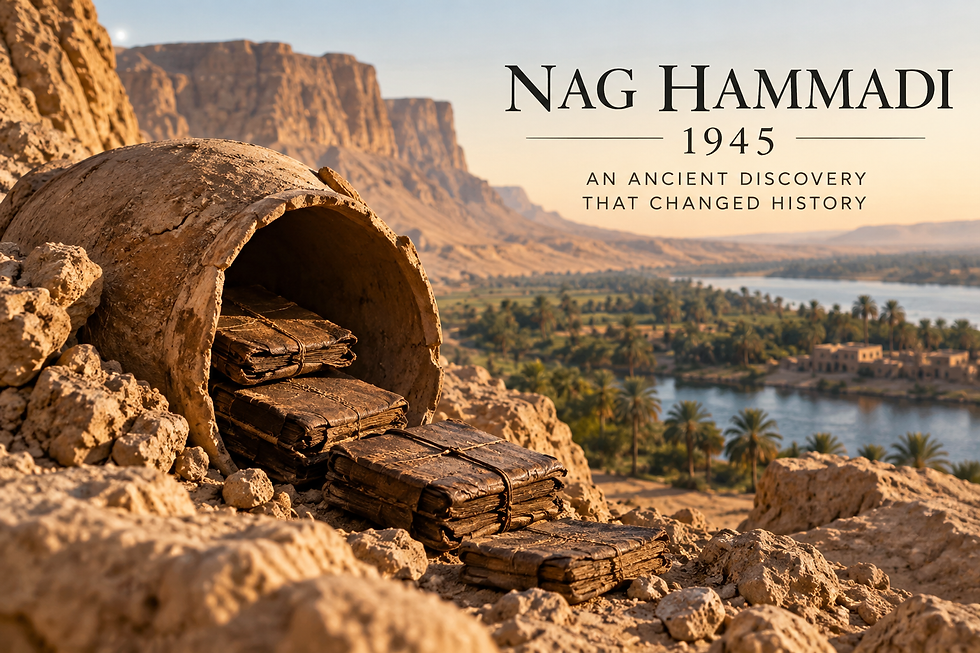
In December 1945, local farmers discovered a large earthenware jar containing ancient papyrus books.
Some details surrounding the discovery have become difficult to separate from later retellings. But what eventually emerged is extraordinary enough without embellishment.
There were thirteen papyrus codices—early forms of bound books—containing more than fifty individual works.
The surviving manuscripts were written primarily in Coptic, an Egyptian language using an alphabet largely derived from Greek.
The physical codices are generally dated to around the fourth century CE.
But the writings inside them are another matter.
Many appear to be Coptic translations of earlier Greek works, meaning at least some of the ideas and texts themselves circulated before the surviving copies were made.
And that leaves us with an important distinction.
The books had been buried in Egypt.
But the ideas inside them had already traveled through an older world.
Who first wrote them?
Who read them?
Who copied them?
What communities treasured them enough to preserve them?
And how did so many of these writings eventually disappear?
Those questions take us much deeper into the story.
WHAT WAS WAITING INSIDE THE JAR?
The Nag Hammadi library is not a single book and does not present one simple system of belief.
It is a collection of different writings gathered into codices.
Some resemble gospels.
Others are dialogues.
Some describe visions or revelations.
Others explore creation, spiritual transformation, prayer, philosophy, wisdom or the nature of the human soul.
Among them are:
The Gospel of Thomas
The Gospel of Philip
The Gospel of Truth
The Apocryphon of John, also called the Secret Book of John
The Sophia of Jesus Christ
The Dialogue of the Savior
The Thunder, Perfect Mind
The Treatise on the Resurrection
The Tripartite Tractate
The Gospel of the Egyptians
The Apocalypse of Peter
…and many others.
They do not all teach the same thing.
And perhaps that makes the discovery even more interesting.
Rather than revealing one neatly organized alternative religion, the books allow us to glimpse a much wider landscape of ancient spiritual thought.
Different writers wrestled with different ideas.
Yet certain questions appear again and again.
What is the true nature of the divine?
What is the true nature of humanity?
Why does the world appear as it does?
Why are human beings ignorant of their origin?
And why is knowledge—not merely information, but a deeper kind of knowing—so important in some of these writings?
These are not small theological disagreements.
They reach directly into the question of human identity.
Explore the Nag Hammadi Texts
For readers who want to explore these writings more deeply, The Nag Hammadi Scriptures, edited by Marvin Meyer, brings the surviving texts together in a comprehensive English-language collection, including the Gospel of Thomas and many of the other writings discussed here.
THE GOSPEL OF THOMAS: WORDS THAT ASK TO BE DISCOVERED
Perhaps the most famous book to emerge from Nag Hammadi is the Gospel of Thomas.
Thomas is unusual.
There is no Christmas story.
No journey through Galilee.
No continuous account of miracles.
No crucifixion narrative.
No resurrection story.
Instead, there are 114 sayings attributed to Jesus.
Some sound remarkably similar to sayings preserved in Matthew, Mark and Luke.
Others are unfamiliar.
Some are simple.
Others can stop a reader in their tracks.
And the collection begins with an intriguing challenge: understanding the meaning of the sayings matters.
That changes the relationship between text and reader.
Thomas does not always explain itself.
It asks something of you.
Seek.
Interpret.
Discover.
Understand.
Again and again, its sayings turn toward seeing what is already present but unnoticed, discovering what is within, becoming whole and knowing oneself.
Which raises a fascinating question:
Why would self-knowledge matter so much in a collection of sayings attributed to Jesus?
That question deserves far more than a paragraph.
It is one of the reasons we are exploring the Gospel of Thomas separately.
THE SECRET BOOK OF JOHN: A VERY DIFFERENT CREATION STORY

Then we encounter something even stranger.
The Apocryphon of John, commonly called the Secret Book of John, presents an elaborate vision of divine reality, creation and the human condition.
Here we find ideas closely associated with some forms of ancient Gnostic thought.
A divine reality exists beyond ordinary description.
From that reality emerge spiritual beings or emanations.
Among them is Sophia—Wisdom.
Then something goes wrong.
A lesser creator emerges and becomes associated with the formation or governance of the material cosmos.
In modern discussions of Gnosticism, this figure is commonly called the Demiurge.
And here the story becomes particularly provocative.
In some versions of this cosmology, the lesser creator does not understand that a greater divine reality exists beyond him.
He believes himself supreme because he does not know what he does not know.
Think about that for a moment.
Power does not necessarily equal wisdom.
Authority does not necessarily equal understanding.
And certainty does not necessarily equal truth.
These are ancient ideas.
But they don't feel entirely ancient.
THE GOSPEL OF PHILIP: OUTWARD RELIGION AND INNER REALITY
The Gospel of Philip takes us in another direction.
Despite its modern title, it isn't a biography of Jesus like the familiar New Testament Gospels.
It reads more like a collection of theological and spiritual reflections.
It explores transformation, symbolism, sacred practices and the relationship between what happens outwardly and what happens within.
It also contains intriguing passages involving Mary Magdalene, passages that have generated considerable debate and speculation.
Some portions of the surviving manuscript are damaged.
Some meanings remain disputed.
And that is precisely why Philip is worth exploring rather than reducing it to a sensational headline.
There is something much more interesting to ask:
What did the people who preserved this writing believe spiritual transformation actually meant?
And why did they distinguish so strongly between outward appearances and inner reality?
THE GOSPEL OF TRUTH: WHAT IF THE PROBLEM IS FORGETTING?
The Gospel of Truth introduces an idea that may be one of the most important threads running through our exploration.
Ignorance.
Not ignorance in the everyday sense of being unintelligent.
Something deeper.
A kind of spiritual forgetting.
Human beings suffer because they do not recognize their true relationship with divine reality.
They have forgotten.
They do not know where they came from.
They do not fully know what they are.
And when knowledge returns, something changes.
Truth awakens.
Ignorance begins to dissolve.
This radically changes the question.
Instead of asking only:
What have human beings done wrong?
we encounter another possibility:
What have human beings forgotten?
And perhaps an even more intriguing question:
What happens when we remember?
SOPHIA: THE MYSTERY OF WISDOM

One of the most captivating figures in some of these ancient cosmologies is Sophia.
Her name means Wisdom in Greek.
But Sophia becomes far more than an abstract concept.
In different writings, she becomes part of an enormous cosmic story involving divine reality, creation, separation and restoration.
The details vary between texts.
But the symbolism is difficult to ignore.
Wisdom.
Separation.
Forgetting.
Remembering.
Returning.
What happens when consciousness becomes separated from its source?
What happens when something incomplete believes itself to be complete?
What happens when we mistake the small world we can see for the entirety of reality?
And what does it mean to return to wisdom?
These questions survived beneath the Egyptian earth for centuries.
Now they are ours to ask again.
THE DEMIURGE: WHAT IF THE RULER DOESN'T KNOW?
Few ideas associated with Gnosticism create as much fascination—or confusion—as the Demiurge.
The word has older roots in Greek philosophy and did not originally have to mean an evil being.
But some writings associated with Gnostic traditions present a lesser creator or ruler of the material cosmos who is ignorant of the higher divine reality beyond him.
In certain accounts, he believes himself to be the highest authority.
Why?
Because he cannot perceive what exists beyond his own level of awareness.
It is an extraordinary idea.
A being could possess tremendous power and still misunderstand reality.
Which means the story is not merely about an ancient supernatural figure.
It presents a question about consciousness itself:
Can we become trapped inside a reality simply because we cannot perceive what lies beyond it?
And if so—
how would we ever know?
WHO BURIED THESE BOOKS—AND WHAT WERE THEY TRYING TO PRESERVE?

This is where history becomes mystery.
We know the codices were hidden.
We know they survived.
We do not know with certainty who placed them there or exactly why.
By the fourth century, Christianity was becoming increasingly institutionalized. Church authorities were debating doctrine, defining acceptable teachings and rejecting writings they regarded as heretical.
Texts could fall outside the boundaries of what religious authorities considered acceptable.
Some scholars have proposed that the Nag Hammadi books may have been associated with monks in the region and concealed during a time when controversial writings were being removed.
Other explanations remain possible.
There is no note buried with the books telling us what happened.
And so a blank space remains in the historical record.
But consider what we do know.
Someone had these books.
Someone gathered them.
Someone placed them where they survived while countless other ancient writings disappeared forever.
Whether the intention was concealment, preservation, protection or something else, the result was remarkable:
the books survived.
And sometimes what survives can tell us almost as much as what disappeared.
HOW DID THESE VOICES DISAPPEAR FROM HISTORY?
This may be the larger question.
Ideas now associated with Gnostic traditions were fiercely opposed by influential early Christian writers.
One of the most famous was Irenaeus, who wrote extensively against teachings he considered heretical.
For centuries, much of what later scholars knew about certain Gnostic groups came through writings like these.
Think about how strange that is.
Imagine that almost everything future generations knew about your beliefs came from someone who had written a book specifically to prove you wrong.
Your opponent's words survive.
Much of your own writing does not.
What picture would history inherit?
This is part of what made Nag Hammadi so extraordinary.
Suddenly, scholars could read substantial ancient writings connected with ideas previously encountered largely through criticism and refutation.
The other voices had returned.
They did not settle every argument.
If anything, they created new ones.
But now we could listen.
And perhaps that is where genuine investigation begins.
WERE THESE REALLY “LOST GOSPELS”?
The phrase “lost Gospels” is dramatic.
But there is some truth hiding inside the popular label.
Not everything discovered at Nag Hammadi is a gospel.
And these books were not simply chapters removed from one original Bible.
The development of early Christianity was much more complicated.
Different communities used different writings.
Some became widely accepted.
Others were disputed.
Some were rejected.
Some disappeared.
Eventually, the collection recognized as the New Testament became established.
But the books that did not become part of that collection did not suddenly become meaningless.
They can still tell us something about the people who wrote them, copied them, read them—and perhaps believed deeply in what they contained.
Some Nag Hammadi writings really were lost to most of the world for centuries.
And finding them allows us to ask questions that would otherwise have been impossible to ask.
WHAT ELSE WAS LOST?
Nag Hammadi also leaves us facing a larger and somewhat haunting question.
If these writings survived because someone placed them in a jar—
what didn't survive?
Papyrus decays.
Libraries burn.
Languages disappear.
Wars destroy cities.
Religious movements rise and fall.
Books are copied—or they aren't.
Authorities preserve some writings and reject others.
Communities disappear.
Ideas survive only if human beings continue carrying them forward.
We will never know how much ancient thought vanished completely.
That doesn't mean every lost teaching contained some extraordinary secret.
But it does mean the historical record we inherited is incomplete.
And once we recognize that, curiosity becomes almost unavoidable.
What are we missing?
WHAT IF WE READ THEM FOR OURSELVES?
Perhaps this is where the Antara Veda journey truly begins.
We don't have to accept every ancient teaching simply because it is old.
And we don't have to reject an unfamiliar idea simply because it falls outside what we were taught.
There is another option.
Read.
Question.
Compare.
Search.
Learn what history can tell us.
Notice where the evidence ends.
Explore the places where scholars disagree.
And then pay attention to the questions the texts awaken inside you.
Because some of the most interesting Nag Hammadi writings do something unusual.
They don't merely ask:
What do you believe?
They ask:
What do you know?
What can you see?
Do you know yourself?
Do you know where you came from?
Those are very different questions.
And nobody can completely answer them for you.
WHAT IF GNOSIS WAS NEVER ABOUT BEING TOLD THE ANSWER?

This brings us back to the idea of gnosis.
Gnosis is usually translated as knowledge.
But in the spiritual traditions we're exploring, the idea can point toward something deeper than collecting facts.
It suggests knowing through experience or recognition.
Knowing rather than merely being told.
And suddenly the mystery of Nag Hammadi becomes more personal.
Perhaps the greatest value of these writings isn't that they give us another ancient authority to follow.
Perhaps it is that they encourage us to look.
To question assumptions.
To examine what we've inherited.
To explore consciousness.
To search ancient wisdom.
And ultimately, to turn the investigation inward.
Because if some of these writers were right about even one thing—that human beings can live without fully knowing what they are—then the greatest mystery isn't buried beneath an Egyptian cliff.
It is us.
THE LIBRARY THAT WAITED
Someone placed those books near the cliffs of Upper Egypt.
Then the world moved on.
Empires rose and disappeared.
Languages changed.
Religions spread across continents.
Kings ruled.
Wars were fought.
Generations were born and died.
And beneath the Egyptian earth, the books waited.
A century passed.
Then another.
Then another.
Until eventually more than a millennium separated the people who had hidden them from the people who would uncover them.
And then, in 1945, human hands held them again.
Words that had been silent for centuries could be read.
Questions that had nearly disappeared could be asked again.
Who are we?
Where did we come from?
What have we forgotten?
What lies beyond what we have been taught to see?
And perhaps most importantly:
What might we discover if we begin searching for ourselves?
Nag Hammadi did not close an ancient mystery.
It reopened one.
And our exploration has only just begun.

$50
Product Title
Product Details goes here with the simple product description and more information can be seen by clicking the see more button. Product Details goes here with the simple product description and more information can be seen by clicking the see more button

$50
Product Title
Product Details goes here with the simple product description and more information can be seen by clicking the see more button. Product Details goes here with the simple product description and more information can be seen by clicking the see more button.
$50
Product Title
Product Details goes here with the simple product description and more information can be seen by clicking the see more button. Product Details goes here with the simple product description and more information can be seen by clicking the see more button.

Comments