Can the Body Know Before the Mind? Intuition, Interoception and the Science of Gut Feelings
Updated: Sep 19
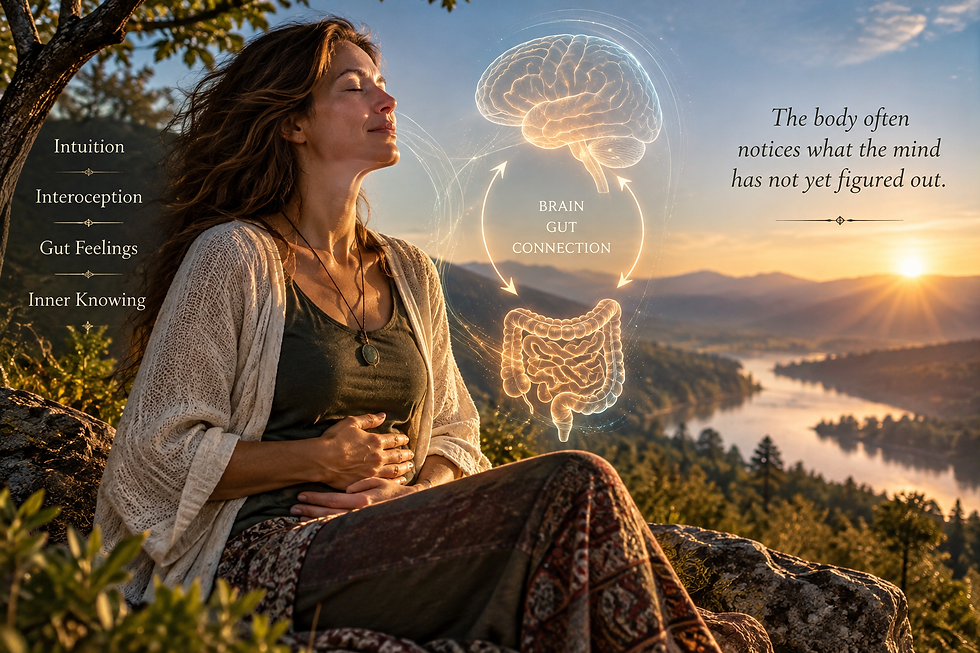
Sometimes the strongest inner signal is not a voice at all. It is a tightening in the stomach, a sudden sense of ease, a heaviness in the chest, a feeling that something is wrong before the conscious mind can explain why—or an unexpected calm around a choice that makes little logical sense at first.
People have described experiences like these for centuries as intuition, instinct, gut feeling or inner knowing. Modern science approaches them through different language: interoception, predictive processing, implicit memory, emotional learning and the brain's continuous interpretation of signals from inside the body.
The two perspectives are not automatically the same. But their meeting point opens one of the most interesting questions in inner work: when the body seems to know something before conscious thought does, what exactly are we experiencing?
The Body Is Always Sending Information
The brain does not experience the body from a distance. It is continually receiving information about heart rate, breathing, digestion, muscle tension, temperature, energy needs and countless other internal processes.
Our perception of these internal signals is known as interoception. Much of it happens outside deliberate awareness, yet it contributes to emotion, motivation and our sense of how we feel from moment to moment.
A racing heart may become part of the experience we call anxiety. A relaxed breath and softened muscles may accompany a sense of safety. Hunger, fatigue and hormonal changes can alter mood and perception before we consciously identify the physical cause.
The body is not simply carrying the mind around. Body and brain are engaged in continuous conversation.
Why a Gut Feeling Can Arrive Before an Explanation
Imagine entering a familiar situation and immediately feeling uneasy. Nothing obvious has happened. Minutes later, you notice a small detail—a tone of voice, a pattern of behavior, a change in the environment—that helps explain the reaction.
One possibility is that the nervous system detected meaningful cues before conscious reasoning assembled them into a story.
The brain is exceptionally good at pattern recognition. Past experience can teach it associations that operate rapidly and automatically. A bodily response may therefore appear before we can verbalize what triggered it.
This does not make every gut feeling correct. But it helps explain why some forms of intuition can feel immediate.
Interoception: The Science of Feeling From Within
Interoception is sometimes described as our sense of the internal body. It includes awareness of signals associated with heartbeat, breathing, fullness, thirst, temperature and other physiological states.
Researchers increasingly recognize that interoception is deeply involved in emotion and self-awareness. What we call a feeling is not produced by thought alone; bodily information contributes to the experience.
This gives a scientific foundation to something contemplative traditions have emphasized for a very long time: paying attention inward can reveal information that is easy to miss when attention remains entirely in the thinking mind.
Science does not establish that bodily sensations provide supernatural knowledge. It does show that conscious reasoning is not our only source of information about what is happening within us.
Intuition and Pattern Recognition
Some intuition may emerge from expertise.
A highly experienced nurse may sense that a patient is deteriorating before being able to identify a single decisive measurement. A skilled craftsperson may know that something is wrong by sight or feel. Someone who has spent years navigating a particular environment may recognize a pattern almost instantly.
These judgments can seem mysterious because the underlying learning has become partly automatic.
The mind has encountered enough examples that it no longer needs to consciously calculate every step.
This kind of intuition is not opposed to experience. It may be experience compressed into a feeling.
But Fear Can Feel Like Intuition Too
The difficulty is that fear, conditioning and intuition can all produce strong bodily signals.
As we explored in Hidden Patterns of the Mind, learned expectations can operate outside conscious awareness. An old pattern may activate because the present resembles something from the past, even when the situations are not actually the same.
A racing heart does not automatically mean danger. A sense of resistance does not always mean a path is wrong. Sometimes discomfort appears precisely because we are doing something unfamiliar.
This is why inner wisdom requires discernment.
How Do We Tell the Difference?
There is no perfect formula for separating intuition from fear, but observation over time can reveal patterns.
Fear often arrives with urgency, repetition and imagined catastrophe. It may demand certainty immediately. Intuitive impressions are sometimes described as quieter and simpler—a clear sense without the long chain of anxious explanation.
That distinction is not a scientific rule, and individual experiences vary. The more useful practice is to become curious rather than instantly obedient.
What happened just before the sensation appeared? Does the feeling remain when the nervous system settles? Is there evidence supporting it? Have similar signals been reliable in the past? Does the feeling point toward careful observation or simply toward escape?
Discernment develops through relationship with our own patterns.
The Heart, the Gut and the Brain
Popular spiritual language sometimes describes the heart or gut as though each contains a separate mind. Biology is more complicated.
The digestive system contains an extensive enteric nervous system and communicates bidirectionally with the brain. The heart also sends physiological information that participates in the body's regulatory systems. These relationships are real and scientifically interesting.
But phrases such as thinking with the heart or trusting the gut are metaphors when they imply that these organs reason independently in the way a brain does.
Their deeper usefulness may be experiential: they remind us that cognition is embodied. Our experience of knowing is not confined to an abstract stream of words in the head.
Ancient Practices of Listening Within
Long before the term interoception existed, contemplative traditions developed practices centered on observing breath, sensation and internal states.
Meditation, yogic practices and other forms of inward attention often ask practitioners to notice what is occurring without immediately reacting to it.
The traditional explanations for these practices vary enormously and should not be collapsed into modern neuroscience. Yet the shared act of careful inward observation creates an intriguing bridge between ancient practice and contemporary study.
Both recognize that awareness can become more refined when attention is trained.
Inner Knowing Is Not the Same as Impulse
This distinction matters deeply for inner knowing.
If every impulse is treated as guidance, we may simply rename habit as intuition. If every uncomfortable sensation is interpreted as a warning, fear can quietly become an oracle.
Listening within requires more, not less, self-awareness.
We learn our recurring reactions. We notice which sensations accompany anxiety, exhaustion, excitement and genuine recognition. We compare impressions with what actually unfolds. Over time, the internal landscape becomes less mysterious—not because mystery disappears, but because we become more familiar with the language of our own body and mind.
Where Consciousness Enters the Mystery
Interoception can help explain how bodily signals contribute to conscious feeling. Pattern recognition can explain why some judgments arise quickly. Predictive processing can help describe how prior experience influences perception.
But these explanations lead back to a larger unresolved question: why is any of this experienced from the inside at all?
As explored in What Is Consciousness?, neuroscience can study correlations between brain activity and experience without yet providing a universally accepted explanation for subjective awareness itself.
We can map signals traveling through the nervous system. The mystery is that those signals become felt experience—a flutter of unease, a wave of calm, a sense of recognition, the unmistakable feeling of being here.
Learning the Language of Your Own Signals
The goal is not to turn every sensation into a message.
It is to become more attentive.
When a strong inner signal appears, we can notice it before constructing an explanation. Where is it felt? What changed? What thought accompanied it? What does the body do when the feeling passes?
Journaling can help reveal patterns that memory alone misses. Meditation can create a small space between sensation and reaction. Simple pauses can allow an initial surge of emotion to settle enough for other information to emerge.
These practices do not guarantee perfect intuition. They build familiarity with the territory.
The Wisdom Beneath Words
We live in a culture that privileges explanation. If we cannot immediately say why we know something, we may assume the impression has no value.
But the mind and body process more information than conscious language can continuously narrate.
Sometimes an impression is wrong. Sometimes it reflects an old wound. Sometimes it is a rapid recognition built from experience. And sometimes we may not yet have enough information to know what it is.
That uncertainty is not a failure of inner wisdom. It is part of discernment.
The deeper practice is learning to listen without immediately believing, dismissing or dramatizing what we hear.
The body may not be an infallible oracle. But neither is it silent.
Between sensation and thought, memory and prediction, instinct and awareness, something is continually speaking in a language older than words.
Learning to recognize that language may be one of the quietest paths back to ourselves.

$50
Product Title
Product Details goes here with the simple product description and more information can be seen by clicking the see more button. Product Details goes here with the simple product description and more information can be seen by clicking the see more button

$50
Product Title
Product Details goes here with the simple product description and more information can be seen by clicking the see more button. Product Details goes here with the simple product description and more information can be seen by clicking the see more button.
$50
Product Title
Product Details goes here with the simple product description and more information can be seen by clicking the see more button. Product Details goes here with the simple product description and more information can be seen by clicking the see more button.


Comments