Prana, Qi and Ki: Are Ancient Traditions Describing the Same Life Energy?
Updated: Sep 20

Long before the word Reiki was spoken, human beings were already describing life through something invisible.
In India, traditions spoke of prana. In China, qi became woven into philosophy, medicine and cultivation practices. In Japan, the related concept of ki entered many ways of understanding vitality, mind, body and disciplined practice.
Today these words are often grouped together as if they all mean exactly the same thing: life-force energy. The resemblance is real, but the history is more complex—and more interesting.
What did prana, qi and ki actually mean within their own traditions? Are they descriptions of one universal phenomenon, different cultural maps of human experience, or ideas that cannot be translated cleanly into the language of modern science?
The Human Search for Vitality
Across history, people noticed a simple mystery: a living body is not merely a collection of parts.
It breathes, responds, heals, moves, feels and eventually dies. Before modern physiology could explain oxygen exchange, cellular metabolism, electrical signaling or circulation, cultures developed other ways of describing what seemed to animate life.
Vital-energy concepts became part of several sophisticated philosophical and healing traditions. They were not simply primitive substitutes for electricity. They belonged to broader systems concerned with health, consciousness, breath, environment, ethics and spiritual development.
What Is Prana?
Prana is a Sanskrit term with deep roots in Indian religious and philosophical traditions. It is closely associated with breath and life, but its traditional meaning extends beyond the air entering the lungs.
Early Indian texts developed increasingly complex ideas about prana as a vital principle involved in living processes. Later yogic traditions described movements or functions of prana within the body and practices intended to regulate it.
This is where pranayama—the disciplined use of breath—enters the story.
Modern yoga classes sometimes translate pranayama simply as breathing exercises. Traditionally, however, breath was understood as intimately related to prana, making the practice both physiological and spiritual.
Breath as a Bridge
Breath occupies an unusual boundary between voluntary and automatic function.
Most of the day, breathing continues without conscious direction. Yet we can deliberately slow it, deepen it, hold it or change its rhythm.
Modern physiology shows that breathing patterns can influence autonomic processes and subjective states. Slow breathing practices, for example, can affect arousal and heart-rate dynamics.
That does not prove prana is identical to a measurable respiratory variable. It does show why breath would have become such a powerful doorway into inner practice long before modern laboratories existed.
What Is Qi?
Qi is one of the most important and difficult-to-translate concepts in Chinese thought.
It has been interpreted as breath, vapor, vital energy, material force and other terms depending on historical period and philosophical context. No single English word captures every use.
Qi became important within Chinese medicine, Daoist traditions, martial arts and practices such as qigong.
Traditional Chinese medicine describes patterns of qi in relation to organs, channels, balance and health. Daoist cultivation traditions developed their own sophisticated approaches to breath, movement, attention and internal transformation.
Qi Is Not Simply Electricity
A common modern explanation says qi is just the body's electrical energy.
That is too simple.
The body certainly uses electrical signals. Neurons communicate through electrochemical processes, the heart has measurable electrical activity, and muscles depend on electrical excitation.
But traditional qi is not historically equivalent to the modern scientific concept of bioelectricity. Translating one directly into the other changes the meaning of both.
There may be interesting areas of overlap between traditional practices and measurable physiology, but resemblance is not identity.
What Is Ki?
Ki is the Japanese reading of the same Chinese character commonly rendered as qi in Mandarin.
As Chinese philosophical and religious ideas entered Japan over centuries, concepts surrounding ki became part of Japanese culture and developed within Japanese contexts.
The word appears in many compounds and expressions, reflecting ideas connected with spirit, disposition, atmosphere, vitality and attention.
For Reiki, ki is especially important because it appears directly in the practice's name.
Where Reiki Fits
As explored in What Is Reiki Energy?, Reiki developed in early twentieth-century Japan through Mikao Usui.
Its energetic worldview did not emerge in a cultural vacuum. Usui lived in a society where ideas involving ki, spiritual cultivation and Buddhist practice already had long histories.
But Reiki should not be projected backward thousands of years as though the modern Usui system existed unchanged in antiquity.
The system has a particular modern history even though the ideas surrounding vitality and spiritual energy are much older.
Are Prana, Qi and Ki the Same?
They are often presented as three names for one universal life force.
That interpretation is understandable, particularly from a comparative spiritual perspective. Each concept has been associated with life, vitality and practices involving body and breath.
Historically, however, prana developed within Indian traditions while qi and ki developed within Chinese and Japanese cultural worlds. Their philosophical systems, practices and technical meanings are not interchangeable.
It is more accurate to say they occupy related territory than to insist they are identical.
What About Chakras and Meridians?
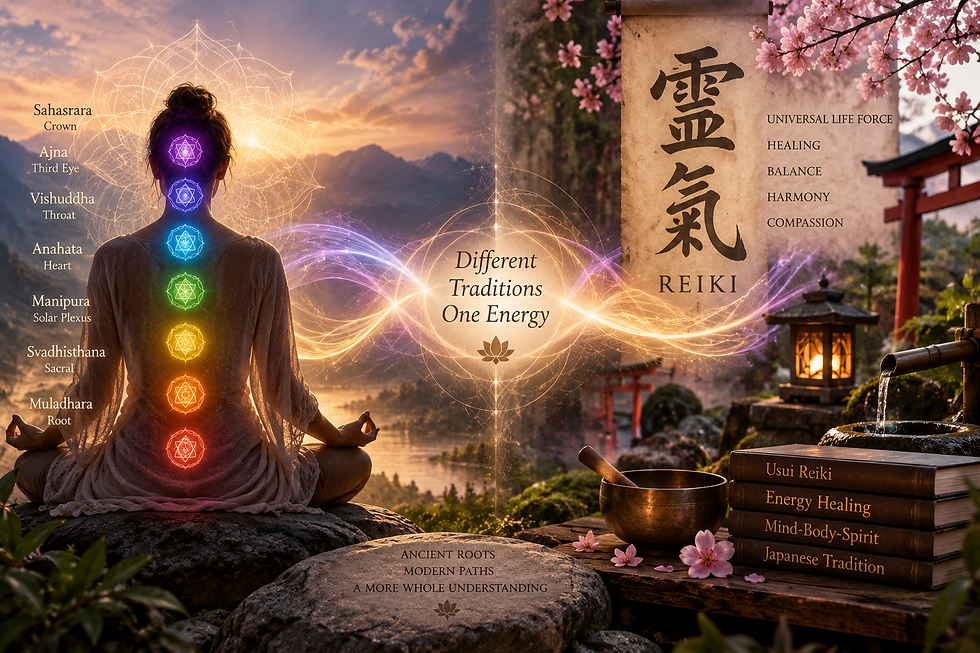
Modern holistic culture frequently combines chakras, meridians, prana, qi and Reiki into one energetic anatomy.
Historically, these maps come from different traditions.
Chakra systems developed within South Asian religious and yogic traditions. Meridian or channel theories belong to Chinese medical traditions. Reiki arose in Japan much later.
Contemporary practitioners may intentionally combine them, and that can become a meaningful modern practice. But the combination should not be mistaken for one ancient system that originally contained all of them.
What Can Science Measure?
Modern science can measure many processes that older cultures could not.
We can observe electrical activity in the heart and brain. We can measure respiration, blood flow, muscle activity, temperature, hormones and metabolic processes. We can study how breathing, meditation, movement and social interaction influence physiology.
What science has not established is a distinct prana, qi or ki field as a physical energy that can be reliably measured in the way we measure electromagnetic radiation or heat.
That is an important boundary between traditional frameworks and established physical science.
Does That Make the Old Systems Meaningless?
No.
A traditional map can contain useful observations without every part of its explanatory framework translating directly into modern scientific categories.
Breath practices can affect physiology. Tai chi and qigong involve movement, attention, balance and breathing. Yoga can influence strength, flexibility, stress and awareness. Reiki sessions may involve stillness, touch, expectation and human presence.
Science can investigate those components while remaining agnostic about metaphysical claims it cannot demonstrate.
The Danger of Forcing Science Onto Spiritual Traditions
Sometimes spiritual ideas are made to sound more credible by attaching scientific vocabulary to them.
Prana becomes bioelectricity. Chakras become endocrine glands. Reiki becomes electromagnetism. Quantum physics is invoked as proof of distant healing.
These translations may sound persuasive, but they often claim connections that have not been scientifically established.
The irony is that forcing ancient concepts into modern scientific language can make the traditions less interesting, not more.
Prana does not need to secretly mean electrons in order to deserve historical and philosophical study.
The Opposite Mistake
There is another error: assuming that because traditional energy cannot currently be measured as a physical force, every practice built around it is therefore useless or imaginary.
Human experience is more complicated than that.
A practice may influence attention, emotion, breathing, behavior, social connection or the mind-body relationship even when its traditional explanation differs from a biomedical one.
People can also find genuine spiritual meaning in a framework without that meaning functioning as laboratory evidence.
Energy as Lived Experience
When people say they feel energy, they may be describing many different experiences.
Warmth. Tingling. Expansion. Tension. Calm. Emotional intensity. A sense of another person's presence. A shift in breathing. An atmosphere in a room that seems to change when someone enters.
Some of these experiences can be investigated through sensory processing, interoception, autonomic physiology and social perception.
We explored this boundary in Can We Feel Another Person's Energy?.
Traditional energy language may organize these sensations differently than neuroscience does.
Interoception: The Inner Sense
Interoception is the nervous system's processing of signals from within the body.
Heartbeat, breathing, gut sensations, temperature and other internal signals contribute to how we feel at any given moment.
As explored in Can the Body Know Before the Mind?, we do not consciously perceive every internal signal directly. The brain integrates them into broader feelings and impressions.
This creates an intriguing meeting point. A traditional practitioner may describe a shift in energy while neuroscience examines changes in internal sensation and regulation.
Those descriptions are not necessarily saying the same thing—but they may sometimes be looking at the same human moment from different directions.
Why Ancient Energy Ideas Persist
Prana, qi and ki have survived not because ancient people had access to modern measuring instruments, but because the concepts were embedded in practices people continued to find meaningful.
Breathing. Meditation. Movement. Healing rituals. Martial disciplines. Contemplation. Attention to the body.
These practices create experiences, and experiences invite interpretation.
Every culture develops language for what it repeatedly encounters.
The Mystery Behind the Word Energy
Modern science gives energy a precise definition. Spiritual traditions often use the word more broadly to describe vitality, presence or an unseen dimension of life.
Confusion begins when one definition is used as proof of the other.
But curiosity begins when we allow each framework to speak clearly.
The ancient practitioner asks: What animates life? How does breath change awareness? Why does balance matter? What happens when attention becomes disciplined?
The scientist asks: What can we measure? Which mechanisms are involved? Can an effect be repeated? What alternative explanations exist?
Both sets of questions can deepen our understanding when neither is forced to impersonate the other.
Life Between the Maps
Perhaps prana, qi and ki continue to fascinate us because they point toward something human beings have always sensed: being alive feels different from merely describing the chemistry of life.
Science can reveal astonishing details about cells, nerves, breath and brain activity. Traditional systems offer inherited maps for experiencing vitality from the inside.
We should not claim those maps have been scientifically proven when they have not.
But we also do not need to throw away centuries of human inquiry simply because its language is unfamiliar.
Somewhere between the measurable body and the lived experience of being alive lies the territory these traditions have been exploring for a very long time.
And that territory remains worth searching.

$50
Product Title
Product Details goes here with the simple product description and more information can be seen by clicking the see more button. Product Details goes here with the simple product description and more information can be seen by clicking the see more button

$50
Product Title
Product Details goes here with the simple product description and more information can be seen by clicking the see more button. Product Details goes here with the simple product description and more information can be seen by clicking the see more button.
$50
Product Title
Product Details goes here with the simple product description and more information can be seen by clicking the see more button. Product Details goes here with the simple product description and more information can be seen by clicking the see more button.

Comments