What Is Reiki Energy? The Tradition, the Experience and What Science Can Actually Measure
Updated: Sep 20
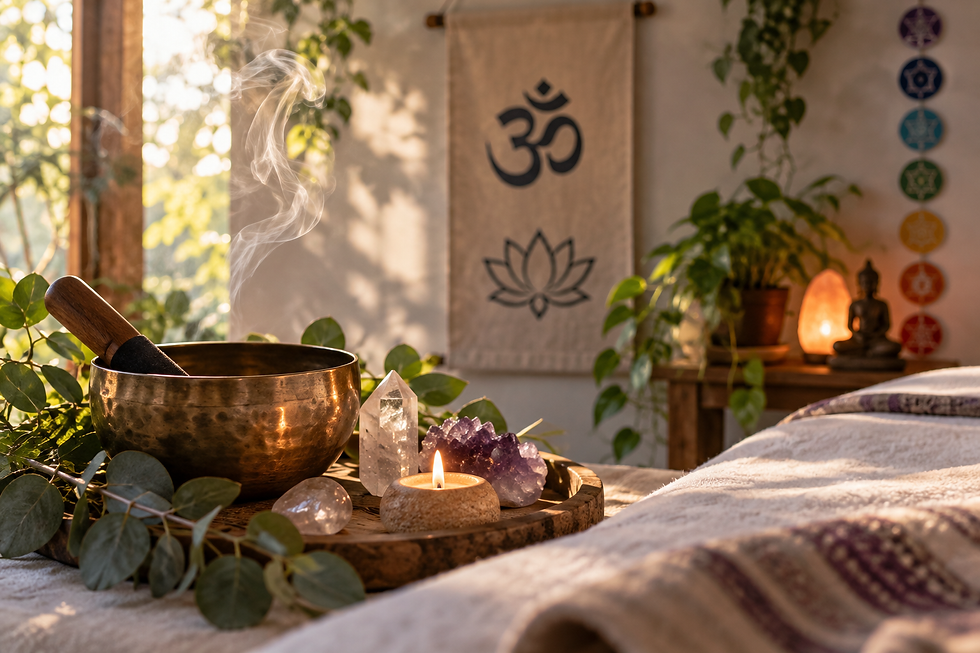
Reiki is often introduced with a simple phrase: energy healing. But behind those two words is a practice with a specific history, a set of rituals and techniques, and a much larger question about how human beings understand healing, presence and the unseen.
For some people, a Reiki session feels deeply calming. Others describe warmth, tingling, emotional release or a sense of quiet they rarely experience in ordinary life. Practitioners traditionally understand these experiences through the movement or balancing of universal life energy.
Modern science asks different questions. What happens to stress, attention and the nervous system during a session? What role do touch, expectation, environment and human connection play? And what, if anything, can research say about the energy Reiki practitioners describe?
Where Reiki Came From
The modern system known as Reiki developed in Japan in the early twentieth century through Mikao Usui. Later teachers helped transmit and adapt the practice, including Chujiro Hayashi and Hawayo Takata, whose teaching played an important role in Reiki's spread in the West.
The history is sometimes surrounded by stories that changed as Reiki moved between cultures. What remains central is a practice involving focused presence, hand positions or hands held near the body, and a traditional understanding of life energy.
Reiki is therefore modern compared with many ancient healing systems, even though it draws on ideas about vital energy that have much older parallels in Asian traditions.
What Does the Word Reiki Mean?
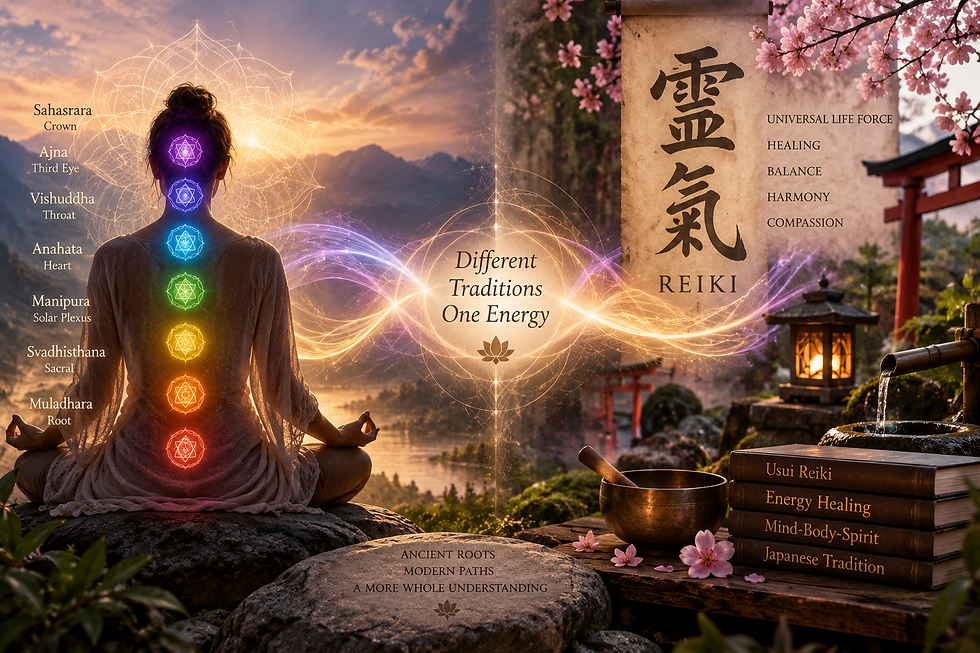
Reiki is commonly translated through the Japanese words rei and ki. Translations vary with context, but the practice is generally associated with a universal or spiritual dimension of life energy.
Ki belongs to a broader family of East Asian concepts concerning vitality and life force. Similar-sounding comparisons are often made with Chinese qi and Indian prana, although these concepts arose within different traditions and should not be treated as identical.
For practitioners, Reiki is not merely a metaphor for relaxation. The energetic framework is part of the tradition itself.
What Happens During a Reiki Session?
A typical session is quiet and noninvasive. The recipient remains clothed while the practitioner places the hands lightly on or just above different areas of the body.
There is usually little physical manipulation. The environment may be calm, with subdued lighting and minimal conversation.
People report a wide range of sensations: warmth, coolness, tingling, heaviness, lightness, drifting imagery, emotion or simply deep rest. Some feel very little physically and still find the session peaceful.
These subjective experiences are real as experiences. Determining what mechanism produces them is a separate question.
The Traditional Explanation: Life Energy
Within Reiki, practitioners traditionally understand healing through the flow of life energy rather than through conventional anatomy or physiology.
The practitioner is generally described not as supplying personal energy but as facilitating or channeling Reiki.
This framework belongs to the practice's spiritual and energetic worldview. Modern biomedical science has not established Reiki energy as a measurable physical force equivalent to electricity, heat or electromagnetic radiation.
That distinction matters, but it does not require dismissing the practice or the experiences people have during it.
What Has Science Studied?
Clinical research has examined Reiki in areas such as anxiety, pain, stress, quality of life and well-being. Some studies and reviews have reported promising changes in particular outcomes, while the overall evidence base has limitations that include small samples, differences in study design and challenges in creating convincing placebo or sham comparisons.
Because of those limitations, Reiki should not be presented as a proven treatment for disease or as a replacement for appropriate medical care.
A more careful conclusion is that researchers have found enough interest in relaxation, comfort and symptom-related outcomes to continue asking questions, while claims about a distinct healing energy remain scientifically unconfirmed.
Why Relaxation Matters
Relaxation is sometimes treated as though it were a trivial explanation.
It is not.
Stress involves real changes in attention, emotion and physiology. A setting that helps someone feel safe enough to release muscular tension, slow breathing and step out of constant vigilance can be meaningful.
Our exploration of the mind-body connection looked at how psychological states and bodily processes continuously influence one another. Deep rest is part of that relationship.
The Power of Focused Presence
A Reiki session also contains something increasingly rare: sustained, quiet attention.
The recipient is not expected to perform, explain or solve anything. Another person is simply present and attentive.
Human nervous systems are highly responsive to social context. As explored in Can We Feel Another Person's Energy?, another person's voice, movement, predictability and presence can influence our internal state.
That does not prove Reiki's energetic explanation. It does show that human presence itself is biologically and psychologically significant.
Touch Without Manipulation
When Reiki includes light touch, touch may contribute another layer to the experience.
Gentle, welcomed touch can carry social and emotional meaning. The nervous system processes touch not only as physical pressure but in relation to context, safety and relationship.
Reiki can also be practiced with hands above the body, so touch cannot explain every reported experience. Still, separating the components of a session helps us understand why studying Reiki scientifically is difficult.
The practice is not one isolated variable. It is an experience composed of attention, ritual, expectation, environment, relationship and, according to its tradition, energy.
Expectation Does Not Mean Imaginary
When expectation contributes to an experience, people sometimes hear that as a polite way of saying it was all in your head.
That misunderstands expectation.
Placebo research shows that context and expectation can influence real subjective and physiological processes in some circumstances. The brain's predictions help shape pain, emotion and perception.
If expectation contributes to relaxation during Reiki, that contribution is still part of a real mind-body response.
It simply does not, by itself, establish the existence of a separate energy field.
Why People May Feel Heat or Tingling
Warmth and tingling during Reiki can have multiple possible explanations.
Hands naturally emit heat. Attention can make subtle bodily sensations more noticeable. Changes in posture, relaxation and circulation may alter what someone feels. Expectation can influence which sensations receive attention.
A practitioner may interpret those sensations energetically, while a scientist may describe them through sensory and physiological mechanisms.
The same experience can therefore sit inside two very different explanatory maps.
Reiki as a Ritual of Attention
Ritual is another word that is often misunderstood.
Calling something ritual does not mean it is fake. Ritual structures attention and meaning. Human beings use ritual around birth, death, healing, grief, transition and spiritual practice in nearly every culture.
A Reiki session creates a deliberate boundary around time: this period is set aside for stillness, care and inward attention.
That structure may itself change how a person experiences the body and mind.
Reiki and Inner Awareness
Quiet sessions can also make internal signals easier to notice.
Breathing, tension, emotion and imagery that disappear beneath ordinary distraction may become more apparent when the environment grows still.
This connects with interoception and intuition—the broader question of how awareness of the body contributes to our inner experience.
Whether those sensations are interpreted as energy movement, nervous-system shifts or simply deeper awareness depends partly on the framework a person brings to the session.
What Reiki Can and Cannot Claim
Reiki can be approached as a complementary practice for relaxation, reflection and personal spiritual experience.
It should not be used to promise cures, diagnose illness or persuade someone to abandon needed medical treatment.
Those boundaries do not strip Reiki of meaning. They allow the practice to be explored without asking it to prove something it has not scientifically demonstrated.
There is room between unquestioning belief and automatic dismissal.
The Question of Energy Remains
Science is exceptionally good at measuring phenomena that can be reliably detected, quantified and tested.
Traditional energetic systems speak in a different language, one shaped by lived experience, spiritual philosophy and inherited practice.
At present, Reiki's proposed life energy has not been established as a measurable physical energy by mainstream scientific methods. That is an important fact.
It is also true that scientific understanding of consciousness, perception and the complex effects of human interaction remains incomplete.
Uncertainty should not be turned into proof—but neither does it end curiosity.
Where Reiki Meets the Antara Veda Path
Reiki belongs naturally at the meeting place between inner experience and modern inquiry.
Its traditional language asks us to consider energy, intention and healing presence. Science asks us to examine nervous-system regulation, expectation, touch, attention, relationship and measurable outcomes.
Those questions do not have to compete.
We can preserve the traditional meaning of Reiki while being clear about what research has and has not demonstrated. We can value a person's experience without turning every sensation into scientific evidence. And we can investigate mechanisms without assuming that mechanism automatically explains away meaning.
The Quiet Space Between Explanation and Experience
Perhaps part of Reiki's enduring appeal lies in something simple.
For a while, there is nothing to achieve.
The body can become still. Attention turns inward. Another person holds a calm and intentional space. Sensations appear and disappear. Thoughts slow enough to be noticed.
A practitioner may call what moves through that space Reiki. A researcher may look for changes in stress, attention or physiology.
The experience itself happens before either explanation is complete.
And that may be the most interesting place to begin: not with the demand that mystery and science cancel one another out, but with the willingness to look carefully at what happens when healing becomes an act of presence.

$50
Product Title
Product Details goes here with the simple product description and more information can be seen by clicking the see more button. Product Details goes here with the simple product description and more information can be seen by clicking the see more button

$50
Product Title
Product Details goes here with the simple product description and more information can be seen by clicking the see more button. Product Details goes here with the simple product description and more information can be seen by clicking the see more button.
$50
Product Title
Product Details goes here with the simple product description and more information can be seen by clicking the see more button. Product Details goes here with the simple product description and more information can be seen by clicking the see more button.

Comments