How to Practice Self-Reiki: A Simple Ritual for Energy, Grounding and Inner Awareness
Updated: Sep 20
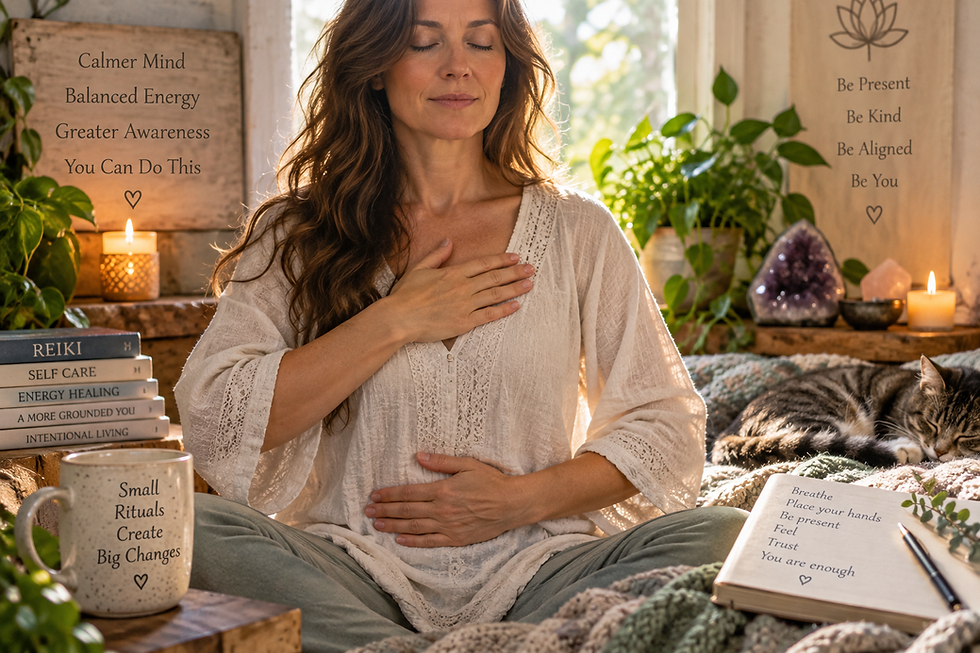
Reiki is often pictured as something one person gives to another. Yet one of its most accessible forms requires no treatment table, appointment or second person at all.
Self-Reiki turns the practice inward. The hands rest gently on the body, attention becomes quieter, and for a few minutes the usual outward pull of the day is interrupted.
Within Reiki tradition, this is a way of working with Reiki energy for one's own balance and well-being. From another perspective, it is also a structured practice of touch, body awareness, stillness and attention.
Those two ways of understanding the experience do not have to erase each other.
Self-Reiki Is Part of the Practice, Not an Afterthought
Reiki training has long included practices that students can use on themselves. This matters because Reiki was never only about becoming a practitioner who treats other people.
The system associated with Mikao Usui also emphasized personal cultivation and daily principles.
Self-practice fits that larger idea: the practitioner is not separate from the work.
What Does Self-Reiki Look Like?
There is no need to create a complicated ritual.
A person may sit or lie somewhere comfortable and place the hands gently on different areas of the body. Common positions include the head, chest, abdomen and other places that feel natural and comfortable.
The hands may remain in each position for several minutes, or move when it feels appropriate.
Some lineages teach particular sequences. Others encourage a more intuitive approach after foundational training.
What Are You Supposed to Feel?
There is no required sensation.
Some people notice warmth, tingling, pulsing or heaviness. Others become sleepy. Some feel emotionally quiet, while others notice thoughts becoming louder before they settle.
And some people feel almost nothing unusual.
None of these experiences proves that a session worked or failed.
Our exploration of Reiki sensations in the hands looked at how heat, attention, interoception and expectation can contribute to what people notice.
Why Touching Your Own Body Can Feel Grounding
Self-touch provides the nervous system with clear sensory information.
A hand resting on the chest or abdomen creates pressure, warmth and a defined point of attention. Instead of awareness scattering across dozens of thoughts, it has somewhere physical to return.
This may be one reason simple hand placements can feel grounding even outside Reiki.
The effect does not require forcing the mind to become blank. The hand itself becomes an anchor.
Attention Is Part of the Practice
Modern life trains attention to jump.
Messages arrive. Tabs remain open. Thoughts compete. The nervous system is asked to switch repeatedly between tasks, worries and stimuli.
Self-Reiki reverses that pattern for a short period.
Instead of searching for the next thing, attention returns to one place: hands, body, breath, sensation.
That is deceptively simple.
The Nervous System and the Structured Pause
As discussed in Can Reiki Calm the Nervous System?, quiet, predictable conditions can support a shift away from sustained arousal.
Self-Reiki creates several of those conditions at once. The person chooses the setting. The touch is predictable. There is no social demand. Breathing may naturally slow.
Science has not established that a unique Reiki energy is responsible for autonomic changes, but the practice contains recognizable ingredients of relaxation and self-regulation.
A Simple Self-Reiki Practice
Choose a place where you can be reasonably undisturbed. Sit supported or lie down. There is no need to create a perfect spiritual atmosphere.
Place both hands somewhere comfortable—perhaps over the upper chest or abdomen.
Let the hands rest rather than press.
Notice their weight and temperature. Notice the movement of breath beneath them. If thoughts appear, they do not need to be stopped. Let attention return gently to the physical contact.
After several minutes, move the hands if you wish.
The practice can last five minutes or much longer. Consistency matters more than creating an impressive session.
What About Intention?
Intention is important in many Reiki traditions.
It can be understood spiritually as opening to Reiki or directing the practice toward healing and balance. Psychologically, intention also organizes attention: it tells the mind what this period is for.
An intention does not have to be a demand.
Instead of I must fix this feeling, it can be as simple as I am giving myself ten quiet minutes to listen.
Listening Instead of Forcing
Self-Reiki becomes less useful when every sensation is treated as a puzzle that must be decoded.
A warm hand does not need an elaborate explanation. A sudden emotion does not automatically reveal a hidden energetic blockage. A restless session does not mean something went wrong.
The practice can be observational rather than diagnostic.
What is here right now?
That question belongs naturally beside the Antara Veda exploration of inner knowing.
Self-Reiki and Body Awareness
When attention becomes quiet, the body often becomes more noticeable.
Tension in the jaw. A shallow breath. Tightness across the shoulders. Fatigue that activity had hidden. A heartbeat that seemed absent from awareness moments before.
This increased awareness is related to interoception—the processing of signals from within the body.
Noticing these signals does not mean every sensation carries a mystical message. But learning to recognize one's internal state can support greater self-awareness.
Can Self-Reiki Help With Stress?
People may find self-Reiki calming, and the structure of the practice includes elements known to influence subjective stress: stillness, focused attention, gentle touch and a temporary reduction in external demands.
That is different from claiming self-Reiki has been proven to treat anxiety disorders, trauma or other medical conditions.
A personal relaxation practice can be valuable while still having appropriate boundaries.
What About Emotional Release?
Some people cry, remember something unexpected or feel emotion surface during quiet practices.
Reiki traditions may interpret this through energetic release. Psychology offers other possibilities: reduced distraction can make existing emotions more noticeable, and body-focused attention can bring feelings into awareness.
Whatever framework is used, there is no requirement to manufacture catharsis.
A peaceful session is not shallow, and an emotional session is not automatically deeper.
Self-Reiki Before Sleep
Evening is a natural time for self-Reiki because the practice does not require alert performance.
Hands can rest on the body while lying in bed, allowing the session to gradually become sleep if that is what happens.
The value is partly behavioral: instead of ending the day with more stimulation, the person creates a quieter transition.
Self-Reiki should not become another task to complete perfectly before sleep. Its usefulness lies in reducing effort, not adding pressure.
Self-Reiki in the Morning
Morning practice has a different quality.
Rather than winding down, a few quiet minutes can create a deliberate beginning before the day's demands arrive.
The Reiki precepts traditionally emphasize the phrase just for today. Morning self-practice pairs naturally with that idea.
The entire future does not have to be solved. Attention begins with this day.
Does Self-Reiki Require Attunement?
Traditional Reiki schools generally teach that Reiki practice is transmitted through training and an initiation or attunement process from a Reiki teacher.
Someone who has not received Reiki training can still place their hands on the body, breathe, rest and practice mindful self-touch. Those actions do not need to be called Reiki in order to be beneficial as a contemplative exercise.
Respecting that distinction preserves the integrity of the Reiki tradition while recognizing that many of its basic conditions—stillness, attention and gentle self-contact—are universally available.
What Science Has Not Established
Scientific research has not demonstrated that self-Reiki channels a distinct measurable life-force energy through the hands.
That means we should not present energetic mechanisms as established physical facts.
But science can investigate components of the experience: attention, touch, expectation, breathing, relaxation and changes in perceived stress.
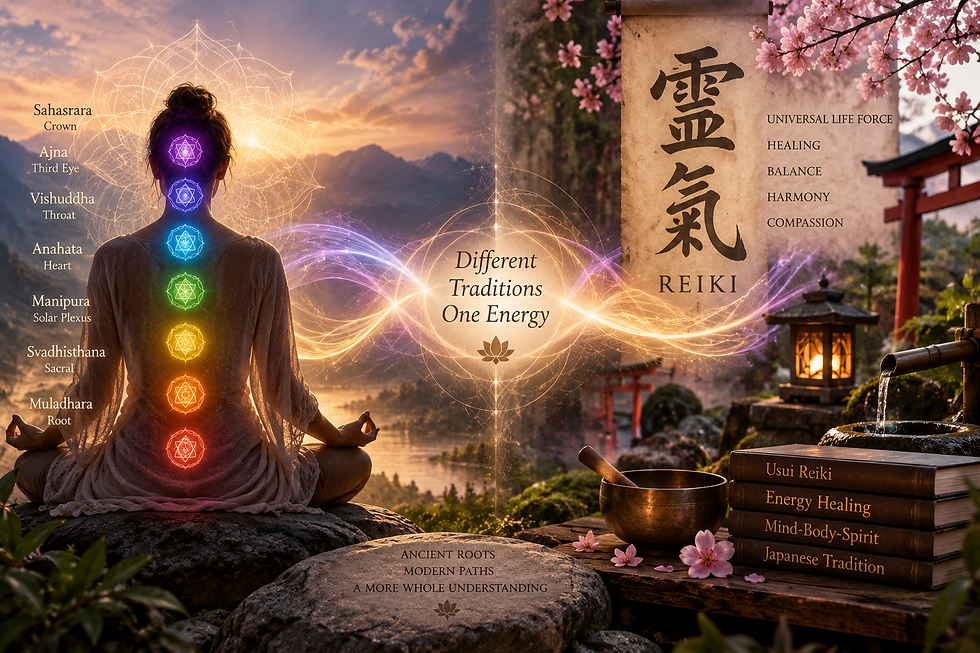
As with prana, qi and ki, traditional energy language and modern scientific measurement are different maps.
The Practice Does Not Need to Become a Test
One of the easiest ways to lose the quiet of self-Reiki is to spend the entire session asking whether it is working.
Do I feel enough heat? Is the energy moving? Did my hands tingle? Am I relaxed yet?
Those questions pull attention back toward performance.
A different approach is to allow the session to be an encounter rather than an experiment in success.
Notice what happens. Let the result remain open.
Creating a Personal Ritual
Ritual becomes powerful through repetition and meaning, not complexity.
A particular chair, a few minutes after waking, hands over the heart before sleep or a short practice after returning home can become a signal: the outward day is stopping for a moment.
Over time, the ritual itself may make settling easier because the brain learns associations.
The practice becomes familiar territory.
When Self-Care Becomes Self-Attention
Self-care is often marketed as something we buy, schedule or add to an already crowded life.
Self-Reiki suggests something quieter.
For a few minutes, nothing new is added.
The hands rest. The body is noticed. The breath continues. Attention stops reaching outward.
Whether a person understands that moment as Reiki energy, nervous-system regulation, meditation, prayerful presence or some combination of these, the act itself carries a simple message.
I am here enough to notice myself.
And sometimes that is where healing begins—not with forcing the body to change, but with becoming present enough to hear what has been there all along.

$50
Product Title
Product Details goes here with the simple product description and more information can be seen by clicking the see more button. Product Details goes here with the simple product description and more information can be seen by clicking the see more button

$50
Product Title
Product Details goes here with the simple product description and more information can be seen by clicking the see more button. Product Details goes here with the simple product description and more information can be seen by clicking the see more button.
$50
Product Title
Product Details goes here with the simple product description and more information can be seen by clicking the see more button. Product Details goes here with the simple product description and more information can be seen by clicking the see more button.


Comments