Can Reiki Calm the Nervous System? Stress, the Vagus Nerve and the Science of Deep Rest
Updated: Sep 20
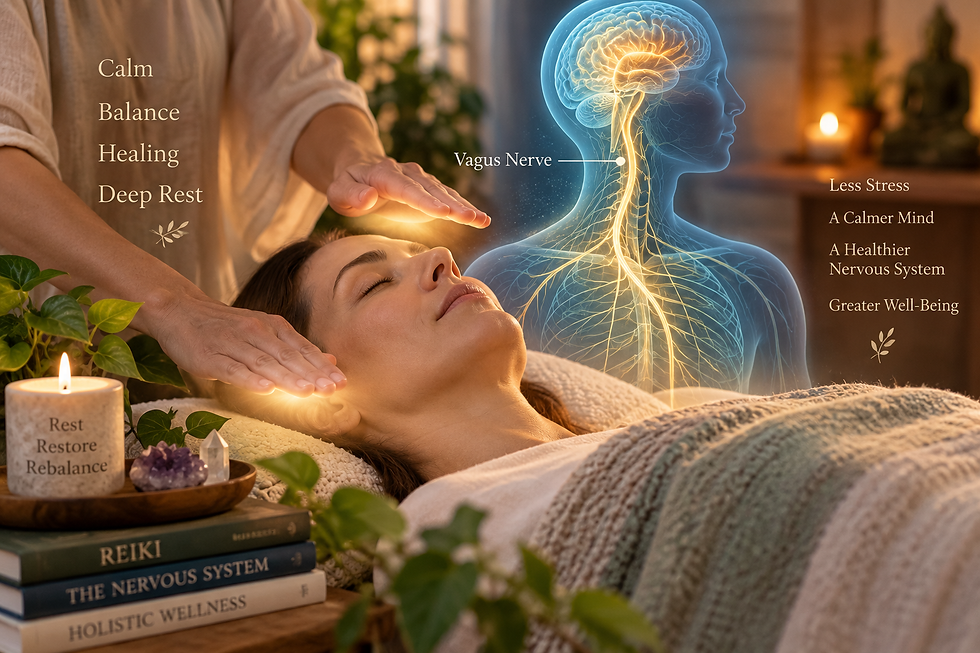
A Reiki session can look almost motionless from the outside. Someone lies quietly while a practitioner rests their hands lightly on the body or holds them just above it. There may be no massage, no vigorous movement and very little conversation.
Yet people often describe leaving the session feeling different: calmer, heavier, lighter, sleepy, emotionally open or simply quieter inside.
Reiki tradition explains the practice through life energy. Modern physiology offers another doorway into the experience—the autonomic nervous system, the network that continually adjusts the body to safety, effort, uncertainty and threat.
Can Reiki actually calm the nervous system? The answer requires separating what researchers can measure from what Reiki tradition believes is happening energetically.
The Nervous System Never Really Switches Off
Even while we are resting, the nervous system is constantly regulating the body.
Heart rate changes. Breathing adjusts. Blood vessels constrict and relax. Digestion shifts. Muscles prepare for movement or release tension. Attention turns toward or away from possible threats.
Much of this happens without conscious instruction.
The autonomic nervous system is one important part of this regulation.
Sympathetic and Parasympathetic Are Not Simple On-Off Switches
The autonomic nervous system is often explained through two major branches: sympathetic and parasympathetic.
The sympathetic branch supports mobilization and is involved in responses to challenge, effort and threat. The parasympathetic branch contributes to functions associated with rest, digestion and recovery.
Popular wellness language sometimes reduces these to stress mode versus healing mode. Real physiology is more complex. Both systems are active in changing patterns, and sympathetic activity is not inherently bad.
We need mobilization to stand up, exercise, focus and respond to life.
The problem is not activation itself. It is what can happen when the body has difficulty returning from prolonged or repeated states of high arousal.
Why Quiet Environments Matter
A typical Reiki session removes many of the demands that keep attention externally engaged.
There is usually no screen to watch, problem to solve or conversation to manage. Lighting may be soft. The recipient is supported physically and given permission to remain still.
Those conditions alone can make it easier for arousal to decrease.
The environment does not prove an energetic mechanism, but it is part of the experience and should not be ignored when asking why Reiki may feel calming.
What Happens to Breathing
When people settle into relaxation, breathing often becomes slower and less effortful.
Breathing is especially interesting because it is both automatic and voluntarily adjustable. Changing the rhythm of breath can influence subjective arousal and aspects of autonomic regulation.
This creates a feedback loop: feeling safer can change breathing, and deliberate slower breathing can sometimes help support a calmer state.
A Reiki recipient may enter this loop without being instructed to perform a formal breathing exercise.
The Heart and Autonomic Regulation
Heart rate is not perfectly regular. The intervals between beats vary, and that variation contains information about autonomic regulation.
Heart-rate variability, or HRV, is frequently discussed in wellness settings. Certain HRV measures can reflect aspects of parasympathetic influence, but interpretation depends on breathing, age, posture, health, measurement method and many other factors.
A single HRV number should not be treated as a spiritual score or a complete measurement of nervous-system health.
Still, heart-rate dynamics give researchers one way to investigate physiological changes during relaxation practices.
Does Reiki Change Heart Rate or HRV?
Some Reiki studies have examined physiological outcomes, including heart rate, blood pressure and autonomic measures. Individual studies have reported changes under particular conditions, but the evidence is not strong or consistent enough to say that Reiki has a unique, reliably established effect on autonomic physiology beyond other components of a calming session.
Small samples, varying methods and difficulties designing convincing sham-Reiki controls make the research challenging.
The careful conclusion is not that nothing happens.
It is that the specific cause of any measured change remains difficult to isolate.
Touch and the Social Nervous System
When Reiki uses light, welcomed touch, the nervous system receives more than pressure against the skin.
Touch occurs inside a social context. Who is touching us, whether we trust them, whether the touch is expected and whether we feel free to stop the interaction all influence how it is experienced.
Supportive human contact can affect emotion and arousal. Reiki sessions may therefore involve both sensory and relational processes.
This connects with our exploration of human connection and synchrony.
What About Hands Held Above the Body?
Reiki does not require direct touch. Practitioners may hold their hands above the body.
That means touch cannot explain every reported response.
But non-touch sessions still contain many other ingredients: focused attention, ritual, expectation, quiet, body awareness, relationship and the physical presence of another person.
The practitioner and recipient may interpret the experience through Reiki's energetic framework, while a researcher attempts to separate these components experimentally.
The Brain Is Constantly Asking: Am I Safe?
The brain continuously evaluates sensory and contextual information for relevance and possible threat.
This evaluation does not always become a conscious thought. A sudden noise can change heart rate before we decide what it was. A tense expression can alter our state before a word is spoken.
The opposite can happen too. Predictability, gentle movement, a familiar environment and respectful attention can reduce uncertainty.
A Reiki session often contains many of those cues.
The Vagus Nerve and Wellness Claims
The vagus nerve is a major cranial nerve involved in parasympathetic regulation and communication between the brain and internal organs.
It has become extremely popular in wellness culture, where nearly every calming practice is sometimes said to stimulate or reset the vagus nerve.
That language often goes beyond what a specific study has demonstrated.
Relaxation practices can influence autonomic state, and parasympathetic processes involve vagal pathways. But it is more accurate to describe the whole regulatory system than to claim that Reiki has been proven to directly reset the vagus nerve.
Polyvagal Theory and Reiki
Polyvagal theory is frequently used by therapists and wellness practitioners to describe experiences of safety, connection, shutdown and mobilization.
Some of its ideas have been influential in trauma-informed practice, while aspects of the theory's anatomical and evolutionary claims remain debated among scientists.
Reiki practitioners may find the language of safety and regulation useful, but polyvagal theory should not be presented as settled proof of how Reiki works.
The broader observation—that social context and perceived safety can influence bodily state—is supported by multiple areas of psychophysiology.
Why People Sometimes Fall Asleep
Falling asleep during Reiki is common enough to be unsurprising.
A quiet room, reclining posture, reduced stimulation and relaxation can all increase sleepiness. People who have been carrying sustained stress may notice fatigue more clearly once external demands disappear.
Sleep is not evidence that someone received more Reiki than another person.
It may simply mean the conditions allowed the body to stop working so hard to remain alert.
Why Emotions Can Surface
Relaxation does not always feel peaceful at first.
When distraction decreases, emotions or memories that were easier to ignore during activity may become more noticeable. Focused body awareness can also bring attention to tension, sadness or unease.
A Reiki practitioner may describe this as energetic release. Psychology may describe changes in attention, emotional processing or state-dependent awareness.
Neither label should be used to pressure someone into believing that every emotional response has one predetermined meaning.
What Does 'Release' Actually Mean?
Wellness language often speaks of the body releasing stored stress or trauma.
People can certainly experience changes in muscular tension, emotion and autonomic arousal. But claims that a specific emotion is literally stored in a particular organ or that a treatment physically releases trauma from tissue require more caution.
The body and memory are deeply interconnected, but metaphor should not be mistaken for established anatomy.
A person can feel a genuine sense of release without needing an exaggerated biological explanation.
Reiki and the Mind-Body Connection
The nervous-system perspective fits naturally with the broader mind-body connection.
Thoughts influence physiology. Bodily states influence emotion and cognition. Social environments influence both. Attention changes perception.
A Reiki session brings many of these processes into the same quiet space.
That makes it scientifically interesting even before the question of subtle energy is resolved.
Where Reiki Energy Fits Into This
Within Reiki itself, practitioners do not generally describe the practice as merely a relaxation technique.
They understand Reiki through the movement or availability of life energy. The system's history and philosophy matter, as we explored in the story of Mikao Usui.
Modern science has not established Reiki energy as a measurable physical force.
But identifying nervous-system mechanisms that may contribute to a session does not require practitioners to abandon the traditional meaning they find in the practice.
Calm Is Not the Same as Cure
If Reiki helps someone relax, that can be worthwhile.
But relaxation should not be transformed into a promise that Reiki can cure medical conditions because it places the body into a healing state.
The body does carry out many restorative processes during rest and sleep, but disease is complex and often requires specific medical treatment.
Reiki is better understood as complementary rather than as a replacement for needed care.
Can You Practice Reiki for Self-Regulation?
Self-Reiki creates many of the same conditions that other contemplative practices use: stillness, deliberate attention, gentle contact and time away from external demands.
Someone may place their hands comfortably on the body, breathe naturally and notice sensation without trying to force a particular result.
Whether interpreted energetically or through nervous-system regulation, the practice can become a structured pause.
The value may lie partly in repetition. The body and mind learn through patterns.
What We Can Say With Confidence
We know that stress and relaxation involve real physiological processes. We know breathing, attention, touch, expectation and social context can influence experience and autonomic state. We know Reiki sessions often contain several of those elements.
We also know the current evidence does not allow us to claim that a unique Reiki energy has been scientifically demonstrated as the cause of nervous-system changes.
Holding both statements at once gives us a clearer picture than either unquestioning certainty or reflexive dismissal.
The Space Where the Body Softens
Perhaps one reason Reiki remains meaningful is that it creates something modern life often removes: a deliberate interval in which nothing is demanded.
No answer has to be produced. No screen needs attention. The body is allowed to become quiet enough for subtle changes to be felt.
Science can measure pieces of that transition—heart rate, breathing, muscle activity, subjective anxiety and other variables.
Reiki tradition gives the transition another language: energy, balance and healing presence.
We do not yet have to force those languages into one explanation.
For now, the most interesting observation may be the simplest one.
When the conditions of safety, stillness and attention change, the human body changes with them.

$50
Product Title
Product Details goes here with the simple product description and more information can be seen by clicking the see more button. Product Details goes here with the simple product description and more information can be seen by clicking the see more button

$50
Product Title
Product Details goes here with the simple product description and more information can be seen by clicking the see more button. Product Details goes here with the simple product description and more information can be seen by clicking the see more button.
$50
Product Title
Product Details goes here with the simple product description and more information can be seen by clicking the see more button. Product Details goes here with the simple product description and more information can be seen by clicking the see more button.

Comments