Reiki Symbols Explained: Their Meaning, History and the Mystery Behind the Sacred Signs
Updated: Sep 20
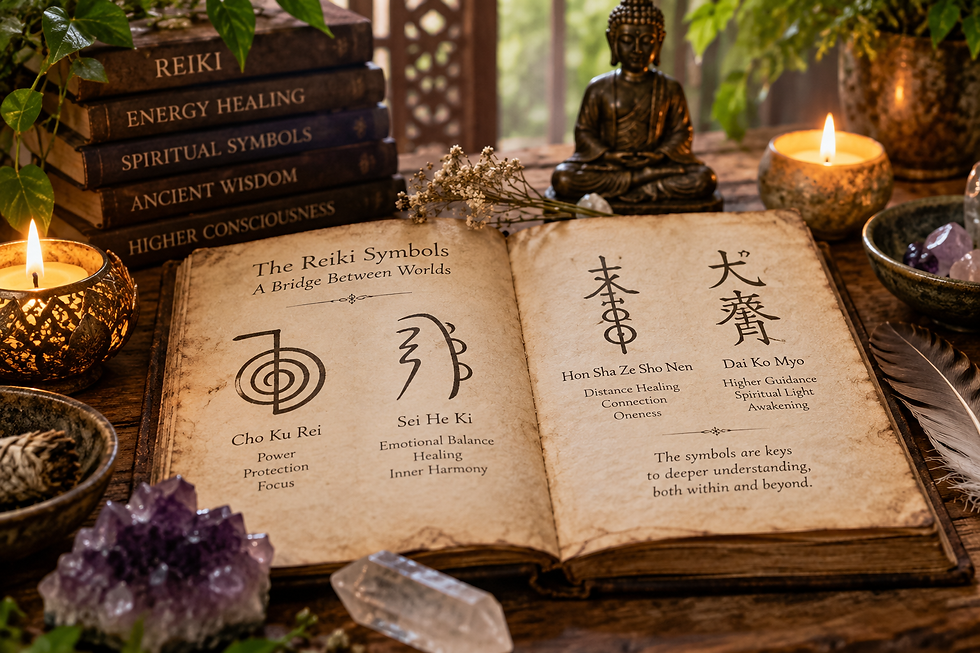
Walk into almost any modern Reiki course and you will eventually encounter a set of graceful symbols drawn in the air, traced over the hands or visualized during practice.
To many people they are the most mysterious part of Reiki.
The symbols are often associated with ideas such as power, emotional balance, distance and spiritual connection. Some lineages once treated their forms and names as private teachings, revealed only after a student reached a particular level of training.
But where did Reiki symbols come from? What were they intended to do, and why did secrecy become part of their story?
Reiki Symbols Explained: How the Symbols Enter Reiki Through Training
Reiki symbols are most strongly associated with later levels of Usui-derived Reiki training rather than with a beginner's first experience of the practice.
Students traditionally learn particular forms, names and ways of using them from a teacher. The exact presentation varies by lineage.
This variation matters. Reiki has traveled across countries and generations, and symbols have sometimes been drawn, pronounced or explained differently.
There is therefore no single modern presentation that captures every Reiki school.
Were the Symbols Secret?
In many Western Reiki lineages, students were instructed not to show the symbols to people who had not received the corresponding attunement or initiation.
The secrecy helped mark them as sacred teachings rather than ordinary illustrations.
Over time, however, Reiki books, websites and training materials made the symbols widely visible. Today anyone can find common versions online.
The fact that a symbol can be seen publicly does not mean every lineage understands its use in the same way.
Why Sacred Traditions Use Restricted Teachings
Reiki is not unusual in linking certain teachings to stages of initiation.
Religious and esoteric traditions across cultures have sometimes reserved prayers, names, diagrams, rituals or contemplative practices for students who had completed particular preparation.
Restriction can serve several purposes. It may protect sacred meaning, create a structured learning process or signal that a teaching is meant to be practiced rather than merely collected.
It can also create mystery and authority, which is why historical discernment remains useful.
Cho Ku Rei and the Idea of Power
One of the best-known Reiki symbols is commonly called Cho Ku Rei, although spellings and interpretations vary.
In modern Reiki teaching it is often described as a power symbol and used with the intention of strengthening or focusing Reiki practice.
Its visual form is commonly drawn as a line and spiral-like pattern.
Practitioners may use it at the beginning of a session, over an area of the body, in a room or as part of personal practice.
These uses belong to Reiki tradition; science has not established that drawing the symbol increases a measurable healing-energy field.
Sei He Ki and Emotional-Mental Practice
Another widely taught symbol is Sei He Ki.
It is often associated with mental and emotional balance, harmony and work involving habitual patterns or difficult feelings.
Some practitioners incorporate it when their intention is emotional support rather than focusing primarily on physical sensation.
The symbol should not be treated as a substitute for mental-health treatment when someone needs professional care.
Within spiritual practice, however, it can function as a powerful focus for intention and reflection.
Hon Sha Ze Sho Nen and Distance Reiki
Perhaps the most intriguing symbol is the one commonly associated with distance Reiki: Hon Sha Ze Sho Nen.
It is used in many lineages when practitioner and recipient are not physically together.
This raises one of Reiki's largest questions. If Reiki can be offered across distance, what exactly is being transmitted, and how would such an effect operate?
Traditional Reiki answers through its energetic framework. Modern science has not established a physical mechanism by which a Reiki symbol transmits a therapeutic force across distance.
That makes distance Reiki a subject where personal experience, spiritual belief and scientific evidence must be carefully distinguished.
Dai Ko Myo and the Master Level
Dai Ko Myo is commonly associated with Reiki master training, although forms and teachings differ among schools.
It is often described in spiritual terms connected with illumination, mastery or deeper connection to Reiki.
The concept of mastery in Reiki does not necessarily mean someone has reached spiritual perfection. Traditionally it marks a level of training and, in many systems, the ability to initiate or teach others.
The title can therefore be understood as responsibility rather than status.
Are Reiki Symbols Ancient?
Reiki symbols are sometimes described as extremely ancient sacred symbols rediscovered by Mikao Usui.
That claim is difficult to establish historically in the sweeping form in which it is sometimes repeated.
Individual forms or words may have relationships to Japanese writing, Buddhist material or older cultural sources, but the Reiki system in which they are used belongs to the modern tradition that developed around Usui and his successors.
An older influence is not the same as proof that the complete modern symbol system existed unchanged for thousands of years.
A Symbol Is More Than Its Shape
Suppose someone copies a Reiki symbol perfectly from a book.
Have they learned Reiki?
Traditional practitioners would generally say no.
Within Reiki, the symbol belongs to a larger practice involving teaching, intention, initiation, repetition and lineage. Its significance is not contained in geometry alone.
This is similar to many sacred forms. A written mantra is not identical to years of mantra practice. A musical score is not the same as music performed by someone who has learned to hear it.
Symbols and the Human Mind
Modern psychology offers another interesting way to understand why symbols can feel powerful.
Human beings are extraordinarily responsive to symbolic meaning.
A wedding ring is physically a small object, yet it can carry years of memory and commitment. A national flag is fabric, but it can evoke identity and emotion. A religious icon can immediately change someone's internal state.
Meaning becomes attached through learning, repetition, culture and experience.
Reiki symbols can function in this way even before we ask whether they have an independent energetic effect.
Symbols as Attention Cues
A trained practitioner may associate a particular Reiki symbol with a specific intention or state of practice.
Drawing or visualizing it can therefore act as an attention cue.
The symbol says, in effect: now I am entering this mode of practice.
Repeated associations can become strong. The mind learns what follows the cue.
That psychological mechanism does not prove or disprove Reiki's energetic interpretation. It explains one way symbols can influence experience through known processes.
Intention, Expectation and Ritual
Reiki symbols often bring three elements together: intention, expectation and ritual.
The practitioner knows what a symbol has been taught to represent. Drawing it focuses intention. Repetition gives the action ritual structure. Expectation shapes attention toward certain sensations or meanings.
As explored in What Is Reiki Energy?, these components can influence human experience even though they do not demonstrate a separate measurable energy force.
Why the Symbols Can Feel Different After Attunement
Practitioners sometimes report that a Reiki symbol feels different after it has been formally taught or connected with an attunement.
Within Reiki, this may be understood as energetic activation or transmission through lineage.
Psychology offers additional possibilities. Ceremony increases salience. A trusted teacher gives the symbol meaning. Expectation changes. Attention becomes more precise. The student begins practicing repeatedly.
These explanations can coexist as different interpretations of the same turning point, but only the psychological components currently have established mechanisms that science can readily investigate.
What Is a Reiki Attunement?
Attunement—sometimes called initiation—is a ritual through which a Reiki teacher introduces a student to a level of practice.
Methods differ between lineages, and teachers may understand the process in different ways.
Energetically, it is often described as opening or strengthening the student's connection with Reiki. Socially and ritually, it also marks entry into a teaching lineage.
The importance of lineage is part of what connects modern practitioners back through teachers such as Chujiro Hayashi and Hawayo Takata toward Usui.
Can Science Test a Symbol?
In principle, specific claims can be tested.
If drawing one Reiki symbol produces a measurable effect that does not occur with a visually similar control symbol, researchers could design blinded experiments to investigate that claim.
The challenge is separating the symbol from practitioner expectation, recipient expectation, ritual context and other variables.
At present, there is not robust scientific evidence demonstrating that Reiki symbols themselves generate unique measurable physical energies.
Does That Make Them 'Just Psychological'?
The phrase just psychological often hides an assumption that meaning is somehow unreal.
Yet meaning changes human experience constantly.
A memory can accelerate the heart. A familiar song can produce tears. A word can change attention. A ritual can mark a transition so powerfully that someone remembers it for decades.
The brain and body respond to meaning because meaning is part of human biology and culture.
Recognizing that does not settle Reiki's spiritual claims, but it prevents us from dismissing symbolic practice as meaningless simply because part of its influence may involve the mind.
The Difference Between Symbol and Magic Formula
Reiki symbols can become distorted when presented as magical codes that guarantee a particular result.
That turns a contemplative and energetic practice into a kind of spiritual vending machine: draw the correct shape and receive the desired outcome.
The older Reiki emphasis on practice, ethics and personal cultivation suggests something more demanding.
A symbol may focus practice, but it does not remove the need for discernment, responsibility or ordinary action.
Should Reiki Symbols Still Be Treated With Respect?
Public availability does not eliminate sacred meaning.
A person can acknowledge that the symbols are easy to find while still respecting the traditions and teachers through which they are transmitted.
Respect does not require inventing historical claims. It can mean learning context, avoiding careless promises and recognizing that a symbol carries different significance for someone who has practiced with it for years than for someone seeing it for the first time.
The Hidden Language of Practice
Symbols are one of humanity's oldest ways of carrying more meaning than words alone can hold.
They compress memory, intention, identity and experience into a form that can be recognized almost instantly.
Reiki symbols do this within a particular spiritual tradition.
A scientist may ask whether the marks themselves produce measurable effects. A practitioner may ask how the symbol changes the quality of attention and energy during practice.
Those questions are not identical.
What the Symbols Point Toward
Perhaps the deepest mistake would be to become so fascinated with the shapes that we forget what they are meant to serve.
Reiki is not a collection of secret drawings.
Its symbols exist inside a larger path of attention, intention, healing practice and personal cultivation.
The mystery is therefore not simply hidden in the lines traced by the hand.
It lies in what happens when a symbol that once meant nothing becomes connected with years of practice—until a few movements of the hand can call an entire inner state into awareness.
That transformation, whether understood through energy, psychology or both, tells us something profound about the human capacity to give form to the unseen.

$50
Product Title
Product Details goes here with the simple product description and more information can be seen by clicking the see more button. Product Details goes here with the simple product description and more information can be seen by clicking the see more button

$50
Product Title
Product Details goes here with the simple product description and more information can be seen by clicking the see more button. Product Details goes here with the simple product description and more information can be seen by clicking the see more button.
$50
Product Title
Product Details goes here with the simple product description and more information can be seen by clicking the see more button. Product Details goes here with the simple product description and more information can be seen by clicking the see more button.


Comments