William Walker Atkinson: Mind Power, The Kybalion and the Hidden History of New Thought
Updated: Sep 19
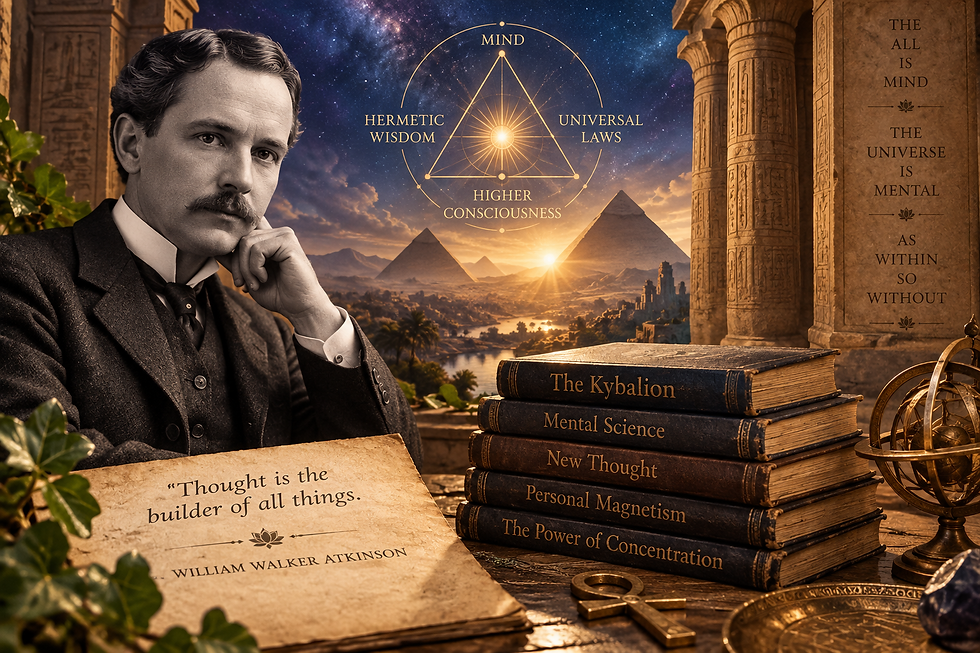
Before manifestation became a modern industry, before the language of mindset filled bookshelves and social media feeds, a quiet experiment was already underway. Writers and teachers were asking whether the mind could be deliberately trained—and whether changing thought might change the direction of a life.
Few people explored that territory as prolifically as William Walker Atkinson. His name is far less familiar today than some of the ideas he helped circulate. Yet his books reached into New Thought, personal magnetism, mental influence, yoga, occult philosophy and the mysterious text known as The Kybalion.
To follow Atkinson is to enter a fascinating crossroads in the history of inner wisdom: a place where nineteenth-century mind-power movements met Eastern philosophy, Western esotericism and the emerging culture of self-development.
Who Was William Walker Atkinson?
William Walker Atkinson was born in Baltimore in 1862. He trained as a lawyer and built a professional life, but later accounts of his career describe a period of severe physical, emotional and financial difficulty in the 1890s. Atkinson subsequently became deeply involved in New Thought and credited a change in his mental outlook with helping transform his circumstances.
By the beginning of the twentieth century, he had become an extraordinarily productive writer and editor. He was associated with New Thought magazines and produced books under his own name as well as several pseudonyms.
That use of pseudonyms makes his legacy unusually difficult to untangle. Atkinson wrote as Theron Q. Dumont and Yogi Ramacharaka, among other names, and scholars and bibliographers have attributed additional works to him with varying degrees of certainty.
The New Thought World Atkinson Entered
Atkinson belonged to the wider New Thought movement, which had already begun exploring relationships among belief, healing, thought and spiritual law.
But his work had a particularly practical flavor. He wrote about concentration, will, memory, personal influence and what he called thought force. The mind was not something to leave unattended. It could be trained.
This places him near writers such as James Allen, who emphasized thought and character, while also pointing toward later teachers who would place even greater emphasis on imagination, assumption and subconscious belief.
What Did He Mean by Thought Force?
Atkinson wrote during an era fascinated by invisible forces. Electricity, magnetism, radio waves and other discoveries were changing how people imagined the unseen world. Spiritual and metaphysical writers often borrowed this new language when describing the mind.
Atkinson sometimes spoke of thought almost as though it radiated outward as a force. He discussed mental influence, personal magnetism and the possibility that concentrated thought could affect other people or circumstances.
These ideas should be understood in their historical context. Modern science has not established a literal thought force operating in the way many early metaphysical writers proposed.
Yet beneath the metaphysical language is a question that remains relevant: what happens when attention becomes focused rather than scattered?
The Lost Art of Concentration
Atkinson considered concentration one of the foundations of mental power. A person whose attention continually jumps from one impulse to another, he argued, has difficulty directing thought toward any sustained purpose.
That observation feels unexpectedly modern. Our environment now competes for attention through notifications, advertising, endless scrolling and rapidly changing information. The ability to remain with a single thought or task can feel almost unusual.
Modern cognitive science approaches attention differently from Atkinson, but it confirms that attention is selective and limited. What we attend to influences what information is processed deeply, what we remember and what actions become more likely.
Atkinson's metaphysical explanations may belong to his era, but his insistence that attention deserves training still carries weight.
Atkinson and the Mysterious Kybalion
Atkinson is also closely connected to one of the most influential occult books of the twentieth century: The Kybalion.
Published anonymously in Chicago in 1908 under the name Three Initiates, The Kybalion presented seven principles it described as Hermetic philosophy. William Walker Atkinson is frequently proposed as its principal or sole author, although the original publication did not identify him and the question of authorship has generated continuing debate.
The connection is important because The Kybalion blends ideas that sound ancient with concepts that strongly resemble the New Thought environment in which Atkinson was writing.
Its Principle of Mentalism—the claim that reality is fundamentally mental—fits naturally beside the era's fascination with mind power. Yet the book is not itself an ancient Hermetic text, a distinction explored more fully in our article on its history.
Eastern Wisdom Through a Western Lens
Another unusual part of Atkinson's career was his writing under the name Yogi Ramacharaka. These books introduced Western readers to ideas presented as yoga, breathing practices, mental discipline and Eastern philosophy.
They became influential, but they also need historical context. Atkinson was an American New Thought writer interpreting and repackaging Indian philosophical and yogic ideas for a Western audience. His books should not be treated as direct substitutes for the diverse traditions from which those ideas originated.
This pattern was common during the period. Western occultists and metaphysical writers were increasingly fascinated by Asian religious and philosophical traditions, often combining them with their own frameworks.
The result was a new spiritual mixture—part ancient influence, part modern reinterpretation.
From Conscious Thought to the Deeper Mind
Atkinson's emphasis on repeated thought also anticipates later interest in subconscious patterns. Joseph Murphy would eventually make the subconscious mind central to his teaching, arguing that deeply impressed beliefs influence behavior and experience.
Atkinson's language was different, but both writers treated the mind as something shaped by repetition and habit.
Modern psychology gives us more precise ways to discuss learned responses, automatic processing and habit formation. We do not need to assume a mysterious mental force to recognize that repeated attention can strengthen patterns of thought and behavior.
Still, the older writers were reaching toward something people continue to experience directly: much of the mind seems to operate before conscious reasoning catches up.
Mind Power or Inner Discipline?
There is a temptation to read writers like Atkinson only for techniques—how to attract something, influence someone or gain personal power.
But the more interesting question may be what these teachings reveal about attention itself.
Where does the mind go when we are not directing it? Which thoughts receive our energy simply because they are familiar? How much of identity is built from repetition? And what changes when we begin deliberately observing those patterns?
Those questions bring Atkinson's work closer to inner knowing than to simple positive thinking. Inner wisdom requires attention. It is difficult to recognize a quiet intuition when the mind is constantly pulled in a dozen directions.
Where Science and Metaphysics Separate
Atkinson often wrote with confidence about mental influence and invisible forces. Those claims are part of his historical teaching, but they should not be confused with established findings in neuroscience or physics.
Science can investigate attention, expectation, memory, habit, suggestion and perception. It can study what happens in the brain when people concentrate or learn new patterns. It has not established that thought radiates as a force capable of directly controlling distant events or other minds.
The distinction matters because it allows us to explore Atkinson without flattening him into either unquestioned truth or historical curiosity.
He was part of a generation trying to understand the unseen dimensions of human experience with the concepts available to them.
Why William Walker Atkinson Still Matters
Atkinson's fingerprints appear across ideas that are still circulating today: focused intention, mental rehearsal, subconscious conditioning, personal magnetism, mind power and the belief that inner states influence outer life.
Some of those ideas have psychological counterparts. Others remain metaphysical claims. And some emerged from cultural exchanges that deserve a more careful historical reading than early twentieth-century writers gave them.
But beneath all of them lies a surprisingly simple invitation: observe where your attention goes.
Thought does not need to be magical to be powerful. What receives repeated attention can shape perception, memory, behavior and identity. And once we become conscious of those patterns, we gain the possibility of choosing differently.
Perhaps that is the most enduring mystery in Atkinson's enormous body of work. The mind we are trying to master is also the mind doing the searching.
And somewhere inside that paradox begins the search for the one who is aware.

$50
Product Title
Product Details goes here with the simple product description and more information can be seen by clicking the see more button. Product Details goes here with the simple product description and more information can be seen by clicking the see more button

$50
Product Title
Product Details goes here with the simple product description and more information can be seen by clicking the see more button. Product Details goes here with the simple product description and more information can be seen by clicking the see more button.
$50
Product Title
Product Details goes here with the simple product description and more information can be seen by clicking the see more button. Product Details goes here with the simple product description and more information can be seen by clicking the see more button.



Comments