Are You Your Memories? How the Mind Reconstructs the Past and Creates a Sense of Self
Updated: Sep 20
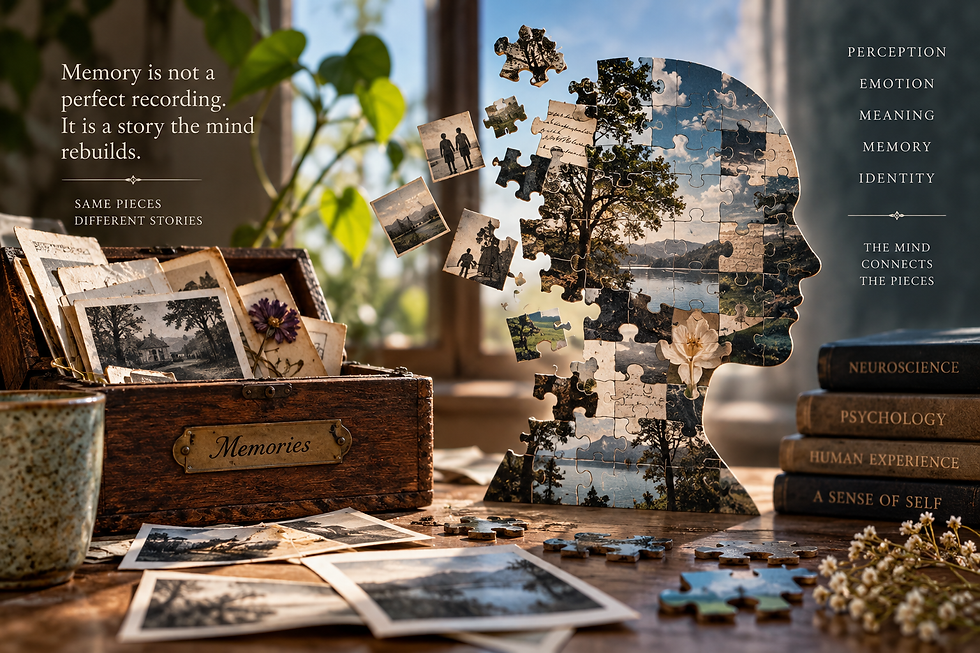
We often speak about memory as though it were a recording stored somewhere inside the brain: a faithful archive of what happened, waiting to be replayed. But memory is far stranger than that.
Each time we remember, the mind reconstructs. Pieces of sensory detail, emotion, meaning and later knowledge can be woven together into an experience that feels immediate and true. The past is not simply retrieved. In important ways, it is rebuilt.
That realization changes more than our understanding of memory. It raises deeper questions about identity. If the story we tell about ourselves depends on memories that are continually reconstructed, how stable is the self we believe ourselves to be?
Memory Is Not a Perfect Recording
Decades of psychological research have shown that human memory is reconstructive rather than photographic. We can remember the general meaning of an event while losing details, combine information from different moments, or become confident about details that were not present exactly as remembered.
This does not mean memory is useless or that every recollection is false. Memory is extraordinarily valuable. But its purpose appears to be more complex than preserving a flawless archive.
The brain uses the past to help navigate the present and anticipate the future. Memory is active, adaptive and deeply connected to meaning.
Why Memories Change
A memory can change because the person remembering has changed.
New information may alter how an old event is interpreted. An experience that once seemed ordinary can take on a different meaning years later. Details may fade while emotional themes remain vivid.
Even the act of recalling a memory can make it temporarily flexible before it is stored again, a process studied under the term reconsolidation.
The past event itself does not change. Our present relationship with it can.
The Story of Who We Are
Identity depends heavily on memory. We know our names, relationships, histories, preferences and personal narratives partly because memory connects one moment of life to another.
Without that continuity, the sense of being the same person across time would be profoundly altered.
Yet if memory is reconstructive, then identity is not built from an untouched archive. It is built from a living story.
That story can become so familiar that we stop noticing it is a story at all.
When an Old Story Becomes a Present Identity
A painful experience may gradually become an identity statement. I failed can become I am a failure. I was rejected can become I am unwanted. I was controlled can become I cannot trust my own choices.
The event and the identity are not the same thing.
But repeated interpretation can bind them together until the conclusion feels like a fact about the self.
This connects with the hidden patterns of the mind that influence behavior outside deliberate awareness. What we remember matters, but so does what we have learned to believe the memory means.
The Brain Builds Continuity
The brain appears to integrate memories, bodily states, social information and ongoing perception into a relatively continuous sense of self.
That continuity is useful. It allows planning, responsibility, relationships and long-term goals. But it can also create the impression that the self is more fixed than it really is.
As explored in Is the Self Created by the Brain?, neuroscience increasingly studies the self not as one single location in the brain but as something emerging from interacting systems.
Memory is one of those systems, but it is not the whole story.
Who Are You Without the Old Narrative?
This question can feel unsettling.
If we loosen our grip on familiar stories, do we lose ourselves?
Perhaps not. We may instead discover how much of identity has been organized around repetition.
A person can carry the sentence this is just who I am for decades without asking when that conclusion was formed, whose voice helped shape it, or whether it still describes the person living now.
Inner work often begins when those old sentences become visible.
Memory, Emotion and the Body
Memories are not only verbal narratives. They can be linked with bodily and emotional responses.
A smell can bring back a place almost instantly. A song can produce emotion before a specific memory becomes clear. A tone of voice can create tension because it resembles something the nervous system learned long ago.
This is one reason the body may react before conscious thought catches up, a theme explored in Can the Body Know Before the Mind?.
The remembered past can therefore live not only as a story we tell but as patterns of expectation and response.
Can Remembering Differently Change Us?
We cannot honestly rewrite history and pretend events never happened.
But meaning is not always frozen.
A memory once interpreted entirely through shame may later be understood through compassion, context or maturity. An experience once seen only as failure may eventually reveal what it taught, changed or exposed.
This does not erase pain. It changes the framework around it.
And when the framework changes, the identity built around the memory may begin to change too.
The Difference Between Fact and Meaning
One useful practice is to separate what happened from what we concluded about what happened.
The fact might be: a relationship ended.
The meaning might be: I am impossible to love.
The fact might be: an opportunity failed.
The meaning might be: I should never try again.
The meaning can feel inseparable from the memory because it has been repeated for so long. But seeing the distinction creates room for another interpretation.
Inner Knowing Beneath the Story
There is a curious connection between memory and inner knowing.
When the mind is constantly narrating who we are based on what has happened before, quieter information can be difficult to hear.
A new desire may be dismissed because it does not fit the old identity. An intuitive pull toward a different life may be overridden by a story about what someone like me is supposed to do.
Listening within may therefore require more than discovering a hidden answer. It may require recognizing which old answers have been repeated so often that they drown everything else out.
The Self as Process Rather Than Object
Some philosophical and scientific perspectives describe the self less as a fixed object and more as an ongoing process.
We remember, predict, interpret, choose, relate and revise. The person who wakes tomorrow carries continuity with the person of yesterday, but is not frozen in yesterday's exact state.
This idea does not make identity meaningless. It makes identity alive.
We are shaped by history without being identical to history.
The Mystery of the Remembering Self
Memory eventually leads us back to the mystery of consciousness.
A memory is not merely stored information. When remembered consciously, it becomes an experience in the present: an image, emotion, sensation or inner scene appearing to someone.
Neuroscience can study the brain systems involved in memory formation and retrieval. But the subjective fact that a distant moment can suddenly become present in awareness remains extraordinary.
The child we once were is gone in one sense, yet a single smell can make that world feel close enough to touch.
We Are More Than What We Remember
Our memories matter. They help form identity, preserve relationships and give continuity to a life.
But perhaps we make a mistake when we allow the remembered past to become the entire definition of who we are.
Memory is a guide, not a prison. A story can be honored without being endlessly repeated. An old interpretation can be questioned without denying what happened.
And the person doing the remembering exists now—not only then.
There may be parts of us that have never been fully expressed because the old story had no place for them.
The search for inner wisdom sometimes asks us to remember.
But sometimes it asks something more difficult: to discover who remains when we stop using the past as the only map of who we are allowed to become.

$50
Product Title
Product Details goes here with the simple product description and more information can be seen by clicking the see more button. Product Details goes here with the simple product description and more information can be seen by clicking the see more button

$50
Product Title
Product Details goes here with the simple product description and more information can be seen by clicking the see more button. Product Details goes here with the simple product description and more information can be seen by clicking the see more button.
$50
Product Title
Product Details goes here with the simple product description and more information can be seen by clicking the see more button. Product Details goes here with the simple product description and more information can be seen by clicking the see more button.



Comments