Is the Self Created by the Brain? What Neuroscience Reveals About Who We Are
Updated: Sep 17

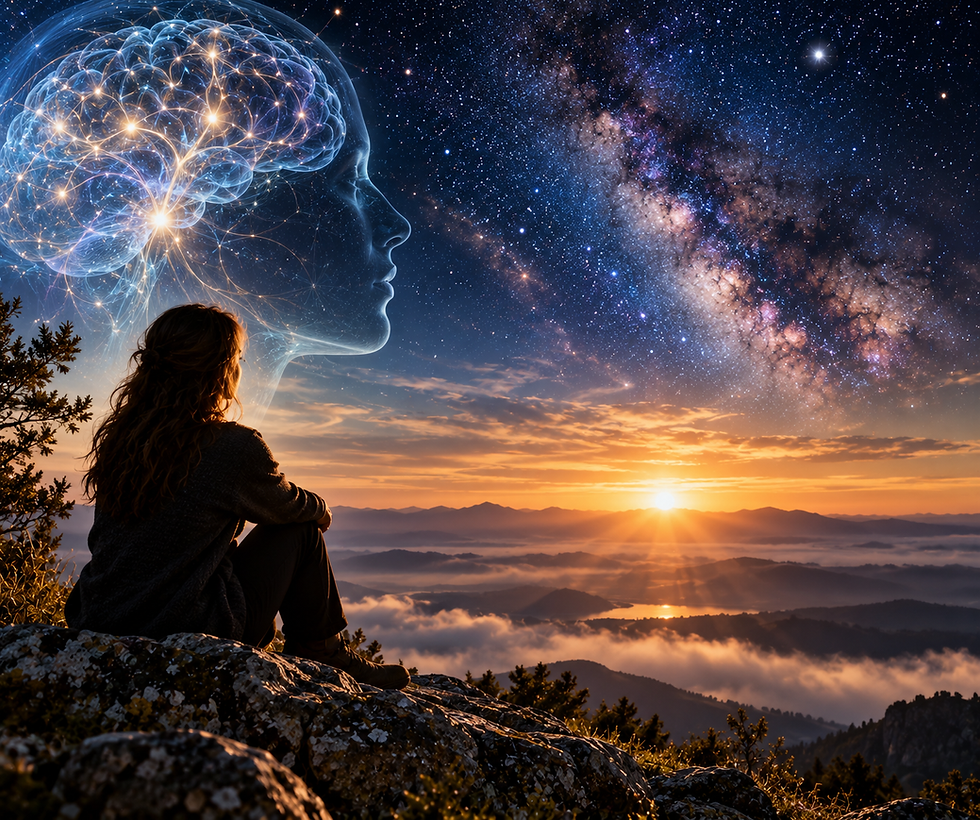
When you say “I,” what exactly are you referring to? The answer feels obvious until we try to locate that self inside the brain. We experience ourselves as a continuous person moving through time—remembering yesterday, making choices today and imagining tomorrow. Neuroscience, however, reveals a far more complicated picture.
The brain contains billions of interacting neurons and many specialized systems, yet researchers have not found a single command center where a permanent self appears to reside. That raises a fascinating question: is the self something the brain creates, something consciousness experiences, or a process that is constantly being rebuilt?
Why the Self Feels So Real
Our sense of identity is remarkably convincing. We recognize our name, our history, our relationships, our preferences and the private stream of thoughts that seems to belong to us alone. Memory helps bind those experiences together, while perception gives us a sense of occupying a body in a particular place.
Yet each of those abilities depends on different brain processes. Memory can change. Attention shifts. Emotions alter the way we interpret events. Even our sense of our own body can be manipulated under carefully controlled experimental conditions. The self may feel like one indivisible thing, while the machinery supporting it is distributed across many systems.
There Is No Single “Self Center” in the Brain
Neuroscience has identified networks involved in self-referential thought, autobiographical memory, body awareness, decision-making and social identity. The default mode network, for example, becomes active during many forms of inwardly directed thought, including remembering the past and imagining possible futures.
But activity associated with the self is not confined to one structure. Different aspects of identity depend on different networks working together. This fits with what we explored in how neuroscience connects the brain and mind: mental life appears to emerge from coordinated activity rather than a tiny observer sitting somewhere inside the skull.
Memory and the Story of Who We Are
Much of personal identity is built from memory. We tell ourselves a continuing story: this happened to me, therefore I became this kind of person, and now I expect my future to unfold in certain ways.
But memory is not a perfect recording. Each act of remembering can involve reconstruction. Details fade, emotional meaning changes and later experiences can influence how earlier events are understood. If our identity depends partly on memory, then the story of the self is not simply stored—it is continually interpreted.
This does not make identity unreal. It suggests that identity may be more dynamic than we normally assume.
The Brain Predicts More Than It Simply Receives
Modern neuroscience increasingly examines the brain as an active prediction system. Rather than passively waiting for information, the brain continually uses prior experience to anticipate what it is likely to encounter and then updates those expectations as new sensory information arrives.
That idea has intriguing implications for the self. The feeling of being a stable person may depend partly on the brain maintaining an ongoing model of the body, the environment and the individual who is navigating it. In this view, the self is not merely discovered. It is continuously constructed and updated.
What Happens When the Sense of Self Changes?
Certain neurological conditions, contemplative practices and altered states can change ordinary self-experience. A person may temporarily experience the boundaries between self and surroundings differently, feel detached from the usual autobiographical story, or become unusually aware of thoughts as events rather than as identity.
These experiences do not by themselves prove any spiritual interpretation. But they reveal something important: the familiar sense of “me” is capable of changing. If the self were a completely fixed and indivisible feature of experience, such shifts would be difficult to explain.
Ancient Traditions Asked a Similar Question
Long before brain imaging, philosophers and contemplative traditions investigated the nature of identity through observation of experience. Some Indian traditions distinguished between the changing contents of the mind and a deeper awareness that witnesses them. Buddhist traditions famously questioned whether a permanent, independent self could be found at all. Greek philosophers approached identity through reason, soul, character and the examined life.
These traditions did not possess modern neuroscience, and their conclusions should not be treated as scientific findings. What is striking is the persistence of the question itself: when thoughts, sensations, memories and roles are observed, what—if anything—remains as the observer?
The Observer Problem
Notice a thought for a moment. You can become aware that the thought is occurring. You can also notice an emotion, a memory or a physical sensation. This creates an unusual philosophical puzzle. If you can observe the contents of your mind, is the observer simply another process within the mind?
Neuroscience can study the brain activity associated with attention and self-awareness, but the subjective fact of experiencing those processes leads us back toward the deeper mystery of consciousness. We can increasingly describe what the brain is doing while a person reports an experience. Explaining why there is an experienced point of view at all remains harder.
Are You the Same Person You Were Ten Years Ago?
Biologically, psychologically and socially, you have changed. Memories have been added and forgotten. Beliefs may have shifted. Cells have turned over. Relationships have altered the way you see yourself. Yet most people experience a powerful continuity between their younger and present selves.
Perhaps identity is less like a fixed object and more like a pattern—a recognizable organization that persists even while many of its components change. A river remains a river although its water is always moving. The comparison is imperfect, but it captures something about the strange combination of continuity and change that defines human identity.
Where Soul Meets Science
Science is becoming increasingly sophisticated at describing the processes that contribute to a sense of self. It can investigate memory, body representation, attention, emotion, prediction and self-referential brain networks. Those discoveries matter because they show that some things we experience as solid and permanent may actually be active processes.
But this does not settle every philosophical question about who or what we ultimately are. Neuroscience can tell us a great deal about the mechanisms associated with identity without necessarily answering whether conscious awareness can be reduced completely to those mechanisms.
That boundary is exactly where inquiry becomes interesting. We do not need to force science to prove ancient spiritual ideas, nor dismiss centuries of human reflection because they arose before modern laboratories. We can allow both to sharpen the question.
Perhaps the Self Is Something We Participate In
The most interesting possibility may be that the self is neither a simple illusion nor a tiny permanent entity hidden inside the brain. It may be an ongoing process—formed through memory, perception, relationships, biology and conscious experience.
And if the self is partly constructed, then identity may be more open to change than we imagine. The stories we inherited, the roles we learned and the assumptions we carry may influence who we believe ourselves to be without defining the full limits of who we can become.
The deeper question is no longer only “Where is the self in the brain?” It becomes something far more personal: if the mind is continually constructing a sense of who you are, how much of that construction can you consciously examine—and perhaps change?

$50
Product Title
Product Details goes here with the simple product description and more information can be seen by clicking the see more button. Product Details goes here with the simple product description and more information can be seen by clicking the see more button

$50
Product Title
Product Details goes here with the simple product description and more information can be seen by clicking the see more button. Product Details goes here with the simple product description and more information can be seen by clicking the see more button.
$50
Product Title
Product Details goes here with the simple product description and more information can be seen by clicking the see more button. Product Details goes here with the simple product description and more information can be seen by clicking the see more button.

Comments