Walking Meditation: How to Turn an Ordinary Walk Into a Practice of Awareness and Reflection
Updated: Sep 23
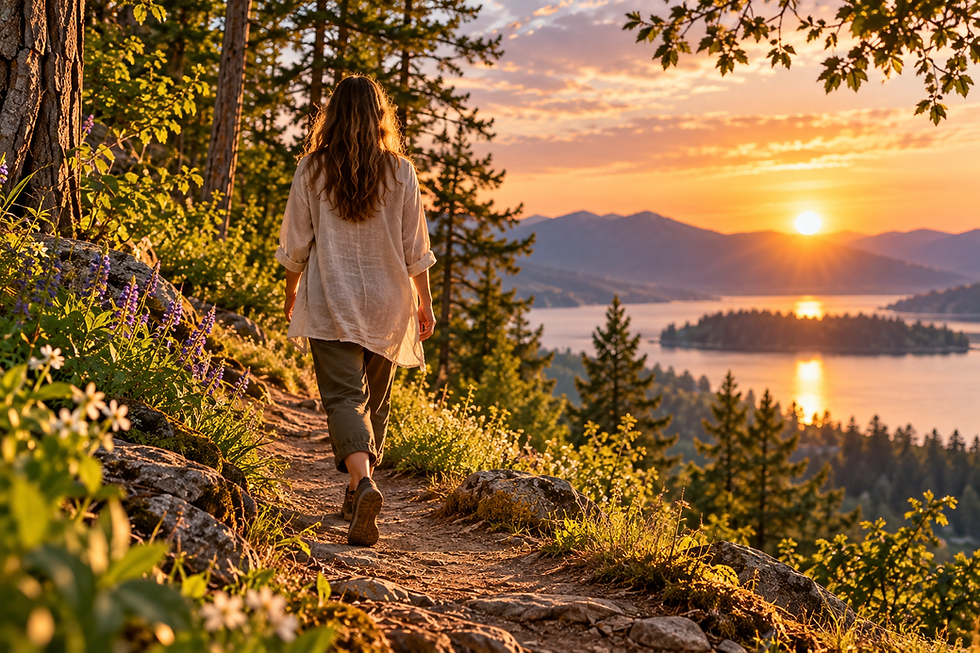
There is something different about walking when there is nowhere you are trying to get.
Most walking is transportation. We move from the house to the car, through a store, down a hallway or toward a destination while the mind is already somewhere else.
Walking meditation changes the purpose. The movement itself becomes the practice.
Instead of using the body to carry a busy mind from one place to another, we let attention travel with the body.
What Is Walking Meditation?
Walking meditation is a contemplative practice in which attention is deliberately placed on the experience of walking.
Forms of walking meditation appear in Buddhist traditions and other contemplative settings, while modern mindfulness practices have adapted the basic idea in many ways.
It can be slow and formal or natural and ordinary. The essential element is awareness of movement rather than reaching a destination.
Why Walk Instead of Sit?
Sitting meditation is not comfortable or appealing for everyone.
Some people become sleepy. Others feel restless. Some find it easier to remain present when attention has physical movement to follow.
Walking gives the mind changing sensations while preserving the simplicity of a meditation anchor.
Begin With the Feet
The feet provide an immediate place to put attention.
Notice the heel meeting the ground, pressure shifting through the foot, the toes leaving the surface and the next foot arriving.
You do not need to mentally narrate every step.
Simply feel the changing contact.
A Five-Minute Walking Meditation
Choose a safe place where you can walk without needing to navigate traffic or obstacles.
Put the phone away.
For the first minute, notice only the feet.
During the second minute, include the movement of the legs and hips.
During the third, notice breathing while continuing to walk naturally.
During the fourth, open attention to sounds, temperature and light.
For the final minute, let all of those sensations coexist without choosing one.
Then stop and notice what changes when movement ends.
You Do Not Have to Walk Slowly
Traditional practices may use deliberately slow walking because it makes individual movements easier to observe.
But everyday walking meditation can happen at a normal pace.
The best speed is one that allows awareness without making the movement feel artificial.
A ten-minute neighborhood walk can become practice without looking unusual to anyone passing by.
What Happens When the Mind Wanders?
It will.
A few steps become a grocery list. A sound triggers a memory. An imagined conversation begins.
When you notice, return attention to the next physical step.
This is the same basic skill described in our beginner's meditation guide: wandering is not failure; noticing and returning is the practice.
Walking Without the Phone
A phone can transform even a quiet walk into a stream of messages, podcasts, photographs and decisions.
There is nothing wrong with listening to something while walking, but it creates a different experience.
For walking meditation, allow the environment itself to provide the sensory field.
The absence of additional input is part of what makes subtler experience noticeable.
The World Becomes More Detailed
When attention is not occupied by a screen or internal monologue, ordinary surroundings often become unexpectedly vivid.
Shadows move across pavement. Wind changes temperature from one side of a street to another. Different birds occupy different distances. The body adjusts balance continuously without conscious instruction.
None of this is new.
Attention is new.
Walking Meditation in Nature
Natural settings can make the practice especially rich because they contain movement, sound, texture and changing light without requiring constant verbal interpretation.
A trail, garden, park or quiet yard can work.
Rather than searching for a mystical experience in nature, begin by actually noticing nature.
Presence is enough.
Walking and the Nervous System
Rhythmic movement, outdoor light, breathing and a temporary reduction in digital stimulation can all influence how a walk feels.
Physical activity itself has well-established effects on health and mood, while contemplative attention adds another dimension to the experience.
Walking meditation should not be reduced to one nervous-system mechanism. Body, environment and attention are interacting at the same time.
The Rhythm of Repetition
Step after step creates a natural rhythm.
Unlike a complex task, walking usually requires little conscious planning once underway.
That leaves attention free to observe movement while the body continues performing something deeply familiar.
Repetition can create the same kind of container found in personal ritual.
Walking With a Question
A reflective walk can begin with one question.
Ask it once before starting, then resist the urge to force an answer.
Walk for ten or fifteen minutes while staying primarily with sensory experience.
At the end, notice whether the question feels different.
Sometimes physical movement changes perspective even when no dramatic answer arrives.
Why Problems Can Look Different After a Walk
When we remain physically still while thinking intensely, attention can become trapped inside a narrow mental loop.
Walking introduces changing sensory information, bodily movement and a different environment.
The problem has not changed, but the conditions under which we are thinking about it have.
That shift can create room for new associations and perspectives.
Walking and Self-Inquiry
Walking can complement the practice of self-inquiry particularly well.
Instead of sitting over a notebook searching for an answer, take one question outside.
Let the body move while the question remains open.
Afterward, journal whatever surfaced without deciding immediately whether it is the final answer.
Notice the Body Before Interpreting It
Walking makes bodily sensation obvious: breathing changes on a hill, shoulders loosen, legs tire, temperature shifts.
This provides practice in noticing sensation before assigning meaning.
That skill is useful when exploring intuition because bodily signals can carry information without automatically telling us what that information means.
Our article on intuition and interoception explores that relationship more deeply.
A Silent Walk With Someone Else
Walking meditation does not always have to be solitary.
Two people can agree to walk together in silence for ten minutes and speak afterward.
Without the need to maintain conversation, attention can settle into shared surroundings while companionship remains present.
The silence may feel unusual at first. That is part of what makes it noticeable.
Walking at Dawn or Dusk
Transitions in light naturally mark time.
A walk near sunrise or sunset can become a simple daily ritual because the environment visibly changes while you move through it.
There is no need to assign cosmic meaning to the moment for it to feel significant.
Repeated attention can make an ordinary threshold in the day feel deeply personal.
When Walking Is Not Accessible
The principle of walking meditation is mindful movement, not walking itself.
Someone who cannot comfortably walk can bring the same attention to wheelchair movement, gentle arm motion, rocking, stretching or another accessible repetitive movement.
The practice belongs to awareness, not to a particular physical ability.
Do You Need a Labyrinth?
Labyrinth walking has a long and varied history, including use in Christian contemplative settings and modern spiritual practice.
A labyrinth can provide a meaningful predetermined path, but it is not required.
A hallway, sidewalk, garden path or small room can be enough.
The path matters less than the attention brought to it.
A Practice for Overwhelming Days
When sitting quietly feels impossible, choose a short route and walk it without solving anything.
For ten minutes, the only task is to feel the next step and notice the surroundings.
If the mind begins rehearsing the problem, return to movement.
You can think about the problem again afterward.
The practice simply creates a temporary space in which you do not have to carry it consciously every second.
From Exercise to Reflection
An ordinary exercise walk and a contemplative walk can overlap.
You do not need to choose between physical health and reflective practice.
A portion of a longer walk can be devoted to silence and sensory attention, followed by whatever pace or entertainment you prefer.
Practices survive when they fit real lives.
The Return Home
At the end of a walking meditation, pause before immediately reaching for the phone.
Notice the body standing still.
Notice the breath.
Notice whether the mind feels exactly as it did when you began.
You do not need to judge the answer.
The walk was not successful only if it produced calm or insight.
For a little while, attention traveled with the body.
In a life where the mind is so often somewhere else, that simple reunion can itself become a practice.

$50
Product Title
Product Details goes here with the simple product description and more information can be seen by clicking the see more button. Product Details goes here with the simple product description and more information can be seen by clicking the see more button

$50
Product Title
Product Details goes here with the simple product description and more information can be seen by clicking the see more button. Product Details goes here with the simple product description and more information can be seen by clicking the see more button.
$50
Product Title
Product Details goes here with the simple product description and more information can be seen by clicking the see more button. Product Details goes here with the simple product description and more information can be seen by clicking the see more button.


Comments