Can Sound Change the Brain? Frequency, Binaural Beats and the Science of Vibration
Updated: Sep 20
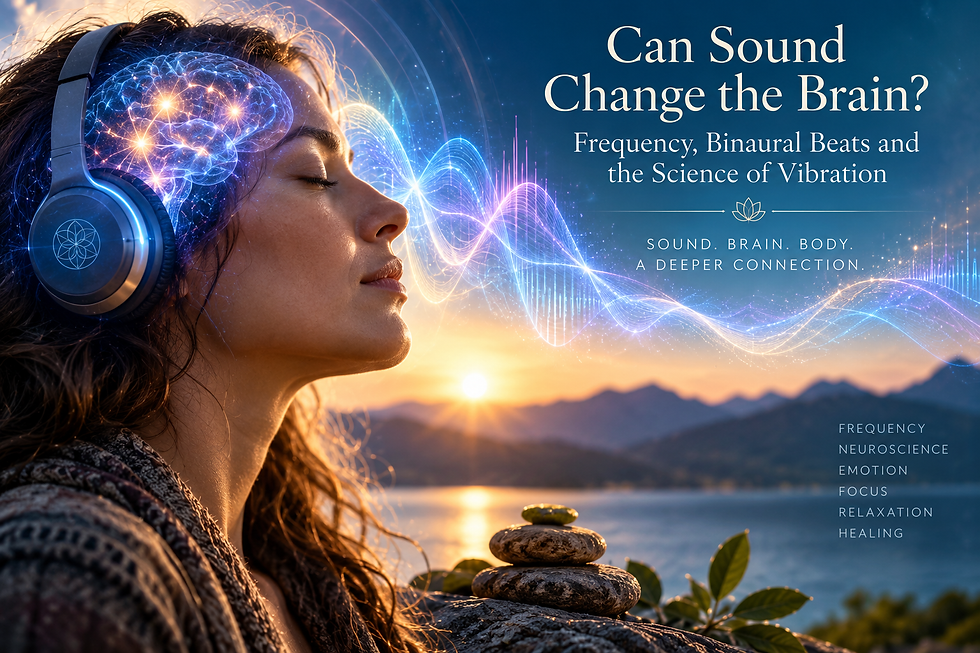
A familiar song can change the atmosphere of a room in seconds. A steady drumbeat can make the body want to move. A harsh, unpredictable noise can raise tension before we consciously decide that it bothers us. Sound is physical vibration, yet our experience of it reaches into emotion, memory, attention and the nervous system.
Across cultures, sound has also been used in ritual, prayer, chanting, meditation and healing traditions. Today, claims about sound frequencies, binaural beats and vibration circulate widely online—sometimes blending genuine neuroscience with ideas that science has not established.
So, can sound change the brain and body in measurable ways? And where does the measurable science end and the larger mystery begin?
Can Sound Change the Brain Through Rhythm and Frequency?
Sound is produced by mechanical vibrations traveling through a medium such as air. When those pressure waves reach the ear, structures of the auditory system transform them into neural signals that the brain can process.
But hearing is not simply detecting frequency.
The brain organizes sound into patterns, identifies voices, separates foreground from background, predicts rhythms and attaches meaning based on memory and context. The same acoustic signal can feel comforting, threatening or meaningless depending on the listener and situation.
Once again, perception is construction as well as reception.
Why Rhythm Moves the Body
Rhythm has a remarkable ability to organize attention and movement.
People naturally synchronize movements with external beats—tapping a foot, clapping, dancing or walking in time. Researchers study this synchronization under concepts such as entrainment, although the term can have different meanings depending on the field.
Rhythmic auditory cues are also used clinically in some rehabilitation settings, including work with movement disorders and gait.
The ability of an external rhythm to influence timing inside a biological system is real. But that does not mean every popular claim made under the word frequency is scientifically demonstrated.
Music, Emotion and Memory
Music recruits widely distributed brain systems involved in auditory processing, emotion, expectation, reward, movement and memory.
That helps explain why a song can produce such an immediate emotional shift. Music is not experienced as a sterile sequence of frequencies. The brain anticipates what comes next, recognizes patterns and connects sounds with personal history.
A melody associated with childhood may bring back a place with startling vividness. As explored in Are You Your Memories?, memory is deeply connected to emotion and identity. Music can become one of its most powerful keys.
Can Sound Affect the Nervous System?
Sound can influence arousal, attention and emotion, which are themselves connected with physiological state.
A sudden loud noise can trigger a startle response. Slow, predictable music may support relaxation for some listeners. Musical tempo, familiarity, preference and context can all influence the experience.
This fits within the broader mind-body connection: sensory experiences can affect psychological state, and psychological state can participate in bodily responses.
There is no single sound that produces the same nervous-system response in everyone.
What Are Binaural Beats?
Binaural beats occur when tones of slightly different frequencies are presented separately to each ear, typically through headphones. The listener may perceive a rhythmic beating corresponding roughly to the frequency difference between the tones.
Researchers have investigated whether binaural-beat stimulation can influence attention, mood, anxiety, sleep or aspects of brain activity.
Results across studies are mixed, and differences in methods make sweeping conclusions difficult. Some studies report effects in particular contexts, while others find limited or inconsistent benefits.
Binaural beats are therefore an interesting area of research, not established proof that selecting a particular frequency can reliably produce a specific mental state.
Brain Waves and a Common Misunderstanding
Electrical activity measured from the scalp with EEG is often described using frequency bands such as delta, theta, alpha, beta and gamma.
These bands are useful scientific descriptions of patterns in neural activity. They are not simple switches for specific states of consciousness.
For example, alpha activity is often associated with relaxed wakefulness under certain conditions, but the brain contains many interacting rhythms at once. Listening to an audio track labeled alpha does not automatically place the entire brain into one uniform alpha state.
The real neuroscience is more complex—and more interesting—than the simplified charts often shared online.
What About 432 Hz and 528 Hz?
Specific frequencies such as 432 Hz and 528 Hz are frequently promoted as having special healing, spiritual or biological properties.
Music can certainly affect mood and physiology, and changing tuning can alter how music sounds. But strong claims that a single musical tuning or isolated frequency has unique, universal healing powers are not established by robust scientific evidence.
That distinction does not prevent someone from finding a particular tuning beautiful, calming or meaningful.
Personal experience and scientific proof answer different questions.
Resonance Is Real Physics
Resonance is sometimes invoked in spiritual discussions of frequency, and it is also a precise physical phenomenon.
A system can respond strongly when driven near one of its natural frequencies. Musical instruments provide obvious examples: strings, air columns and resonant bodies amplify particular vibrations.
Biological tissues and structures also have physical properties, and medical technologies can use sound mechanically—for example, diagnostic ultrasound and certain therapeutic applications.
But the existence of physical resonance does not automatically validate every metaphorical claim about people vibrating at a spiritual frequency.
The scientific and symbolic meanings should be distinguished rather than blended together.
Chanting, Breath and Repetition
Chanting is especially interesting because it combines sound with breathing, rhythm, repetition, attention and often social connection.
If chanting slows and regularizes breathing, some of its calming effects may involve mechanisms also seen in deliberate breath practices. Group chanting may add synchrony, belonging and emotional meaning.
Traditional cultures may understand chanting through sacred or energetic frameworks that go beyond these mechanisms.
Science can investigate measurable effects without deciding the ultimate spiritual meaning of the practice.
Why Repetition Can Change Experience
Repeated sound can narrow and stabilize attention.
A mantra, drum pattern or repeated phrase gives the mind a predictable object to return to. That can reduce the constant switching of attention that characterizes ordinary mental activity.
Meditative repetition may therefore change subjective experience through attention, expectation, breathing and learning.
This does not make the experience less meaningful. Understanding one mechanism does not necessarily exhaust everything a practice means to the person using it.
Sound and the Predictive Brain
The brain is constantly anticipating what comes next in music and speech.
A rhythm creates expectation. A melody establishes patterns. When the next note arrives exactly where expected, the brain processes one kind of event; when it surprises us, attention may sharpen.
This connects with predictive perception. Our experience of sound depends partly on incoming vibration and partly on the brain's model of what that vibration means.
Music plays with prediction deliberately—and emotion often lives in the tension between expectation and surprise.
Ancient Sound Practices and Modern Science
Human beings used drums, bells, singing bowls, chants, hymns and sacred recitation thousands of years before neuroscience existed.
Those traditions developed within cultural and spiritual systems with their own explanations of what sound was doing.
Modern science should not be used to retroactively certify every traditional belief. But neither should the antiquity of a practice be dismissed as meaningless simply because its original language differs from contemporary physiology.
The more careful question is: what effects can be measured, what meanings were traditionally assigned, and where do the two genuinely intersect?
Can Sound Heal?
The word healing can mean very different things.
Music therapy is an established professional field in which trained practitioners use musical experiences toward individualized therapeutic goals. Sound and music can also support relaxation, emotional expression, social connection and quality of life.
Those uses are different from claiming that a particular tone cures disease by frequency alone.
Sound can be therapeutically meaningful without requiring unlimited claims.
The Experience Behind the Measurement
Even after frequency, amplitude, neural responses and physiological changes are measured, something remains.
There is the experience of sound itself.
A pressure wave has no sadness in it. A frequency measured in hertz contains no nostalgia. Yet when vibration meets a nervous system, memory and consciousness, sound becomes music, warning, comfort, prayer or meaning.
Physics describes the vibration. Neuroscience investigates the processing.
But the lived experience belongs to the strange territory where matter becomes awareness.
Listening at the Boundary
Sound gives us an unusually clear place to watch soul and science meet.
We can measure vibration with precision. We can observe changes in brain and body. We can study rhythm, attention, emotion and synchronization.
At the same time, human beings have always used sound for experiences that cannot be reduced to numbers alone: grief, celebration, transcendence, memory, belonging and the search for something larger than the ordinary self.
The mistake is not in exploring frequency.
It is in pretending we already know more than we do.
Between measurable vibration and lived meaning lies a remarkable frontier—and every time we truly listen, we enter it.

$50
Product Title
Product Details goes here with the simple product description and more information can be seen by clicking the see more button. Product Details goes here with the simple product description and more information can be seen by clicking the see more button

$50
Product Title
Product Details goes here with the simple product description and more information can be seen by clicking the see more button. Product Details goes here with the simple product description and more information can be seen by clicking the see more button.
$50
Product Title
Product Details goes here with the simple product description and more information can be seen by clicking the see more button. Product Details goes here with the simple product description and more information can be seen by clicking the see more button.



Comments