Aromatherapy for Meditation: How Scent Can Become an Anchor for Attention and Inner Stillness
Updated: Sep 24
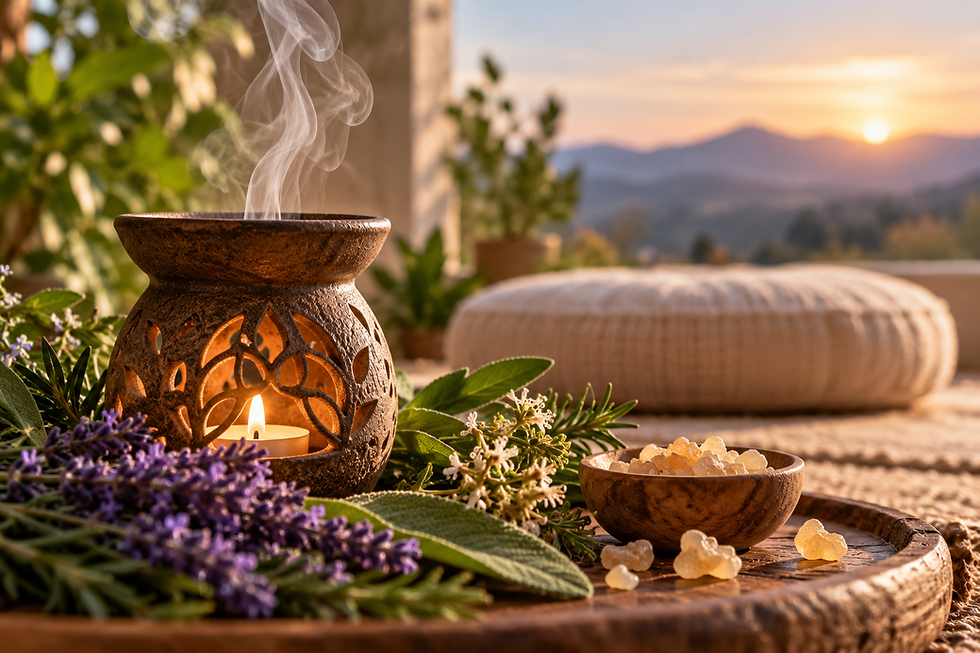
Meditation is usually described as a practice of attention, breath or awareness. But the room around us participates too.
Light, temperature, sound and scent all become part of the environment in which we turn inward. Aromatherapy can be used in meditation not as a shortcut to a mystical state, but as a deliberate sensory marker: a fragrance that says this moment is different from the one before it.
Why Use Scent in Meditation?
Smell is immediate and difficult to ignore. A carefully chosen aroma can draw attention into the present moment before the mind has finished explaining what it thinks about the experience.
Used consistently, scent can also become associated with the beginning of a contemplative practice.
Scent as an Anchor
Meditation anchors give attention somewhere to return when thought wanders. Breath, bodily sensation and sound are common examples.
Aroma can serve a similar purpose for some people. Notice the scent, notice when attention has drifted, and gently return to the sensory experience without forcing anything to happen.
You Do Not Need to Stop Thinking
A common misconception is that meditation succeeds only when thought disappears.
Thoughts will arise. The practice is noticing that they have arisen and returning attention.
Our beginner's meditation guide explores this in more depth.
Aromatherapy for Meditation: Choosing an Aroma
Begin with an essential oil you genuinely enjoy rather than one a chart says you should use.
Lavender may feel soft and familiar. Frankincense may feel resinous and contemplative. Citrus may feel bright. A woody aroma may feel steady.
Those descriptions are invitations, not rules.
Frankincense and Contemplative Atmosphere
Frankincense has a long relationship with ceremonial fragrance, making it a natural choice for people drawn to historical aromatic traditions.
Its modern essential oil is not identical to burning ancient resin, but its aroma can still become part of a personal contemplative setting.
Our article on frankincense explores the plant, resin trade and sacred history behind the scent.
Lavender and Evening Meditation
Lavender is often chosen when meditation is part of an evening routine.
Its cultural association with rest and its familiar floral-herbal aroma can help create a quieter atmosphere for some people.
If lavender does not feel calming to you, there is no reason to force the association.
A Simple Five-Minute Scent Meditation
Choose a safe aromatic method and use only a modest amount.
Sit comfortably and notice the first impression of the aroma.
Then shift attention to breathing for several cycles.
When the mind wanders, return either to the breath or briefly to the scent.
After five minutes, notice how the aroma seems different from when you began.
Why the Scent May Seem to Fade
The olfactory system adapts during continued exposure. An aroma that initially feels strong may become less noticeable after several minutes.
That fading can itself become part of meditation: notice how perception changes even when the source of the scent remains.
Aroma and the Practice of Silence
Scent can be especially interesting when paired with silence because one sensory channel becomes more noticeable as others become quieter.
If you are exploring stillness, our article on the practice of silence offers another way to work with attention.
Creating a Meditation Ritual
Use the same aroma, seat and approximate time for a week or two.
The repetition can make the beginning of meditation easier to recognize psychologically.
Lighting a lamp, opening a journal or introducing a familiar scent can all become part of the transition into practice.
This is the same principle explored in the power of personal ritual.
Scent and Memory Can Enter Meditation
An aroma may unexpectedly bring up a memory.
If that happens, you do not need to chase the memory or push it away. Notice it, notice the emotional response, and decide whether returning to the meditation feels appropriate.
The connection between smell and autobiographical memory is explored in Why Scent Triggers Memory.
Aromatherapy Is Not Required for Spiritual Practice
Humans have meditated without essential oils for centuries.
Aroma is an optional support, not a requirement and not evidence that a meditation is deeper or more spiritual.
Sometimes the most meaningful practice will happen in a completely ordinary room with nothing but attention.
Diffusion Without Overwhelming the Room
If using a diffuser, follow the manufacturer's directions and begin conservatively.
Heavy fragrance can become distracting rather than supportive.
Ventilation matters, and shared spaces require consideration for other people, children, pets and anyone with respiratory sensitivities.
Personal Inhalers
A personal aromatic inhaler can keep the scent close to one person without filling an entire room.
This can be useful when others do not want fragrance in the shared environment.
Use an appropriately prepared product and avoid direct contact with the eyes or sensitive tissues.
Topical Meditation Blends
Some people enjoy applying a diluted aromatic oil to the hands or another appropriate area before meditation.
Topical essential oils require suitable dilution. Our guide to carrier oils and dilution explains why carrier oils matter.
Aroma and Body Awareness
Scent can be paired with a body-centered meditation.
Notice the aroma first, then move attention slowly through the body, observing tension, temperature and contact with the chair or floor.
This creates a bridge between external sensation and body awareness.
Do Certain Oils Raise Your Vibration?
Language about vibration is common in spiritual aromatherapy.
People may use the word symbolically to describe feeling clearer, lighter, calmer or more connected. That personal language can be meaningful.
It should not be confused with a scientifically established frequency ranking in which particular essential oils measurably raise a person's spiritual vibration.
The experience can be explored without inventing precision that has not been demonstrated.
A Scent Does Not Have to Mean the Same Thing to Everyone
Cultural history and personal memory shape fragrance.
One person may associate incense with sacred ceremony, another with childhood, and another with an unpleasant experience.
A meditation aroma should support your practice, not someone else's idea of what spirituality is supposed to smell like.
Try Meditation Without Naming the Oil
If possible, have someone safely prepare an aroma without telling you which oil it is.
Notice the sensory qualities and emotional response before learning its identity.
This can reveal how much expectation and labeling influence our experience.
The Difference Between Atmosphere and Effect
Aromatherapy can change the atmosphere of a meditation space quickly.
That does not mean the essential oil is doing the meditation for us.
The fragrance may invite attention, mark a transition or awaken memory. The deeper practice remains the willingness to notice what is happening.
Where Aromatherapy and Inner Wisdom Meet
Scent is invisible, yet unmistakably present. Meditation asks us to notice experiences that are equally easy to overlook: breath, sensation, thought, emotion and the quiet movement of attention.
Used thoughtfully, aroma can become a doorway into that noticing.
This is close to the kind of inner knowing Antara Veda continues to explore—not a voice that tells us what to believe, but a deeper attentiveness to what is already happening within us.
Begin With One Breath
You do not need a complicated blend or a shelf full of oils.
Choose one aroma. Use it safely and lightly. Sit down.
Notice the scent.
Notice the breath.
Notice what the mind does next.
Then return.
That simple act of returning may be the real ritual.

$50
Product Title
Product Details goes here with the simple product description and more information can be seen by clicking the see more button. Product Details goes here with the simple product description and more information can be seen by clicking the see more button

$50
Product Title
Product Details goes here with the simple product description and more information can be seen by clicking the see more button. Product Details goes here with the simple product description and more information can be seen by clicking the see more button.
$50
Product Title
Product Details goes here with the simple product description and more information can be seen by clicking the see more button. Product Details goes here with the simple product description and more information can be seen by clicking the see more button.


Comments